
 CA
 NZ
 UK
 AU
 IND

 US

 Share
 X (Formerly Twitter)
 Whatsapp
 Facebook
 LinkedIn
 Telegram
 Email This Article
 Copy Link
 Summarize with AI
 Chat GPT
 Perplexity
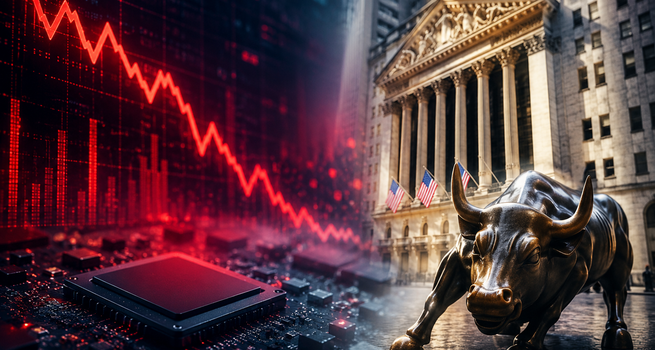
Key Highlights
- The Nasdaq 100 fell 1.5% while the Dow Jones Industrial Average reached a record high.
- Semiconductor stocks sold off despite strong earnings from Samsung Electronics.
- Investors are reassessing whether AI infrastructure spending can continue at its current pace.
- Banks and healthcare companies attracted fresh inflows as investors rotated into defensive sectors.
- Rising Treasury yields and renewed geopolitical tensions added to pressure on growth stocks.
The AI Boom Has Entered a More Demanding Phase
For much of the past two years, the stock market has rewarded one proposition almost without hesitation: spend more on artificial intelligence.
Every announcement of another hyperscale data centre, another GPU order or another multibillion-dollar infrastructure commitment seemed only to reinforce investors' conviction that the AI investment cycle had years left to run. Valuations climbed accordingly.
Tuesday's trading suggested that confidence is no longer unconditional.
The Nasdaq 100 fell around 1.5%, dragged lower by a broad retreat in semiconductor shares. The S&P 500 barely moved. Yet the Dow Jones Industrial Average rose nearly 200 points to another record high.
Such divergence is telling. Markets are no longer moving together. They are beginning to distinguish between companies whose fortunes depend on ever-expanding AI capital expenditure and those whose earnings remain tied to the more familiar rhythms of the real economy.
Strong Earnings Were Not Enough
Ordinarily, a stellar earnings report from one of the world's largest memory-chip manufacturers would have buoyed the entire semiconductor industry.
Instead, Samsung Electronics reported a remarkable nineteen-fold increase in quarterly profit only to watch global chipmakers slide.
The contradiction is less surprising than it first appears.
Markets are forward-looking. Investors have spent much of the year bidding semiconductor stocks higher on expectations that memory prices, AI server demand and cloud investment would all continue accelerating. Once expectations become sufficiently elevated, even excellent results cease to surprise.
Indeed, they invite a different question: what comes next?
That question was reflected across virtually every corner of the semiconductor ecosystem.
Memory producers declined sharply. Equipment manufacturers such as Applied Materials (NASDAQ: AMAT) and Lam Research Corporation (NASDAQ: LRCX) fell heavily. Designers including Advanced Micro Devices (NASDAQ: AMD), Arm Holdings plc (NASDAQ: ARM) and Marvell Technology (NASDAQ: MRVL) also retreated. Even ASML Holding (NASDAQ: ASML)—arguably the most strategically indispensable company in semiconductor manufacturing—was not spared.
This was not an isolated earnings reaction. It was a reassessment of an entire investment narrative.
From Celebrating Spending to Demanding Returns
The market's enthusiasm for artificial intelligence has rested upon an extraordinary assumption: that the largest technology companies will continue spending unprecedented sums on infrastructure.
That assumption has, until now, appeared entirely reasonable.
Cloud providers including Microsoft Corporation (NASDAQ: MSFT), Amazon.com, Inc. (NASDAQ: AMZN), Alphabet Inc. (NASDAQ: GOOGL) and Meta Platforms, Inc. (NASDAQ: META) have collectively committed hundreds of billions of dollars to AI data centres, networking equipment, specialised processors and memory.
Those investments have transformed semiconductor companies into some of the world's most valuable businesses.
But financial markets are impatient institutions. They celebrate investment only until they begin asking when it will produce adequate returns.
The debate is gradually shifting away from how much companies can spend towards whether those expenditures can generate sufficient productivity gains, pricing power and profits to justify their scale.
That distinction matters enormously.
Infrastructure spending may continue growing. Yet if its rate of growth slows even modestly, companies whose valuations already discount years of relentless expansion may face difficult adjustments.
A Rotation Rather Than a Retreat
The broader market offered little evidence of widespread panic.
Instead, capital flowed elsewhere.
Banks attracted buyers, with JPMorgan Chase & Co. (NYSE: JPM) advancing around 1%. Healthcare also outperformed as Johnson & Johnson (NYSE: JNJ) gained roughly 3%.
This rotation has become increasingly common whenever enthusiasm surrounding artificial intelligence begins to fade.
Investors are not abandoning equities. They are reallocating towards businesses whose earnings depend less on ambitious technological promises and more on predictable economic activity.
Such shifts are often characteristic of mature bull markets. Leadership narrows. Valuation discipline returns. Investors become more selective.
Higher Yields Complicate the Picture
Technology stocks also contended with a less accommodating macroeconomic backdrop.
Treasury yields edged higher after attacks on an LNG tanker in the Middle East revived concerns about energy prices and inflation.
The relationship is familiar.
Higher yields reduce the present value of future earnings, making richly valued growth companies especially vulnerable. Semiconductor stocks, whose valuations often rely on profits expected many years ahead, therefore tend to react more sharply than defensive sectors.
The geopolitical developments were hardly the primary driver of Tuesday's decline. They merely reinforced existing doubts.
The Market Is Becoming More Discerning
Even recent additions to major indices failed to escape the changing mood.
SpaceX (NASDAQ: SPCX) slipped around 1% following its inclusion in the Nasdaq 100. The decline was modest but symbolic. Joining a prestigious index is no longer enough to guarantee fresh enthusiasm if investors are already questioning broader technology valuations.
This reflects a market becoming increasingly discriminating.
Artificial intelligence remains one of the most compelling structural investment themes of the decade. Few investors doubt that computing demand will continue expanding.
What they increasingly question is whether every company exposed to that theme deserves the premium multiples accumulated during the past two years.
That is a healthier debate than the one markets have been having.
The Next Stage of the AI Rally
Tuesday's trading may prove less significant for its losses than for what those losses reveal.
The first phase of the AI boom rewarded participation. Companies simply needed exposure to data centres, graphics processors or cloud infrastructure to command higher valuations.
The next phase is likely to reward execution.
Investors will increasingly demand evidence that extraordinary capital expenditure is translating into durable revenue growth, sustainable profitability and attractive returns on invested capital.
For semiconductor companies, the challenge is no longer convincing investors that demand exists.
It is demonstrating that demand can remain exceptional long enough to justify valuations built upon extraordinary expectations.
That is a considerably higher bar.
FAQs
Q. Why is the Nasdaq falling today?
The Nasdaq declined primarily because semiconductor and AI infrastructure stocks sold off as investors reassessed whether AI-related capital expenditure can continue expanding rapidly enough to justify elevated valuations.
Q. Why did chip stocks fall despite Samsung's strong earnings?
Samsung's results confirmed strong industry conditions, but investors viewed them as largely anticipated. Attention shifted towards future growth rather than current profitability.
Q. Why is the Dow outperforming technology stocks?
Investors rotated into financials, healthcare and other sectors offering stable earnings and comparatively lower valuations, allowing the Dow Jones Industrial Average to reach another record.
Q. Is this the end of the AI bull market?
Not necessarily. The long-term investment case for artificial intelligence remains intact. However, markets are entering a phase where earnings quality and returns on capital may matter more than AI exposure alone.
Q. What should investors monitor next?
The most important indicators will be hyperscaler capital expenditure plans, semiconductor earnings guidance, AI monetisation trends and whether rising infrastructure investment continues translating into sustainable corporate profits.


 Nov 09, 2026





 Please wait processing your request...