
 CA
 NZ
 UK
 AU
 IND

 US

 Share
 X (Formerly Twitter)
 Whatsapp
 Facebook
 LinkedIn
 Telegram
 Email This Article
 Copy Link
 Summarize with AI
 Chat GPT
 Perplexity
Key Highlights
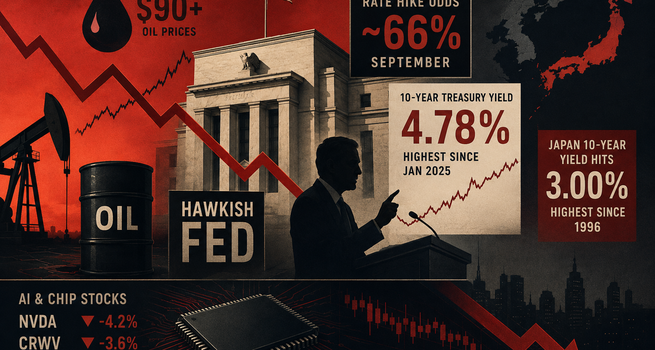
- US stocks fell as oil prices, Treasury yields, and September rate-hike odds all rose at once.
- The 10-year Treasury Yield reached about 4.78% to 4.79%, its highest level since January 2025, while the 30-year sits near 5.25% to 5.27%.
- Chip, neocloud, and data-center power stocks, including NVIDIA (NASDAQ: NVDA), CoreWeave (NASDAQ: CRWV), and Vertiv (NYSE: VRT), led the decline as the most rate-sensitive, high-multiple names.
- Japan's 10-year government Bond Yield hit 3.00% for the first time since 1996, reducing a major source of foreign Demand for US Treasuries.
US stocks sold off as three forces hit risk assets simultaneously: an oil price spike tied to escalating US-Iran tensions, a Global Bond rout pushing the 10-year Treasury yield to its highest level since January 2025, and hawkish Federal Reserve commentary that lifted September rate-hike odds to roughly two-thirds. The Nasdaq opened down more than 1%, with AI-linked names among the earliest and steepest decliners as the VIX jumped.
Three Forces Hitting the Market at Once
Fresh military exchanges between the US and Iran, along with renewed concern over shipping through the Strait of Hormuz, pushed Crude Oil higher, with WTI in the high $80s and Brent around or above $90 a barrel. Rising energy prices revive Inflation fears directly, since energy costs feed into broader price indexes the Fed tracks closely.
At the same time, a global bond selloff pushed the 10-year Treasury yield to around 4.8%, a multi-month high, while Japan's 10-year government bond yield hit 3%. Higher yields reduce the present value of far-out cash flows, which is why the Nasdaq and high-multiple growth stocks, many of them tied to AI infrastructure spending, are leading the market lower.
Compounding both dynamics, Fed Chair Kevin Warsh's remarks at the Jackson Hole symposium lifted September rate-hike odds to roughly two-thirds, up from about 35% to 40% a week earlier. September is also historically the weakest month of the year for the S&P 500, adding a seasonal headwind on top of the rate and oil pressure. JOLTS data and Friday's payrolls report are the next scheduled data points markets will use to reassess the Fed's path.
Why Chip, Cloud, and Power Stocks Are Getting Hit Hardest
This is a rate-and-oil shock rather than a company-by-company Earnings problem, and the stocks falling hardest are the market's most rate-sensitive, high-beta names. Chip designers including NVIDIA (NASDAQ: NVDA), AMD (NASDAQ: AMD), Arm Holdings (NASDAQ: ARM), and Marvell Technology (NASDAQ: MRVL) are taking the brunt of the selling, since their valuations assume years of continued AI-driven growth that higher long-term yields now force investors to discount more heavily. Arm, as a high-multiple intellectual property play, tends to move especially hard on risk-off days. Marvell carries an added company-specific overlay: after a strong quarter, it had already sold off on concerns that its Google custom-chip ramp is now expected to be more meaningful in fiscal 2029 rather than sooner, with near-term margins looking softer.
Test, equipment, and connectivity names are also under pressure. Aehr Test Systems (NASDAQ: AEHR), a high-beta test-equipment name, is seeing profit-taking after a large earlier run and a recently weaker second-half outlook. KLA Corporation (NASDAQ: KLAC), tied to wafer inspection and process control, is following the broader semiconductor-equipment sector lower as investors question the timing of AI capital expenditure. Credo Technology (NASDAQ: CRDO), a high-speed connectivity and optics name, is among the weaker AI hardware performers today and reports earnings after the close, which is contributing to defensive positioning ahead of that print.
Neocloud and AI infrastructure operators are also being sold aggressively. These companies depend on cheap capital, GPU supply, power access, and customer prepayments to fund their buildouts, making them especially vulnerable when yields rise and risk appetite falls. CoreWeave (NASDAQ: CRWV) was down more than 3% at the open, compounded by high Debt levels and earlier concerns after Nvidia paused some revenue-sharing and credit-support arrangements. IREN (NASDAQ: IREN) had already sold off following its fourth-quarter report, in which AI Revenue overtook Mining revenue but came with a revenue miss, large impairments on retired mining equipment, and costly transition spending, leaving the stock's high Beta to amplify today's broader move.
Data-center power and electrical equipment names are moving with the same chain. Vertiv (NYSE: VRT), which supplies cooling and power infrastructure, and Powell Industries (NASDAQ: POWL), an electrical equipment provider for large facilities, are Downstream beneficiaries of the AI buildout and are being marked down alongside it as investors worry that higher rates and energy costs could slow or stretch out hyperscaler capital spending, even without any company-specific news.
Finally, the hyperscalers themselves, Amazon (NASDAQ: AMZN), Alphabet (NASDAQ: GOOG), Microsoft (NASDAQ: MSFT), and Meta Platforms (NASDAQ: META), are falling with the broader Nasdaq. These companies are the buyers of the chips and data-center capacity described above, and the market has already been scrutinizing their enormous AI Capital Expenditure against comparatively shrinking free cash flow. On a risk-off day, they decline alongside high-multiple Growth Stocks even though their underlying businesses continue to grow.
Where Treasury Yields Sit and Why They're Rising
The Treasury yield curve is upward-sloping: the 1-month bill sits near 3.77%, close to the current policy rate; the 2-year note is around 4.35% to 4.36%, up sharply after Jackson Hole; the 10-year is at approximately 4.78% to 4.79%, its highest level since January 2025; and the 30-year sits near 5.25% to 5.27%, after spending much of 2026 above 5%. That shape reflects a higher-for-longer environment with a rising term premium, rather than the inverted curve typically associated with Recession fears.
Five distinct drivers are behind the move. First, Fed Chair Kevin Warsh turned hawkish at Jackson Hole on August 28, saying inflation remains too high and that recent CPI and PCE prints do not show meaningfully improved underlying trends, while offering little forward guidance, which itself raises Volatility and the term premium markets demand. Second, the US-Iran conflict and related Hormuz shipping risk pushed oil higher over the weekend and into Monday, feeding directly into inflation expectations and reaccelerating the bond selloff. Third, a global bond rout led by Japan, where the 10-year JGB yield hit 3% for the first time since 1996 amid fiscal concerns and pressure on the Bank of Japan to raise rates, has reduced a major source of foreign demand for US Treasuries, since Japanese investors have less incentive to buy Treasuries when domestic yields are also attractive. Fourth, heavy fiscal and Corporate Bond supply, including large US deficits, elevated Treasury issuance, and AI-related corporate debt competing for the same long-duration buyers, has kept pressure on the long end even after the Treasury attempted to cushion it by doubling Buybacks in the 10- to 30-year sector. Fifth, Warsh's communication style, offering less pre-commitment than prior Fed chairs, means each speech and data release can reprice the entire curve, keeping both the 2-year and 10-year unstable through a data-heavy week that includes JOLTS, ADP, and Friday's payrolls report.
What to Watch Next
Friday's payrolls report could either lock in or fade current September rate-hike odds, depending on whether the labor market shows further cooling or unexpected strength. Continued oil price gains tied to the US-Iran conflict would keep the inflation premium embedded in yields elevated. A weak Japanese 30-year bond auction, scheduled for September 3, could export additional selling pressure into US Treasuries. Finally, whether Warsh follows through on a hawkish tone with an actual rate hike in mid-September, or talks tough and then holds again, is likely to shape how much credibility-related risk premium remains priced into the long end of the curve going forward.

 Nov 02, 2026

 Please wait processing your request...