
 CA
 NZ
 UK
 AU
 IND

 US

 Share
 X (Formerly Twitter)
 Whatsapp
 Facebook
 LinkedIn
 Telegram
 Email This Article
 Copy Link
 Summarize with AI
 Chat GPT
 Perplexity
Index Update
US equities ended lower on Friday as a renewed chip-sector sell-off and escalating geopolitical risks weighed on sentiment. The S&P 500 fell 1%, the Nasdaq declined 1.5% and the Dow lost 407 points, with Nvidia, Broadcom, AMD and Intel retreating on concerns that AI hyperscalers may curb infrastructure spending amid advances in Chinese AI models. Rising fuel prices intensified inflation concerns, while fresh US–China political tensions raised doubts about the durability of the trade truce. Netflix also dropped 7.3% after guiding for another quarter of slowing revenue growth.
Market Movers
Among the top-performing stocks of the session Sadot Group Inc. surged 77.54%, while Baiya International Group Inc. rallied 36.18%. On the losing side, Vivakor, Inc. fell 46.95%, while QumulusAI, Inc. declined 33.36%, making them the weakest performers during the trading day.
Commodities Update
Crude oil prices retreated from intraday highs on Monday, with WTI trading near USD 80 per barrel after briefly exceeding USD 85 and Brent hovering around USD 87 after topping USD 91. Prices eased after Iran acknowledged receiving mediation proposals and indicated that negotiations with the US could continue if aligned with its national interests. Nevertheless, recent US–Iran military exchanges, attacks on vessels transiting the Strait of Hormuz and a strike on a Kuwaiti oil facility continue to threaten regional supply flows, keeping volatility elevated and a substantial geopolitical risk premium embedded in oil prices.
Gold held near USD 4,030 per ounce while silver rebounded to about USD 57 on Monday, as investors weighed the US–Iran conflict, threats to Strait of Hormuz shipping and the inflationary implications of elevated energy prices. Although oil prices eased after Iran signalled openness to negotiations, Brent remained near a one-month high, sustaining concerns that inflation could remain persistent and US interest rates may stay higher for longer. Reinforcing this view, Cleveland Fed President Beth Hammack indicated that further rate hikes may be required, with markets now assigning an 80% probability to a December Fed rate increase, up from 73% a week earlier.
Macro Updates
The US dollar index held near 101 on Monday, extending its two-session rise as heightened Middle East tensions supported oil prices and strengthened expectations for persistently high inflation and potentially higher US interest rates. Fresh US airstrikes against Iran, Tehran’s collapse-of-ceasefire declaration and vessel interceptions in the Strait of Hormuz elevated safe-haven demand, while hawkish Fed commentary lifted the implied probability of a September rate hike to about 53%; markets nonetheless expect policy to remain unchanged at this month’s meeting.
Bonds Commentary
The 10-year US Treasury yield rose to around 4.57% on Monday as escalating US–Iran tensions lifted oil prices and renewed inflation and rate-hike concerns. Fresh US airstrikes, Iran’s declaration that the ceasefire had collapsed, and vessel interceptions in the Strait of Hormuz heightened geopolitical risk, while Cleveland Fed President Beth Hammack’s warning on persistent inflation reinforced the hawkish outlook. Markets now price a roughly 53% chance of a September Fed hike, although rates are still expected to remain unchanged at the upcoming meeting.
Futures Update
US equity-index futures rose around 0.4% on Monday, led by a stabilization in chip and major technology stocks after last week’s sell-off pushed Nasdaq 100 futures to more than two-month lows. Investors remain focused on whether AI hyperscalers could slow infrastructure spending, with Alphabet’s outlook on Wednesday expected to offer a key read-through for semiconductor and software capital-expenditure trends. Elevated Middle East tensions kept fuel prices high, though easing bond yields and continued strength in credit-sensitive bank holding companies following solid sector earnings supported broader market sentiment.
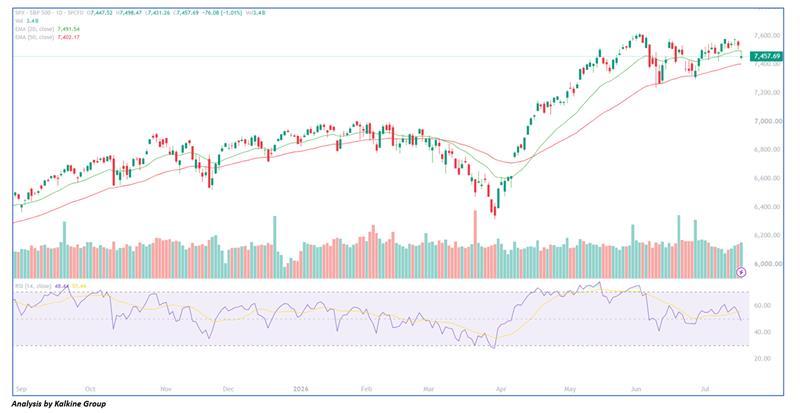
Following the weakness seen in the previous session, U.S. stocks extended their losses on Friday, with all three major averages closing notably lower. The Nasdaq led the decline as selling pressure persisted across the broader market. Despite the pullback, the S&P 500's broader technical structure remains constructive, with the index continuing to trade above both its 20-day EMA (7,492) and 50-day EMA (7,402). The RSI has eased to around 48, reflecting neutral momentum following the recent consolidation. As long as the index holds above the 20-day EMA, the broader bullish trend remains intact. Immediate support is located near 7,492, followed by stronger support at the 50-day EMA around 7,402, while a recovery above 7,500 could restore bullish momentum and set the stage for another test of the recent highs.

 Nov 17, 2026
 Please wait processing your request...