
 CA
 NZ
 UK
 AU
 IND

 US

 Share
 X (Formerly Twitter)
 Whatsapp
 Facebook
 LinkedIn
 Telegram
 Email This Article
 Copy Link
 Summarize with AI
 Chat GPT
 Perplexity
Key Highlights
- Apple unveiled its first touchscreen MacBook Pro, built around a new OLED ProLED XDR Display.
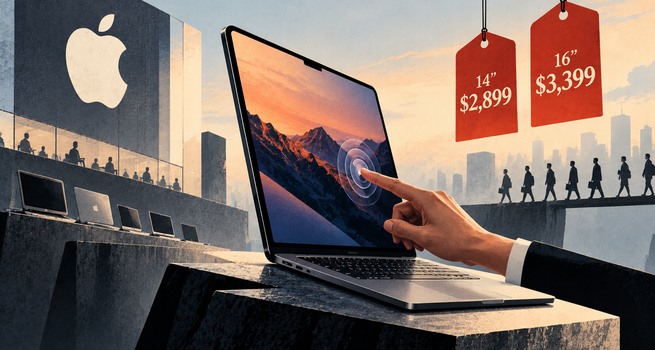
- 14-inch model starts at USD 2,899; 16-inch starts at USD 3,399, both sharply higher.
- Global laptop shipments could fall 11% this year amid rising AI-driven memory costs.
- Mac generated USD 10.35 billion in Revenue last quarter, under 10% of total sales.
Apple (NASDAQ:AAPL) makes consumer hardware, software and services, including the iPhone, Mac and iPad lines. The headline from its Wednesday event is that Apple finally put a touchscreen on a MacBook. The more interesting question is whether customers will pay sharply more for it at a moment when component costs are already squeezing the whole PC industry.
What Apple Actually Changed
The new MacBook Pro pairs a touch-enabled OLED display, which Apple calls a ProLED XDR Display, with its existing M5 Pro and M5 Max chips rather than a newer processor generation. The 14-inch model starts at USD 2,899 and the 16-inch at USD 3,399, both well above prior MacBook Pro pricing, with availability set for November 6. Because the chip lineup is unchanged, the touch display is effectively the single new capability buyers are being asked to pay more for.
Breaking With Its Own Orthodoxy
That the new feature is touch at all matters because Apple spent close to two decades building a public case against it, with past Leadership arguing that touch and keyboard computing served fundamentally different purposes and that the iPad already handled the touch use case well. CEO John Ternus, who built his career on Mac hardware and the company’s shift to its own silicon, is the executive now reversing that position, in what is already his third major hardware launch since taking over, following a folding iPhone in September and a smart home device in October. Reversing a philosophy a company has defended for years is rarely cost-free internally, and doing it alongside a price increase suggests Ternus is betting that differentiation, not nostalgia for old arguments, is what carries the Mac forward.
The Pricing Calculus
The increase arrives on top of a year in which nearly every Mac, including a USD 300 bump to the Mac Mini in August, has already gotten more expensive. Apple’s own leadership has described the memory cost backdrop driving those increases as potentially unsustainable, which suggests the company sees this as a structural cost it has decided to pass through rather than a temporary blip. Framed that way, touch may be less the product than the pretext, a differentiated feature that gives Apple a story to tell customers about why they are paying more, at exactly the moment the broader industry needs one.
The Strategic Bet Behind the Launch
Mac revenue of USD 10.35 billion last quarter was under 10% of Apple’s total sales, which on its own would not justify this much engineering and Marketing effort. The stronger rationale sits elsewhere: the Mac remains the only platform developers can use to build iPhone apps, and Apple has spent recent months positioning its chip and memory design as well suited to running AI models locally rather than in the cloud. Reports that at least one major AI developer has been buying Mac Minis in bulk for testing, and a separate effort suggesting large models could run across networked clusters of Macs, hint at a Mac strategy increasingly aimed at developers and AI infrastructure buyers, a different kind of customer who may be less price-sensitive than the mainstream laptop buyer that industry shipment data describes.
Where Things Stand
Industry data complicate the bet. Only around 17% of notebook PCs shipping globally this year include a touchscreen, and touch models have historically carried slightly lower average selling prices than non-touch ones, not higher, which cuts against the idea that touch alone commands a premium. Overall PC shipments could fall roughly 11% this year, with the third quarter down 20% industry-wide and Apple’s own unit shipments down an estimated 11%, meaning Apple is raising prices into a shrinking market rather than a growing one.
Taken together, the launch reads less as a simple hardware refresh and more as two bets layered on top of each other: that touch and design can justify a materially higher price even as the broader category contracts, and that a smaller, higher-value base of developers and AI-focused buyers can offset softer Demand from mainstream customers. What to watch from here is how Mac sales and pricing trends move over the next two quarters, whether the touch feature shows up as a stated purchase driver in future industry surveys, and whether memory costs ease enough for Apple to hold pricing steady on its next Mac refresh rather than raise it again.


 Oct 30, 2026





 Please wait processing your request...