
 CA
 NZ
 UK
 AU
 IND

 US

 Share
 X (Formerly Twitter)
 Whatsapp
 Facebook
 LinkedIn
 Telegram
 Email This Article
 Copy Link
 Summarize with AI
 Chat GPT
 Perplexity
Key Highlights
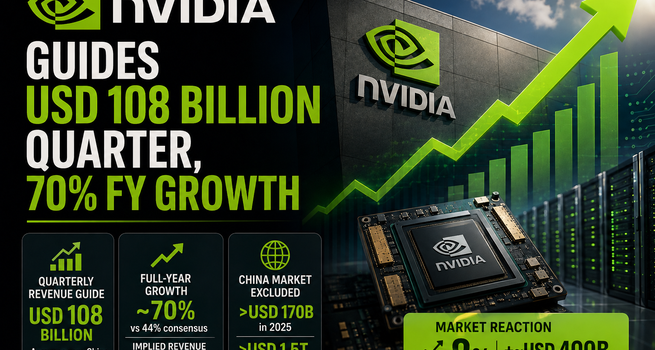
- Guidance of USD 108 billion for the coming quarter assumes zero data centre compute Revenue from China.
- Projected full-year growth of roughly 70 per cent against Wall Street consensus near 44 per cent implies revenue of about USD 673 billion.
- The shares recovered from an initial 4 per cent decline to trade 8 per cent higher, adding around USD 400 billion in market capitalisation.
Nvidia Corporation (NASDAQ: NVDA) has guided to USD 108 billion in revenue for the coming quarter and projected growth of roughly 70 per cent for its next fiscal year. Wall Street consensus ahead of the result sat closer to 44 per cent. On the company’s own projection, next-year revenue would reach approximately USD 673 billion. Market commentary circulating after the release described the figures as the largest growth numbers ever posted by a company of this scale. The data below is drawn from that guidance and the accompanying commentary.
The guidance in numbers
Two figures carry the release. The first is the USD 108 billion quarterly guide, which the commentary places at roughly 1,730 per cent growth across four years. The second is the full-year projection of about 70 per cent, which the commentary values at approximately USD 673 billion and describes as roughly 2,400 per cent growth since fiscal 2022.
A USD 673 billion figure at 70 per cent growth implies a current fiscal year running near USD 396 billion. The gap between the 44 per cent consensus and the 70 per cent projection is the part of the release that moved expectations, since a 26 percentage point difference at this revenue base translates into more than USD 100 billion of annual revenue.
Where that would place the company by revenue
On the commentary’s reading, revenue at that level would make Nvidia the third largest company in the world by revenue, behind only Amazon and Walmart. Both of those are retail businesses operating on materially thinner margins, so a ranking by revenue alone does not carry across to earnings. The commentary also states that revenue would exceed Apple’s by roughly USD 200 billion.
The guidance excludes China entirely
The most consequential detail in the release is what the guidance leaves out. The USD 108 billion quarterly figure assumes zero data centre compute revenue from China. The company’s Form 10-Q states that it is "effectively foreclosed from competing in China’s Data Center market", and notes that shipments of its H200 chip are heavily restricted.
The scale of what is excluded is substantial. The commentary puts China’s core artificial intelligence industry above USD 170 billion in 2025, with a projection of more than USD 1.5 trillion by 2030, making it the second largest AI market globally. None of that sits inside the guided figures. On this framing the China position functions as unmodelled optionality rather than a contribution at risk, since a market that contributes nothing to the forecast cannot disappoint against it. The corollary is that any reopening would represent addition rather than recovery.
The spending backdrop
The Demand side rests on Capital Expenditure by a small number of very large buyers. The commentary places combined annual capital expenditure across the Magnificent 7 companies above USD 1 trillion, and describes the resulting cycle as the largest Investment wave in modern history.
The construction data gives a physical read on the same trend. United States data centre construction has reached a record USD 68 billion annualised, which now exceeds office construction by USD 25 billion, the widest gap recorded. In 2022 the relationship ran the other way, with office construction exceeding data centres by USD 57 billion. That is a swing of USD 82 billion in relative position across roughly three years, and it is the kind of change that shows up in cement and steel rather than in forecasts.
The market reaction
Price action following the release was not linear. The shares fell about 4 per cent initially before recovering to trade around 8 per cent higher, adding roughly USD 400 billion in Market Capitalisation on the session, which the commentary describes as on track for a potential daily record. An 8 per cent move producing a USD 400 billion addition implies a market capitalisation in the region of USD 5 trillion.
The Inflation counterweight
The same commentary sets the growth figures against a less comfortable macroeconomic reading. Personal consumption expenditures inflation in the United States has reached 3.7 per cent, close to double the Federal Reserve’s long-run 2 per cent objective, with oil prices back above USD 80 per barrel.
The conclusion drawn in the commentary is that the benefits of the current cycle are concentrated among asset owners. That is a characterisation of distribution rather than a measurement of it.
What the projection rests on
Three qualifications sit alongside the headline numbers. The USD 673 billion figure is a company projection rather than a reported result, and it exceeded consensus by a wide margin, which means the market had not previously judged it achievable. Demand is concentrated in a small number of hyperscale buyers whose capital expenditure plans can be revised. And the guidance assumes no contribution from the second largest AI market in the world, which is a conservative assumption on the revenue line and a reminder of how much of the demand picture currently sits outside the company’s reach.
The views on future growth described above are those of the market commentary referenced and not of Kalkine. Forward-looking projections, including the company’s own guidance, are estimates that may not be achieved.
This article is general information only and does not take into account any individual objectives, financial situation or needs. It is not a recommendation to buy, sell or hold any security. All details are as stated in the company announcement or third party research referenced and are subject to change. Past performance is not a reliable indicator of future performance. Investors should consider the appropriateness of any information having regard to their own circumstances and seek independent financial advice before making any financial decision.


 Nov 03, 2026





 Please wait processing your request...