
 CA
 NZ
 UK
 AU
 IND

 US

 Share
 X (Formerly Twitter)
 Whatsapp
 Facebook
 LinkedIn
 Telegram
 Email This Article
 Copy Link
 Summarize with AI
 Chat GPT
 Perplexity
Key Highlights
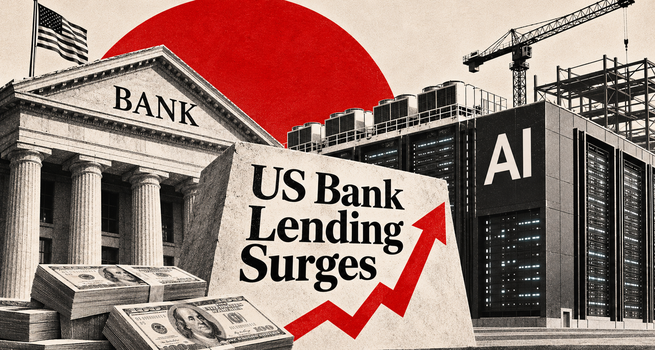
- Commercial and Industrial (C&I) loans at large US banks surged 11.4% year-on-year in October to $1.6 trillion, the highest level since June 2020 and the strongest annual growth rate since February 2023.
- In Q3 2026, C&I loans at the 25 largest US banks grew nearly 10.0% year-on-year, the strongest growth in 10 years excluding pandemic-related swings, reversing an 8.0% year-on-year contraction recorded in Q4 2025.
- The surge has been driven by Big Tech companies and data-center developers drawing on bank Credit to fund AI infrastructure, with regional lenders also extending credit to construction firms and suppliers benefiting from the buildout.
- The data-center buildout is increasingly being funded by debt, a structural shift that is reshaping credit Demand across the US banking system.
C&I Loan Growth: The Numbers in Detail
Commercial and Industrial loans at large US banks reached $1.6 trillion in October 2026, up 11.4% from the same month a year earlier. That is the highest absolute level since June 2020 and marks the strongest year-on-year growth rate since February 2023, a period when post-pandemic credit demand was still running at elevated levels.
The quarterly data reinforces the trend. C&I loans at the 25 largest US banks grew nearly 10.0% year-on-year in Q3 2026, the strongest pace in 10 years when pandemic-era distortions are excluded. That compares sharply with an 8.0% year-on-year contraction in Q4 2025, meaning the sector swung from meaningful credit shrinkage to decade-high credit expansion in the space of three quarters.
The speed and scale of the Reversal are unusual by historical standards and point to a specific demand driver rather than a broad cyclical recovery in Business borrowing.
AI Infrastructure: The Engine Behind the Lending Surge
The primary driver of the C&I lending acceleration is the AI infrastructure buildout. Big Tech companies, including those that have disclosed a combined $3.3 trillion in off-balance-sheet commitments for data-center construction and equipment, are drawing on bank credit to fund near-term capital expenditure. Data-center developers and co-location operators are also borrowing to finance construction pipelines that have grown substantially over the past 18 months.
This represents a structural change in how AI infrastructure is being financed. In the earlier phase of the AI Investment cycle, much of the spending was funded from Operating Cash Flow and Equity capital raises. The shift toward Debt financing, and specifically toward bank credit rather than bond markets alone, indicates that the buildout has reached a scale and pace that is absorbing a broader range of financing sources.
The data-center buildout is increasingly being funded by debt. That observation, straightforward on its face, has significant implications for the US banking sector, for credit markets, and for the Financial Risk profile of the AI infrastructure investment cycle as a whole.
Regional Banks Join the Lending Expansion
The lending growth is not confined to large money-centre banks. Regional lenders are also expanding credit, primarily to construction companies, engineering firms, specialist contractors, and other businesses operating in the Supply chain that supports the data-center buildout. As projects move from planning into active construction, the demand for working capital, equipment financing, and project-level credit has spread outward from the largest borrowers to a wider group of smaller businesses.
This broadening of credit demand is consistent with a Capital Investment cycle that has moved from the announcement phase into active execution. Large data-center projects typically generate secondary lending demand across multiple tiers of the supply chain, including property development, power infrastructure, networking equipment, and facilities management, each of which may require its own credit arrangements.
What the Lending Data Means for Credit Markets
The surge in C&I lending has two readings for credit markets. On one reading, it is a positive signal: businesses are investing, banks are willing to lend, and the credit quality of AI infrastructure borrowers, at least at the large-cap end, is generally strong. The largest technology companies carry investment-grade ratings and substantial cash flows, which makes them creditworthy borrowers even as their absolute debt loads grow.
On the other reading, the acceleration in debt-funded AI spending adds a new layer of financial risk to the AI investment cycle. If AI Revenue growth proves slower than anticipated, or if competition compresses the margins of AI infrastructure operators, the debt-servicing burden across the sector will increase. For regional banks with concentrated exposure to construction and data-center supply chains, a slowdown in project activity could translate into credit quality deterioration.
The broader context is worth noting. Across the technology sector, financing conditions for AI infrastructure companies have tightened at the smaller end of the market. CoreWeave, the GPU cloud provider, has seen its debt yields rise above 15% and credit-default swap spreads reach record levels. Large-cap borrowers remain insulated by their balance-sheet strength, but the divergence in financing conditions between large and small AI infrastructure players is a trend that bank credit data will continue to reflect.
This article is for informational purposes only and does not constitute financial advice or a recommendation to buy, sell, or hold any security. Readers should conduct their own research or consult a qualified financial adviser before making any investment decisions.


 Nov 03, 2026





 Please wait processing your request...