
 AU
AU
 UK
UK
 CA
CA
 NZ
NZ
 IND
IND

 US
US

 Share
Share
 X (Formerly Twitter)
 Whatsapp
 Facebook
 LinkedIn
 Telegram
 Email This Article
 Copy Link
 Summarize with AI
 Chat GPT
 Perplexity
Can an IRA hold private company shares? Learn the IRS rules, prohibited transaction risks, UBTI exposure, valuation requirements, and compliance challenges.
Key Highlights
- Self-directed IRAs can legally hold private company shares, startup Equity, and certain private placements.
- Prohibited transaction rules create significant compliance risks for investors with ownership or management involvement.
- Valuation, Liquidity, and potential UBTI obligations make private-company investments more complex than public securities.
Many investors looking beyond public markets eventually ask whether retirement funds can be invested in private companies. The answer is yes. A self-directed IRA can hold certain private company shares, but the opportunity comes with substantial regulatory and administrative responsibilities.
Unlike publicly traded stocks, private investments require careful attention to IRS rules governing ownership, valuation, and prohibited transactions.
Can an IRA Invest in Private Companies?
A self-directed IRA can generally purchase private company stock, Limited Liability company interests, Partnership interests, Venture Capital investments, and certain private placements.
These investments are commonly used by investors seeking exposure to startup businesses, Private Equity opportunities, or companies not available through public markets.
However, simply because an Investment is permitted does not mean every transaction is allowed.
Prohibited Transactions Are the Biggest Risk
The IRS closely monitors transactions involving retirement accounts and related parties.
An IRA owner generally cannot use retirement Assets to benefit personally, directly or indirectly. Transactions involving the account holder, certain family members, or entities they control may trigger prohibited transaction rules under Internal Revenue Code Section 4975.
For example, serving as a compensated executive, using IRA-owned assets for personal benefit, or structuring investments that create conflicts of interest can jeopardize the IRA's tax-advantaged status.
For many investors, prohibited transaction risk is often more significant than investment risk itself.
Valuation Requirements Cannot Be Ignored
Private companies do not trade on public exchanges, making valuation more challenging.
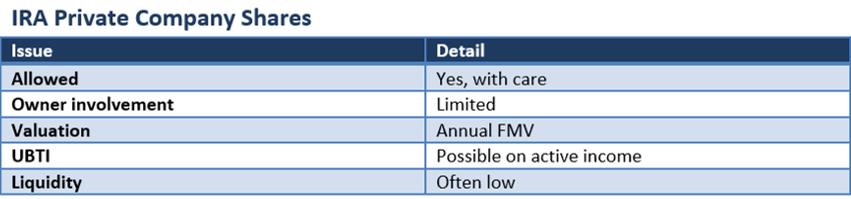
IRA custodians typically require annual fair Market Value reporting for Form 5498 filings. Depending on the investment, independent appraisals or third-party valuations may be necessary to support reported values.
Accurate valuations become increasingly important when calculating distributions, transfers, conversions, or required minimum distributions.
Understanding UBTI Exposure
Another important consideration is Unrelated Business Taxable Income (UBTI).
While most passive investment income inside an IRA remains tax-deferred, income generated from an active trade or business may trigger UBTI obligations. Certain leveraged investments can also create taxable income within the retirement account.
When UBTI applies, the IRA may be required to file Form 990-T and pay taxes on a portion of its Earnings.
Investors considering private operating businesses should evaluate potential UBTI exposure before investing.
Liquidity Can Become a Problem
Private-company shares often lack an active Secondary Market.
This limited liquidity may not matter during periods of growth, but it can create challenges when investors need to take required distributions, transfer assets, or rebalance portfolios.
Selling private shares can take months or even years, depending on market conditions and company-specific restrictions.
Private Equity Opportunities Come With Added Complexity
Private-company investments can provide access to innovative businesses and potentially Long-term Growth opportunities unavailable in public markets.
Yet the benefits must be weighed against higher compliance burdens, valuation uncertainty, liquidity constraints, and potential tax complications.
Investors should understand that retirement-account rules remain in force regardless of how attractive a private investment opportunity may appear.
Conclusion
Private company shares can be held within a self-directed IRA, but they require far greater oversight than traditional stocks or mutual funds. Prohibited transaction rules, annual valuation requirements, potential UBTI exposure, and liquidity constraints all introduce additional layers of complexity. For investors considering private equity inside a retirement account, professional guidance from experienced tax advisers, custodians, and retirement specialists can be critical to maintaining compliance while pursuing alternative investment opportunities.


 Jun 02, 2026




 Please wait processing your request...