
 CA
 NZ
 UK
 AU
 IND

 US

 Share
 X (Formerly Twitter)
 Whatsapp
 Facebook
 LinkedIn
 Telegram
 Email This Article
 Copy Link
 Summarize with AI
 Chat GPT
 Perplexity

Key Highlights
- An RMD, or required minimum distribution, is the minimum amount you generally must withdraw annually from certain retirement accounts once you reach your applicable RMD age, currently 73 or 75 depending on your birth year.
- The Withdrawal amount is calculated using a simple formula: your Account Balance divided by a number from an IRS table.
- The deadline to take your RMD is December 31 each year, except for your very first one, which can wait until April 1 of the following year.
- Skipping an RMD or taking too little results in a tax penalty of 25 percent of the amount you should have withdrawn.
- Donating your RMD directly to charity, known as a qualified charitable distribution, lets you satisfy the requirement without paying tax on it.
RMD stands for required minimum distribution. It is simply the smallest amount of money the government requires you to take out of certain retirement accounts each year once you reach a certain age.
Here is the basic idea. When you put money into a traditional IRA or a 401(k), you generally did not pay tax on it at the time. That money then grew for years, also without being taxed. This was a good deal for savers, but it was never meant to last forever. Eventually, the government wants its share of tax on that money. The RMD is how that happens. Once you reach the required age, you must withdraw a minimum amount every year and pay regular income tax on it, whether you need the money to live on or not.
Think of it like a library book with an increasingly firm due date. The account let you hold onto that money tax-deferred for decades, meaning the tax bill was postponed rather than eliminated. Now it is time to start returning a portion of it, on a schedule the IRS sets, whether or not you are ready to spend it.
Who Has to Take an RMD, and When
Not every account has this rule, and not every age is the same for everyone.
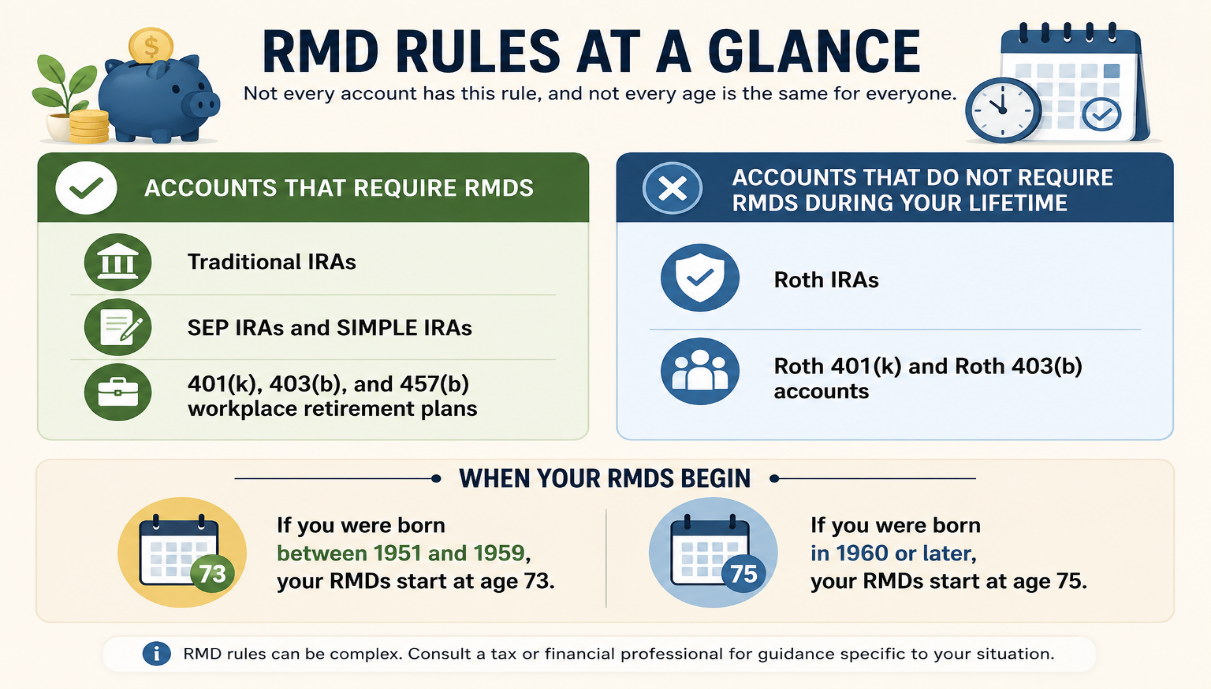
There is one common exception. If you are still working past your RMD age and you do not own five percent or more of the company you work for, many workplace plans let you delay RMDs from that specific employer's plan until you actually retire. This exception does not apply to IRAs, and it does not apply to old 401(k) accounts from employers you no longer work for.
How to Calculate Your RMD
The math behind an RMD is more approachable than it sounds. There is one formula, and it stays the same every year:
Your RMD = Your account balance on December 31 of last year, divided by a number from an IRS table called the life expectancy factor.
The IRS publishes this life expectancy Factor in a chart called the Uniform Lifetime Table. You look up your age for the year, find the corresponding number, and divide your balance by it. Here is what that looks like in practice at a few different ages.
Example 1: You are 73 years old with $500,000 in your IRA. The table gives you a factor of 26.5 at this age. $500,000 divided by 26.5 equals about $18,868. That is your required withdrawal for the year, which works out to roughly 3.8 percent of your balance.
Example 2: You are 80 years old with $750,000 in your account. The factor at 80 is 20.2. $750,000 divided by 20.2 equals about $37,129, or roughly 5 percent of your balance.
Example 3: You are 90 years old with $400,000 in your account. The factor at 90 is 12.2. $400,000 divided by 12.2 equals about $32,787, or roughly 8.2 percent of your balance.
Notice a pattern here. The older you get, the smaller the number you divide by, which means a larger slice of your account must come out each year. This is intentional. The table assumes your remaining life expectancy shortens as you age, so the required withdrawal grows accordingly.
One more useful detail: if you have several traditional IRAs, you can calculate the RMD for each one separately, add them together, and then withdraw that total amount from just one of the accounts if you prefer. Workplace plans like 401(k)s do not allow this. Each 401(k) must have its own RMD taken out of that specific account.
The December 31 Deadline
Every year, your RMD must be withdrawn by December 31. Miss this date and you are considered to have skipped it, even by one day.
There is one exception, and it only applies to your very first RMD. You are allowed to wait until April 1 of the year after you turn 73 (or 75, depending on your birth year) to take that first withdrawal. It sounds like extra time, and technically it is, but there is a catch. If you delay your first RMD into that following spring, you will still owe your second RMD by December 31 of that same year. That means two withdrawals landing in the same tax year, which can push you into a higher Tax Bracket than if you had spread them across two separate years. Some retirees choose to take the first RMD in the initial RMD year rather than delaying it, for this reason. Whether delaying is actually the better move depends on the individual's income, deductions, and overall tax picture in each of the two years involved, so it is worth thinking through both scenarios rather than defaulting to one.
What Happens If You Miss an RMD
The penalty for missing an RMD, or taking out less than required, is a 25 percent tax on the amount you should have withdrawn but did not. For example, if your required withdrawal was $20,000 and you only took out $10,000, you could owe a penalty on the missing $10,000.
The good news is that this penalty used to be 50 percent before a recent law change, so it has already been cut in half. It can drop even further, to 10 percent, when the shortfall is corrected within the applicable correction window, generally within two years, and the correct paperwork, known as Form 5329, is filed. That window can close earlier in some cases, such as if the IRS has already assessed the tax or sent a formal notice, so it is best not to wait longer than necessary to fix a missed RMD. If the mistake happened for a good reason, such as a bank error or a recently inherited account, you can also ask the IRS to waive the penalty entirely by explaining what happened in writing.
Turning Your RMD Into a Charitable Gift
If you do not need the extra income from your RMD, there is a strategy worth knowing about called a qualified charitable distribution, or QCD.
Here is how it works. If you are 70 and a half or older, you can have your IRA send money directly to a qualified charity instead of to you. That amount counts toward your RMD for the year, but it does not count as taxable income. In 2026, you can donate up to $111,000 this way. A QCD differs from a conventional charitable contribution because the qualifying amount is excluded from your income entirely, rather than claimed as a deduction. This matters because a QCD can lower your adjusted gross income directly, which is not the same as claiming a deduction against it. It is also worth knowing that starting in 2026, taxpayers who do not itemize can separately deduct up to $1,000 of qualifying cash charitable gifts, or $2,000 for married couples filing jointly, so a regular donation is no longer limited to itemizers only, though it still works differently from a QCD.
The rules are specific. The money has to go straight from your IRA Custodian to the charity. It cannot pass through your own bank account first. And the charity has to be a qualifying organization, which rules out things like donor advised funds.
What Happens to an RMD If You Inherit the Account
If you inherit a retirement account from someone other than a spouse, different rules apply. In most cases, you must empty the entire account within ten years of the original owner's death. The test for whether you also owe annual withdrawals during that ten year window is not simply whether the original owner had already begun taking RMDs. It depends on whether the original owner died on or after their required beginning date, the specific date their own RMDs were legally required to start. If they died on or after that date, you generally must take a required withdrawal every year during the ten year window, not just empty the account by the final year. If they died before reaching that date, you generally have more flexibility in how you spread withdrawals across the ten years, as long as the account is fully emptied by the end of year ten.
A surviving spouse, a minor child of the original owner, or someone who is disabled or chronically ill may qualify for more flexible rules that stretch payments out longer. Because these rules vary quite a bit depending on your relationship to the original account owner, it is worth checking with a tax professional if you inherit a retirement account, rather than assuming the standard rule applies to you.
Why Your RMD Can Affect More Than Just Your Tax Bill
Because an RMD counts as regular taxable income, a large withdrawal in one year can have ripple effects beyond just the tax owed on that specific amount. It can push up your Medicare Part B and Part D premiums, since those are partly based on your income from two years earlier. It can also increase how much of your Social Security benefit is taxable, since that calculation also depends on your overall income.
This is why many retirees think about their RMD as one piece of a bigger tax picture each year, rather than a separate, isolated event. Spreading out other income, using a qualified charitable distribution, or planning ahead with Roth conversions in earlier years are all strategies some retirees use to soften this effect, though the right approach depends on each person's individual situation.
Planning Ahead of the December Deadline
An RMD is simply the government's way of making sure tax-deferred retirement savings eventually get taxed. The rules are specific but learnable: withdrawals generally begin at age 73 or 75 depending on when you were born, the amount is calculated using your account balance and an IRS table, the deadline is December 31 each year, and missing it comes with a real financial penalty. Once you understand the basic formula and the deadline, the rest of the RMD rules mostly cover exceptions and planning strategies, such as using a qualified charitable distribution or understanding the special rules for inherited accounts. For anyone approaching this age, it is worth taking the time to understand these basics well before the calendar runs out on the year.


 Sep 22, 2026





 Please wait processing your request...