
 CA
 NZ
 UK
 AU
 IND

 US

 Share
 X (Formerly Twitter)
 Whatsapp
 Facebook
 LinkedIn
 Telegram
 Email This Article
 Copy Link
 Summarize with AI
 Chat GPT
 Perplexity
Key Highlights
- AI adoption among retirement plan consultants and advisors has shifted sharply, with firms describing their use as still evaluating falling from 44 percent in 2025 to just 14 percent in 2026.
- A 2025 survey found 66 percent of large plan sponsors, those managing 100 million dollars or more in assets, saw potential in AI-powered virtual assistants for answering routine 401(k) questions.
- AI tools perform reliably on mechanical tasks such as Rebalancing and tax-loss harvesting, but household-level tax and estate nuance still requires human judgment.
- The SEC's 2026 Examination Priorities name AI washing, or overstating a system's AI capabilities, as a distinct focus area for Investment adviser reviews.
- The Department of Labor restored the long-standing five-part Fiduciary test in March 2026 after courts vacated a 2024 rule, and has stated it has no current plans for new rulemaking on the fiduciary definition.
AI Moves From the Back Office to the Advice Itself
Artificial intelligence has been quietly embedded in retirement plan administration for years, handling meeting transcription, portfolio analysis, and first-draft financial plans behind the scenes. What has changed in 2026 is that AI is increasingly generating the advice itself, not just supporting the adviser who delivers it.
A study of consultants and advisors overseeing more than 10 trillion dollars in defined contribution plan Assets found that firms describing their AI use as still evaluating fell from 44 percent in 2025 to just 14 percent a year later. Firms with formal AI governance structures report using AI roughly 50 percent more frequently across Business functions, suggesting that clear internal policy accelerates adoption rather than slowing it. A separate 2025 survey found that 66 percent of plan sponsors managing 100 million dollars or more in retirement assets saw potential in AI-powered virtual assistants for answering routine 401(k) questions, an early signal of the interest that has since accelerated.
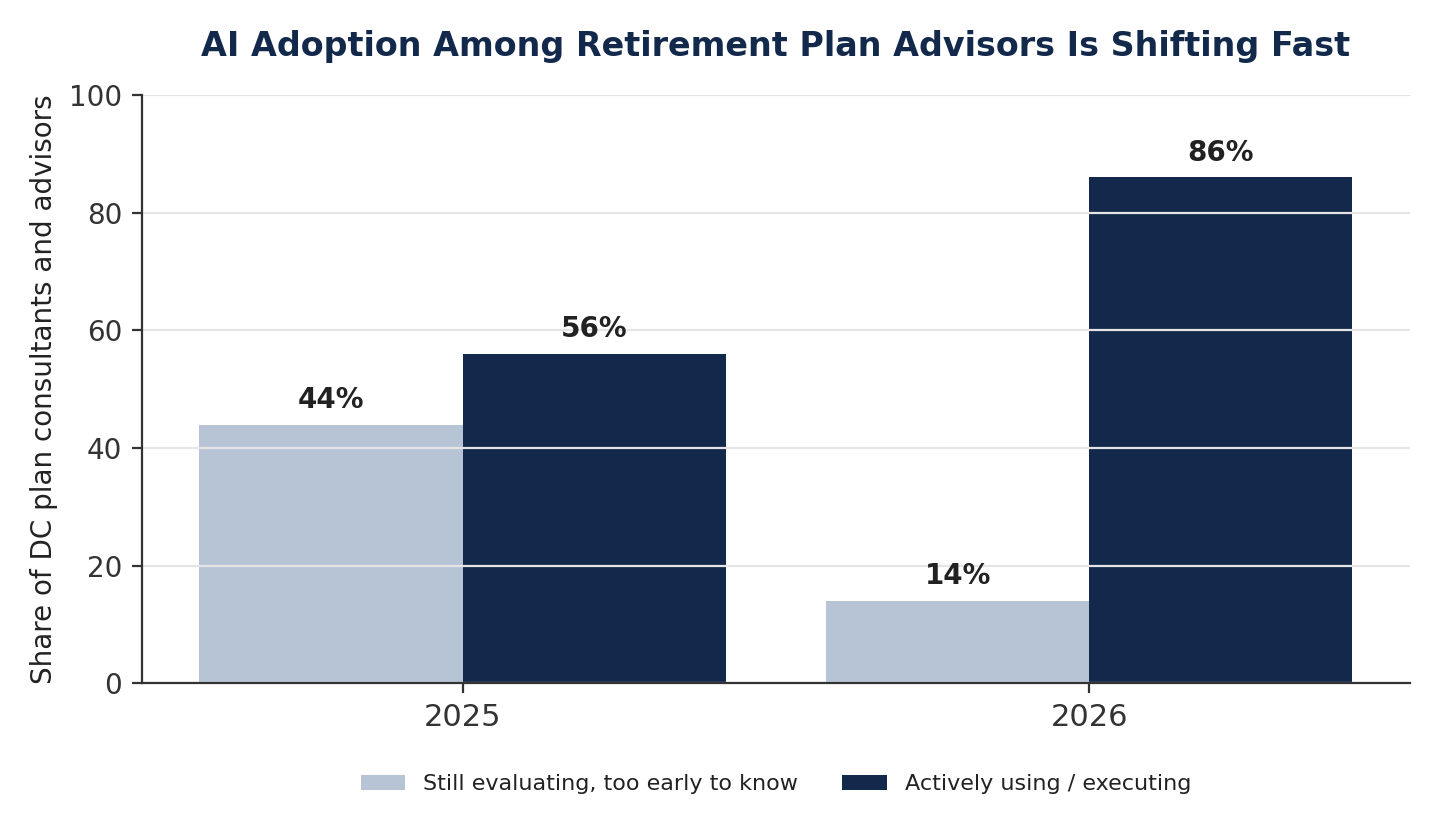
Chart 1. Share of retirement plan consultants and advisors by stage of AI adoption, 2025 versus 2026.
Where AI-Driven Advice Is Already Live
The shift is visible in specific product launches. One year after Robinhood Strategies launched in March 2025, following its Acquisition of AI planning firm Pluto, it remains, according to a 2026 industry review of the robo-advice landscape, the only major robo-adviser built around an AI recommendation engine. The same review found that Betterment, Wealthfront, SoFi, and Fidelity Go have not introduced comparable AI-led advice products, noting that fiduciary requirements, cost, and related concerns are likely slowing client-facing AI adoption across the industry. Separately, some established platforms have added dynamic Withdrawal modeling, adjusting projected retirement spending to market conditions and spending patterns rather than relying on a fixed rule set years in advance. This type of feature is generally a rules-based or algorithmic enhancement rather than an AI system in the generative or machine-learning sense, and providers vary in how they build and describe it.
Independent registered investment advisers have folded AI into much of their workflow as well, from transcribing and summarizing client meetings to flagging tax-loss harvesting opportunities and running Monte Carlo simulations on retirement scenarios. In most cases, this leaves the human adviser still delivering and standing behind the final recommendation, with AI compressing the analytical work that happens between meetings.
What These Tools Are Genuinely Good At
No independent study rates these tools on a formal reliability scale, so the distinctions below reflect the structure of each task rather than a measured benchmark. Mechanical processes with clearly defined inputs and outputs, where the goal is optimization rather than judgment, are generally better suited to automation than tasks requiring discretion across unusual or overlapping circumstances.
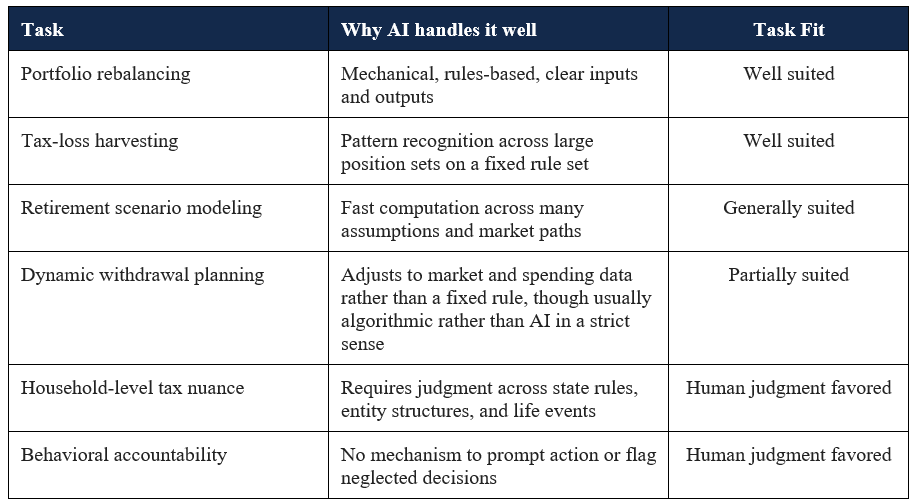 Table 1. How well AI-driven retirement tools tend to suit different tasks, based on task structure rather than a formal reliability study.
Dynamic withdrawal modeling is a useful example of the middle ground. Rather than locking in a fixed withdrawal percentage established years earlier, some platforms now adjust projected withdrawals as markets move and spending patterns shift. This is a genuine improvement over a static rule applied uniformly across very different market environments, though it still depends on the quality of the underlying assumptions and the platform's disclosure of how those assumptions are set, and, as noted above, the feature is typically algorithmic rather than AI-driven in a strict sense.
Where the Trust Gap Is Real
The more serious question is not whether these tools can compute a reasonable answer, but who is accountable when the answer is wrong, and how clearly the tool's actual capabilities are disclosed to the person relying on it.
The Securities and Exchange Commission's Division of Examinations named AI washing, the practice of overstating a system's AI capabilities, as a distinct focus area in its published 2026 examination priorities, alongside scrutiny of automated investment tools and the data sources feeding them. Existing obligations under the Investment Advisers Act, including the requirement that Marketing statements align with how a system actually functions, apply in full to AI-driven tools. The use of AI does not itself change a firm's fiduciary duty, its obligations under Regulation Best Interest, or its supervision and recordkeeping requirements. Firms have previously faced enforcement action for overstating what their AI systems do or for making performance claims the underlying system cannot support, and the 2026 exam priorities signal continued scrutiny of that same conduct.
The fiduciary picture for AI-generated advice specifically is less settled than for disclosure. In March 2026, the Department of Labor removed a 2024 fiduciary rule from federal regulation after courts vacated it, restoring what the agency describes as the long-standing five-part test used to determine investment advice fiduciary status under ERISA since 1975. The Department stated it has no current plans for new notice-and-comment rulemaking on the fiduciary definition itself, though it left open the possibility of additional guidance, including transitional or non-enforcement relief. In practical terms, this means there is no AI-specific fiduciary rule pending, and whether a given AI-generated recommendation carries fiduciary status depends on the same five-part test applied to any other investment advice, evaluated against the specific structure of the tool and the firm offering it.
There is also a structural limitation worth naming plainly. Business owners, and anyone whose financial life is entangled with compensation structure, entity choice, or succession planning, generally fall outside what a standalone AI tool can meaningfully address. The same applies to the behavioral function a human adviser serves: prompting someone to increase a contribution rate, revisit outdated beneficiary designations, or simply take action when a plan has drifted. An AI tool can model the right answer without ever prompting the person to act on it.
How to Evaluate an AI-Driven Retirement Tool
Because the regulatory framework is still developing and marketing language can outpace what a system actually does, the more durable approach is for individuals to apply their own evaluation criteria before relying on an AI-generated retirement plan.
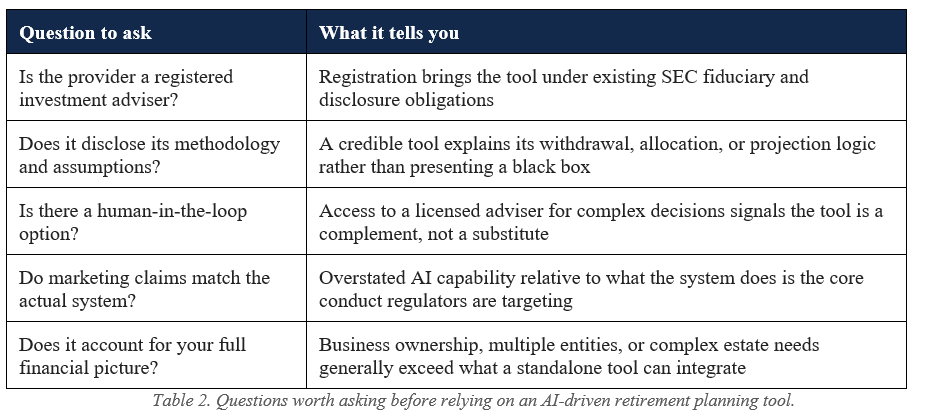
Many financial firms are converging on a hybrid structure rather than positioning AI as a full replacement for human advice. In this model, AI tools handle Portfolio Management functions such as asset allocation, rebalancing, and tax-loss harvesting, while scenario modeling tools support ongoing what-if questions between meetings, and a human adviser is reserved for higher-complexity decisions such as Roth conversion timing, Equity compensation strategy, insurance review, and estate planning updates. This structure does not resolve the underlying disclosure and fiduciary questions, but it does limit how much weight rests on the AI-generated output alone.
Bottom Line
AI-driven retirement tools have moved well past the experimental stage inside the retirement plan industry itself, with adoption among advisors and consultants accelerating sharply over the past year. For clearly mechanical tasks, rebalancing, tax-loss harvesting, and scenario computation, these tools are generally well suited to automation, though no independent study yet rates them on a formal reliability scale. For anything involving household-level judgment, complex tax exposure, or genuine accountability for follow-through, the appropriate posture remains treating AI output as an input to a decision rather than the decision itself. With the SEC naming AI washing as a specific 2026 examination focus and no AI-specific fiduciary rule in place at the federal level, the most useful question for any saver is not whether an AI tool can produce an answer, but whether the firm behind it can clearly explain how that answer was produced and who stands behind it if it is wrong.


 Sep 02, 2026





 Please wait processing your request...