
 CA
 NZ
 UK
 AU
 IND

 US

 Share
 X (Formerly Twitter)
 Whatsapp
 Facebook
 LinkedIn
 Telegram
 Email This Article
 Copy Link
 Summarize with AI
 Chat GPT
 Perplexity
Key Highlights
- SpaceX's first quarterly report as a public company beat every major revenue estimate, then fell in after-hours trading anyway.
- The reflex is not new. Tesla triggered the same reaction on the same calendar date sixteen years earlier, and CoreWeave repeated it in 2025.
- The common thread is not the chief executive or the sector. It is capital expenditure that outpaces what the market has been told to expect.
- The mechanic has now recurred inside Tesla's and CoreWeave's own later quarters, and inside Alphabet's and Oracle's, independent of SpaceX, suggesting a durable pricing behaviour rather than a debut-day quirk.
- Microsoft and Amazon show the discount is not automatic. In the same earnings week as Alphabet's sell-off, both were rewarded for linking capex to demonstrated demand instead of projected demand.
- The open question is not whether markets discount capex. It is how long that discount lasts before spending converts into measurable, demand-linked return.
A Beat That Wasn't Rewarded
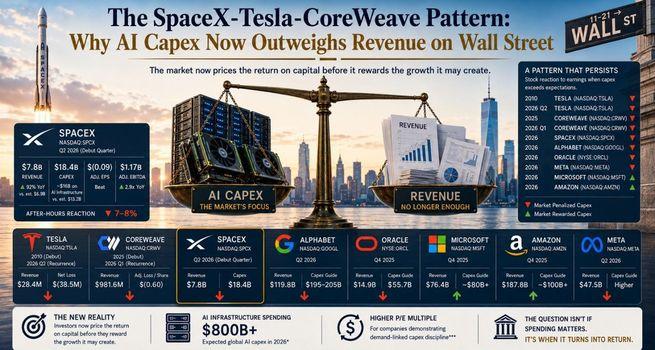
SpaceX's (NASDAQ:SPCX) first earnings report as a listed company should have been an unambiguous win. Revenue rose 92 percent year on year to 7.8 billion dollars, comfortably ahead of the roughly 6.9 billion dollars analysts had modelled. Net loss narrowed sharply, adjusted EBITDA nearly tripled, and the growth rate outpaced almost any company of comparable scale reporting this earnings season.
Shares fell 7 to 8 percent in after-hours trading anyway.
The reason was capital expenditure. SpaceX spent 18.4 billion dollars in the quarter, roughly 16 billion of it on artificial intelligence infrastructure, against consensus expectations closer to 13.2 billion dollars. The market had a strong quarter placed in front of it and chose to price the spending instead. That choice is the more interesting story, because it is not unique to SpaceX, and it is not new.
A Pattern With a Sixteen-Year Memory
Tesla (NASDAQ:TSLA) filed its own first quarterly report as a public company on August 4, 2010, sixteen years to the day before SpaceX's debut. The numbers were, by any modern standard, tiny: revenue of 28.4 million dollars, up 36 percent sequentially, against a net loss that had widened to 38.5 million dollars. Tesla was a single-product company with no clear line of sight to the Model S. Yet the market's reaction traced the same shape now visible in SpaceX's print. Shares had rallied toward 30 dollars on IPO enthusiasm, then slid back toward 20 dollars once investors weighed the scale of ongoing spending against an unproven product category.
CoreWeave (NASDAQ:CRWV) supplies the case that matters most, because it removes the one variable Tesla and SpaceX share: Elon Musk. CoreWeave's 2025 debut as a public company showed revenue up 420 percent year on year to 981.6 million dollars, a beat larger in relative terms than SpaceX's, alongside an adjusted loss of roughly 60 cents per share. The market's response centred not on that growth but on the capital intensity of the AI data centre buildout behind it. Three companies, three chief executives, three sectors, one reflex.
The Table Behind the Pattern

Set side by side, revenue growth explains none of the variance in stock reaction. Capital expenditure, relative to what the market had been told to expect, explains almost all of it.
Proof the Pattern Outlives the Debut
A single repeated reaction across three unrelated companies would be notable on its own. What makes the pattern harder to dismiss as coincidence is that it recurs inside Tesla's and CoreWeave's own later quarters, long after their respective debuts, with no connection to SpaceX at all.
Tesla's second-quarter 2026 results showed revenue of 28.24 billion dollars, ahead of estimates, while adjusted earnings per share of 0.33 dollars missed forecasts by a wide margin. Management guided full-year capital expenditure above 25 billion dollars to fund artificial intelligence, robotics, and autonomous vehicle infrastructure. The stock fell despite the beat, the same mechanic that first surfaced in Tesla's 2010 debut, now reappearing sixteen years and dozens of quarters later.
CoreWeave's more recent history is, if anything, more severe. Its fourth-quarter 2025 results triggered an 18.6 percent single-day decline despite a revenue beat, after management guided 2026 capital expenditure to a range of 30 billion to 35 billion dollars, well above prior estimates. Its first-quarter 2026 report repeated the pattern almost exactly: a revenue beat, a wider-than-expected loss, another upward revision to capex guidance, another after-hours decline.
The mechanic does not belong to any one company's debut. It belongs to how the market currently treats capital-intensive growth, full stop.
Why the Discount Has Widened, Not Narrowed
Tesla's 2010 spending was judged in isolation, against the uncertain prospects of electric vehicles as a category. SpaceX's 2026 spending is judged against something larger: a live, sector-wide debate over whether artificial intelligence infrastructure investment across the market will generate an adequate return on the capital being committed to it. The same earnings season that produced SpaceX's debut has already supplied the proof. Alphabet (NASDAQ:GOOGL) lifted its 2026 capital expenditure guidance to a range of 195 billion to 205 billion dollars on July 22, and its shares fell roughly 5 to 7 percent even though revenue of 119.8 billion dollars beat consensus and Google Cloud grew 82 percent year on year. Oracle (NYSE:ORCL), a company with none of the debut-quarter novelty or founder mystique attached to Tesla or SpaceX, fell 8.5 percent the day after its own June earnings call once management confirmed it was accelerating capex, part of a decline that had already taken the stock down more than 35 percent for the year. Neither company was reporting a first quarter. Both were punished the same way SpaceX was. That is the clearest evidence that today's capex discount is not a newly listed company's problem or a founder's problem. It is a market-wide pricing mechanism, and every company reporting AI-related capital spending is now being read against it, whether that company is reporting its first quarter or its fortieth.
Where the Pattern Has Broken, in the Same Week
The discount is not automatic, and the clearest proof sits inside the same reporting week as Alphabet's sell-off. Microsoft (NASDAQ:MSFT) and Amazon (NASDAQ:AMZN) reported days later and defended nearly identical scales of AI spending, yet their shares rose 18 percent and 10 percent respectively over that week, as investors credited both companies with tying their capex directly to visible, contracted demand rather than projected demand. Meta (NASDAQ:META), reporting in the same stretch, fell nearly 10 percent despite double-digit revenue growth, for largely the same reason Alphabet did: spending the market judged as outrunning the evidence for it.
The distinction the market drew was not the size of the capex figure. Alphabet, Microsoft and Amazon were all guiding toward capital expenditure in a similar order of magnitude. The distinction was how convincingly each company could show that spending was demand-led rather than speculative. Tesla's own history offers the same lesson from an earlier cycle: its first profitable quarter, reported in 2013, was met with a sharp rally rather than renewed scepticism, once investors reclassified prior spending from speculative to validated. Nothing about the spending itself changed in either case. What changed was whether its output could be shown, not just promised.
SpaceX has not yet reached that inflection point, and the Microsoft-Amazon precedent suggests it will take a demonstrated link between capex and contracted revenue, not simply a strong quarter, to get there. Additional near-term catalysts, including scheduled events later in the same week as its debut report, will offer the market its next opportunity to make that judgment.
The Structural Takeaway
Across Tesla, CoreWeave, SpaceX, Alphabet, Oracle, Microsoft and Amazon, the variable driving stock reaction to earnings is not revenue growth. It is the market's confidence in the return profile of forward capital expenditure, measured against a benchmark that now spans the entire AI infrastructure sector rather than any single company's own trajectory. That benchmark has grown less forgiving, not more, over sixteen years, but it is not indiscriminate either. Microsoft and Amazon's gains in the same week as Alphabet's and Meta's losses show the market is pricing the credibility of the spending, not merely its size.
Whether SpaceX's discount narrows the way Tesla's and Microsoft's eventually did will depend less on the size of its next quarter than on how convincingly its AI-related spending begins to show up as demand-linked return rather than promise.
This article is for informational purposes only and does not constitute financial or investment advice. Readers should conduct their own research or consult a licensed financial advisor before making investment decisions.


 Nov 13, 2026





 Please wait processing your request...