
 AU
AU
 UK
UK
 CA
CA
 NZ
NZ
 IND
IND

 US
US

 Share
Share
 X (Formerly Twitter)
 Whatsapp
 Facebook
 LinkedIn
 Telegram
 Email This Article
 Copy Link
 Summarize with AI
 Chat GPT
 Perplexity
Highlights
- Waymo operates 3,000+ vehicles delivering 500,000 weekly paid rides across 10 U.S. cities; Tesla operates 37-42 vehicles in Austin with most requiring safety monitors.
- Baidu's Apollo Go matched Waymo's October 2025 pace with 250,000 weekly driverless rides, expanding into Hong Kong, Dubai, Abu Dhabi and Switzerland.
- Global robotaxi market projected to grow from $789 million in 2024 to $96.9 billion by 2032 at 82.6% CAGR, driven by autonomous technologies and MaaS adoption.
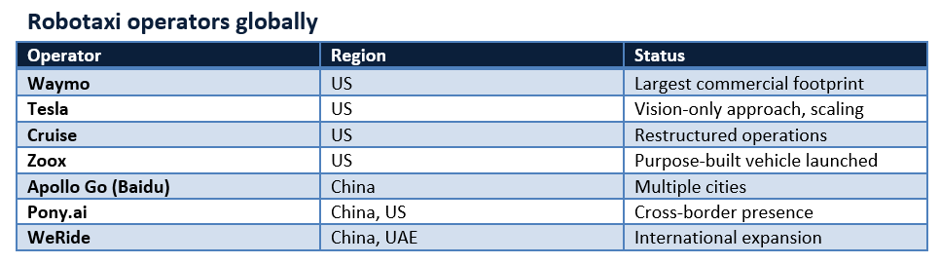
Operational Performance and Scale
Waymo completed approximately 14 million fully driverless trips in 2025, generating over $286 million in Revenue at an average fare of $20.43 per ride. On December 8, 2025, Tiger Global Management revealed Waymo had surpassed 450,000 weekly paid rides, representing an 80% increase in approximately seven months and solidifying its position as the clear leader in autonomous driving.
The operational gap between Waymo and competitors is stark. Tesla operates just 42 vehicles in Texas—more than 13 times fewer than Waymo's 577 registered in the state. Alphabet Inc.'s Waymo (Nasdaq: GOOGL) has built the world's largest commercial robotaxi fleet; Tesla (NASDAQ: TSLA) has stalled.
Tesla's Missed Targets
For 2025, Elon Musk promised 500 robotaxis in Austin and over 1,000 in the Bay Area by year-end. The actual numbers: roughly 42 in Austin and around 130 in San Francisco, almost all with safety monitors. He also promised 8-10 metro areas and said robotaxis would reach half the U.S. population. The service never expanded beyond Austin and San Francisco.
Ten months into the program, Austin's unsupervised fleet sits at approximately 19 vehicles. During Tesla's Q1 2026 Earnings Call, Musk acknowledged that robotaxi revenue would not be material this year. New targets for 2026—expansion to Dallas, Houston, Phoenix, Miami, Orlando, Tampa, and Las Vegas in the first half—remain unmet with only two months remaining.
Chinese Competition: Baidu's Apollo Go
Baidu's Apollo Go robotaxi unit fulfilled over 250,000 fully driverless orders weekly as of October 31, matching Waymo's April 2025 pace. The service operates primarily in Wuhan, Beijing, Shanghai, and Shenzhen, while expanding internationally to Hong Kong, Dubai, Abu Dhabi, and Switzerland.
Baidu benefits from cost advantages. Its sixth-generation model costs less than $30,000 USD, with the seventh generation expected to cost under $20,000. Apollo Go has completed more than 17 million rides globally, with vehicles clocking over 240 million kilometers, of which 140 million were fully driverless. The company reports no major accidents involving human injury or death.
Partnership Models and Market Integration
Rather than competing directly, Uber (NYSE: UBER) and Lyft (NASDAQ: LYFT) are integrating autonomous fleets into their platforms. Waymo vehicles can be requested through Uber's app in certain cities, suggesting a hybrid approach that blends proprietary fleets with third-party distribution networks.
This partnership model signals industry consolidation. Ride-hailing incumbents provide customer access and payment infrastructure; autonomous operators like Waymo, Baidu, Pony.ai and WeRide provide the technology and vehicle operations. The shift reflects recognition that robotaxi operators win on scale, incumbents win on customer reach.
Market Size and Growth
The global robotaxi market was valued at $789.3 million in 2024 and is projected to reach $96.9 billion by 2032, growing at a compound annual growth rate of 82.6% during the forecast period. This exponential growth is driven by the convergence of advanced autonomous driving technologies, rising urban mobility challenges, and increasing adoption of mobility-as-a-service models across major metropolitan areas.
Economics: Unit Profitability and Scale
Robotaxis eliminate driver costs, which typically represent 60-70% of traditional ride-hailing expenses. Combined with efficient routing and 24/7 operation, robotaxis become potentially cheaper than personal car ownership in urban areas.
Waymo maintains an average revenue per ride of approximately $15-17, pricing roughly 15% below Uber and Lyft in overlapping markets. The company targets reaching 1 million weekly rides by the end of 2026, translating to an annual revenue run rate approaching $1.6 billion at current pricing. Whether these economics scale to justify Waymo's $126 billion valuation depends on continued expansion, regulatory approvals in new markets, and sustained safety performance.
Regulatory Scrutiny and Urban Challenges
Waymo faces increased oversight as its scale grows. The National Highway Traffic Safety Administration and National Transportation Safety Board are investigating alleged illegal behavior around school buses in San Francisco. City officials are questioning how the company manages stalled robotaxis and use of police and fire resources to clear them.
These regulatory pressures create reputational risk at a critical moment. However, Waymo's 127 million autonomous miles driven across Phoenix, San Francisco, Los Angeles, Austin, Atlanta, Miami, Dallas, Houston, San Antonio, and Orlando—with a 90% reduction in serious injury crashes compared to human drivers—provide a strong safety foundation.

_06_11_2026_12_45_08_746277.jpg)
 Jun 11, 2026




 Please wait processing your request...