
 CA
 NZ
 UK
 AU
 IND

 US

 Share
 X (Formerly Twitter)
 Whatsapp
 Facebook
 LinkedIn
 Telegram
 Email This Article
 Copy Link
 Summarize with AI
 Chat GPT
 Perplexity

Key Highlights
• Equinix added a record 9,700 net interconnections, while Digital Realty leans on large wholesale leases to hyperscale and AI tenants.
• Both raised 2026 guidance, with Equinix lifting long-term Revenue growth to 10-13% and Digital Realty guiding Core FFO to $8.15-$8.20 per share.
• Equinix is largely self-funding growth, while Digital Realty raised $2.5 billion in share sales plus a $3.5 billion Virginia data centre deal.
For Equinix, Inc. (NASDAQ:EQIX) and Digital Realty Trust, Inc. (NYSE:DLR), data centre Demand now sets both the speed of revenue growth and the size of Capital budgets at these two S&P 500 real estate Investment trusts. Both are classified in the Data Center REITs sub-industry, and both raised their 2026 guidance after the quarter to June 30, 2026. Equinix earns most of its money from interconnection-rich colocation. Digital Realty leans more heavily on large wholesale leases to hyperscale cloud and artificial intelligence customers. The same demand wave therefore reaches their income statements by different routes.
Two Landlords, Two Business Models
A data centre REIT owns buildings that house servers, supplies power and cooling, and rents out space measured in racks or megawatts. The key difference between these two lies in who the tenants are and how they buy.
Equinix sells smaller footprints to thousands of enterprises, networks and cloud providers, and charges for the cross-connections that link them inside its buildings. Those interconnections produced $453 million of revenue in the three months to June 30, 2026, and the company added a record 9,700 net interconnections. Its xScale programme, which builds large facilities for hyperscalers through joint ventures, had 52 projects under way across 33 markets.
Digital Realty operates more than 300 facilities in over 55 metros across more than 30 countries. It reports bookings in three buckets: deals above 1 MW, deals of 0-1 MW, and interconnection. In the second quarter it signed $100 million of annualised rent in the largest category and $108 million across the two smaller ones.
What the Second Quarter Showed
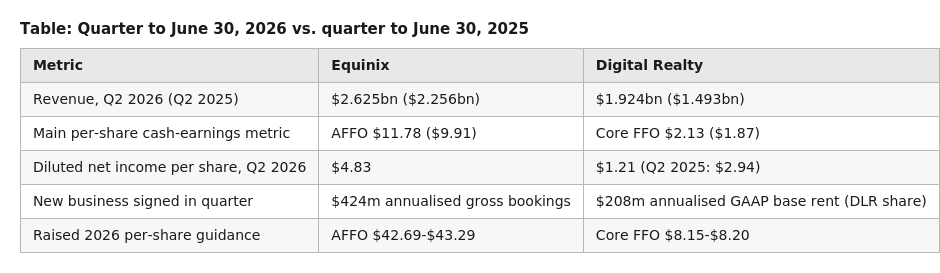
Both reported strong year-on-year growth, but the headline figures need careful reading. Equinix revenue rose 16% to $2.625 billion, and adjusted funds from operations, a REIT cash-earnings measure that adds back Depreciation and deducts recurring maintenance spending, rose 19% to $11.78 per diluted share.
Digital Realty's revenue rose 29% to $1.924 billion. The quarter also included a $188 million net promote, a performance-linked payment from a development joint venture, which the company excludes from the core funds from operations per share figure it guides on. On that basis, Core FFO was $2.13 per share against $1.87 a year earlier.
How Demand Turns Into Earnings
The link from demand to profit runs through pricing, utilisation and power. When Supply of powered space is tight, landlords can raise rents on renewal. Digital Realty reported cash renewal spreads of 25.4% in the quarter, meaning expiring leases were renewed at rents well above the previous level.
Utilisation matters because most costs in a finished building are fixed. Equinix posted an adjusted EBITDA Margin of 53% in the second quarter, and its 2026 guidance implies margin expansion of about two percentage points for the year. Each extra customer or cross-connect in an existing Facility adds revenue at little extra cost.
Signed but not yet started leases give visibility on future income. Digital Realty ended June with a record Backlog of $1.9 billion of annualised rent at 100% share, or $1.4 billion at its own share.
The Capital Bill Behind the Growth
Equinix now expects total Capital Expenditure of $5-6 billion in 2026, and in July raised its annual capex range for 2027-2029 to $5-7 billion from $3-4 billion. At the same time it lifted its long-term revenue growth outlook to 10-13% a year, from 7-10%, and its AFFO per share growth target to 9-12%, from 5-9%.
Digital Realty is funding expansion partly with new equity. It sold 13.5 million shares through its at-the-market programme in the first half of 2026, raising about $2.5 billion. It also agreed to acquire a 64% stake in three Northern Virginia data centres with 288 MW for about $3.5 billion, and bought land in Kansas City for $475 million that can support up to 2 gigawatts.
These choices show a difference in approach. Equinix is raising both spending and its growth targets from a base of enterprise and interconnection revenue. Digital Realty is adding large-scale capacity quickly, which increases its exposure to hyperscale tenants and to the timing of their build programmes.
Balance Sheets and index Standing
Digital Realty reported total Debt of $18.6 billion and net debt of 4.7 times adjusted EBITDA at the end of June. Equinix disclosed total debt principal of about $22.2 billion and cash of $979 million, without stating a leverage ratio.
Both remain S&P 500 constituents. Equinix joined the index in March 2015 and Digital Realty in May 2016.
Risks to the Demand Story
Strong demand does not guarantee strong returns. If AI spending by the largest technology groups slows, the wholesale pipeline could shrink, which would affect Digital Realty's larger deals and Equinix's xScale projects first.
Power availability and local opposition can delay new sites. Heavy capital spending also brings financing risk: higher interest rates or weaker share prices would make debt and Equity funding more expensive. Digital Realty's diluted Net Income per share also fell year on year in the second quarter, which shows that GAAP results can move differently from the non-GAAP measures both companies emphasise.
What Investors Should Watch Next
For Equinix, the indicators to track include quarterly net interconnection additions, gross bookings, and progress on the updated 2027-2029 outlook, alongside actual capex against the $5-6 billion 2026 range.
For Digital Realty, the useful markers are bookings in the 0-1 MW and interconnection categories, the conversion of its $1.9 billion backlog into revenue, renewal spreads, and further share issuance. Both companies' third-quarter results will show whether the raised 2026 guidance, including Equinix's third-quarter revenue guidance of $2.525-2.575 billion, is being met.


 Nov 02, 2026





 Please wait processing your request...