
 AU
AU
 UK
UK
 CA
CA
 NZ
NZ
 IND
IND

 US
US

 Share
Share
 X (Formerly Twitter)
 Whatsapp
 Facebook
 LinkedIn
 Telegram
 Email This Article
 Copy Link
 Summarize with AI
 Chat GPT
 Perplexity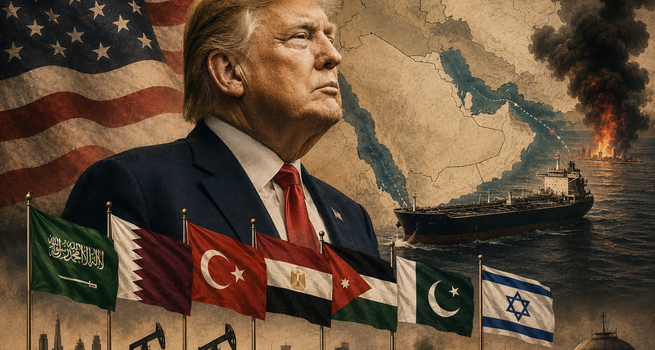
Trump's decision to attach Abraham Accords expansion to an Iran ceasefire framework is driven by domestic political logic, legacy-building, and a deterrence calculus. For markets, it converts a tractable energy Supply problem into a multi-party diplomatic variable with no credible near-term resolution path.
Key Highlights
- Trump has formally demanded Saudi Arabia, Qatar, Turkey, Egypt, Jordan, and Pakistan sign the Abraham Accords as part of an Iran war settlement, collapsing two separate diplomatic tracks into one conditioned package.
- The Accords linkage serves domestic political logic, giving a vulnerable Iran deal an Israeli normalization wrapper for Congressional credibility.
- Hormuz closure since March 2026 triggered the largest oil supply disruption in recorded market history, with Brent breaching $120 per barrel.
- Pakistan has rejected the Demand outright; Saudi Arabia's Palestinian statehood condition is structurally immovable.
- Markets pricing a clean Hormuz reopening must now assign probability weight to a deal fractured by its own diplomatic architecture.
The Statement and Its Strategic Logic
On May 25, 2026, President Donald Trump posted on Truth Social that he had spoken with leaders of Saudi Arabia, Qatar, Pakistan, Turkey, Egypt, and Jordan and was "mandatorily requesting" that all countries sign the Abraham Accords immediately. He tied the demand directly to the Iran war settlement, stating that if Iran signed an agreement with the United States, it would be an honour to have Tehran join the same coalition. Negotiations with Iran, Trump added, were "proceeding nicely."
The Abraham Accords are a set of US-brokered normalisation agreements signed in 2020 under which the UAE, Bahrain, Morocco, and Sudan formally recognised Israel, breaking a decades-long Arab consensus that recognition could only follow Palestinian statehood.
Understanding why Trump made this demand requires understanding the political problem he is trying to solve. The original Abraham Accords, brokered in his first term, are his signature foreign policy achievement. An Iran deal, especially one where the US is widely understood to be offering more than it receives relative to the 2015 JCPOA, is domestically vulnerable to criticism from Congressional hawks and pro-Israel voices.
Attaching Abraham Accords expansion gives the Iran deal a pro-Israel framing, making it politically defensible. It also allows Trump to pursue the Saudi-Israel normalization that the Biden administration had come close to securing before October 2023, and to claim it as a personal diplomatic legacy. The real prize is Riyadh. A Saudi-Israel normalization would be the most consequential Middle Eastern diplomatic event since the 1979 Egypt-Israel peace treaty.
There is also a deterrence dimension. A broad normalization coalition including Turkey and Pakistan would visibly isolate Iran diplomatically and consolidate the perception of Iranian strategic defeat not only militarily but geopolitically.
Why the Conditions Are Structurally Unworkable Now
The political logic of the Abraham Accords demand is coherent as a long-run regional vision. The timing makes it structurally implausible.
Saudi Arabia's normalisation condition is not a negotiating position. It is a domestic political constraint. The kingdom's longstanding requirement is a credible roadmap to Palestinian statehood. The ongoing Gaza conflict has made that condition harder to satisfy, not easier, and no Saudi Leadership can absorb the domestic cost of normalisation without it. Egypt and Jordan carry formal peace agreements with Israel but face severe public pressure over Gaza. Pakistan's response was unambiguous: the issues are not linked and there is no compulsion to comply. Turkey and Qatar are active intermediaries in Gaza ceasefire talks. Demanding simultaneous normalisation with Israel is structurally inconsistent with those roles.
The Market Cost of Diplomatic Overreach
The Strait of Hormuz closure since March 4, 2026 has been the dominant macro risk event of the year. The IEA characterised it as the largest supply disruption in the history of the global oil market. Gulf producers collectively lost over 10 million barrels per day by mid-March.
QatarEnergy declared Force Majeure on all LNG exports. CEPR modelling estimates a one-quarter closure scenario raises US headline Inflation by 0.6 percentage points, with stagflationary risk rising sharply if closure extends. Brent Crude has remained above $100 per barrel through May. The S&P 500 is down approximately 3% year-to-date against three consecutive prior years of returns above 16%.
A narrow, executable ceasefire resolving Hormuz access compresses energy risk premiums, stabilises freight rates, and relieves sovereign Credit spreads across Import-dependent emerging markets. That is what markets are partially pricing.
The Abraham Accords linkage converts that tractable problem into a multi-party political negotiation with no credible resolution timeline. Analysts close to the talks note the US appears to be conceding more to Iran than it is receiving, suggesting Tehran retains meaningful Leverage. A counterparty with leverage is unlikely to accept conditions designed primarily to satisfy Washington's domestic political calculus.
The scenario markets should model is not the grand bargain. It is the one where diplomatic ambition delays a deal that was otherwise closeable, keeping Brent elevated, extending inflationary pressure, and deferring the Equity market relief that a clean Hormuz reopening would otherwise deliver.

_06_12_2026_23_00_13_327450.jpg)
 Jun 12, 2026




 Please wait processing your request...