
 AU
AU
 UK
UK
 CA
CA
 NZ
NZ
 IND
IND

 US
US

 Share
Share
 X (Formerly Twitter)
 Whatsapp
 Facebook
 LinkedIn
 Telegram
 Email This Article
 Copy Link
 Summarize with AI
 Chat GPT
 Perplexity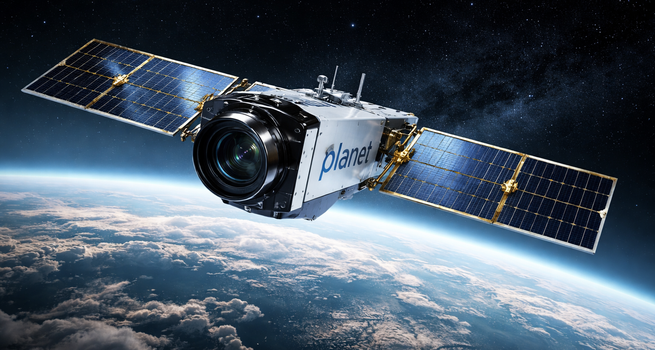
Key Highlights
- Planet Labs stock surged over 30% following strong earnings and guidance
- The company reported its first annual adjusted profit since listing
- A $900 million backlog provides strong revenue visibility
- AI partnerships with Nvidia and Google are reshaping its growth story
- Rising geopolitical demand is accelerating adoption of geospatial intelligence
Introduction: A Breakout Moment for Commercial Space Data
Planet Labs’ recent stock surge marks a pivotal shift in how investors perceive the commercial space economy. Once viewed as a speculative satellite imaging company, Planet is now emerging as a scalable data platform with improving financial discipline and clear demand tailwinds.
The company’s latest results reflect more than just strong quarterly execution. They signal a broader inflection point where geospatial intelligence, artificial intelligence, and national security priorities converge. Markets are responding accordingly, pushing the stock up sharply as investors reassess both growth durability and long term strategic value.
Commercial Space Sector Analysis: Demand Meets Strategic Relevance
The commercial satellite and geospatial intelligence market is undergoing a structural transformation. Historically dominated by government contracts and niche applications, the sector is now expanding into enterprise analytics, climate monitoring, agriculture, and defense intelligence.
Several macro forces are driving this shift.
First, geopolitical tensions have increased the need for real time earth observation. Governments and defense agencies are prioritising persistent surveillance capabilities, creating long duration contracts and stable revenue streams.
Second, climate change and resource management have elevated demand for high frequency data. Corporates and governments are increasingly relying on satellite insights for monitoring emissions, tracking supply chains, and assessing environmental risk.
Third, advances in cloud computing and artificial intelligence have unlocked the commercial potential of satellite imagery. Raw data is no longer the end product. Instead, actionable insights are becoming the primary value driver.
Planet Labs sits at the intersection of these trends, positioning itself as both a data provider and an analytics platform.
Earnings Growth and Profitability: A Turning Point in Financial Performance
Planet’s latest earnings report provides strong evidence of operational progress.
Quarterly revenue reached $86.8 million, significantly ahead of expectations and representing a 41% year on year increase. For the full fiscal year, revenue climbed to $307.7 million, marking a 26% annual growth rate.
More importantly, the company achieved its first annual adjusted EBITDA profit of $15.5 million. This milestone is critical. It signals that Planet is transitioning from a growth at any cost model to a more balanced approach that combines expansion with financial discipline.
The reported net loss of $246.9 million may appear concerning at first glance. However, a large portion of this loss was driven by non cash accounting adjustments related to warrant liabilities. Excluding this impact, the underlying loss narrows significantly, reinforcing the improving core profitability profile.
For investors, this distinction is essential. It separates operational performance from accounting noise and highlights the company’s path toward sustainable earnings.
Revenue Visibility and Backlog Strength: A Key Investment Driver
One of the most compelling aspects of Planet’s story is its growing backlog.
The company ended the year with approximately $900 million in contracted revenue, representing a 79% increase from the previous year. This backlog provides strong visibility into future revenue streams and reduces uncertainty around growth sustainability.
Notably, contracts with governments such as Sweden, Germany, and Japan account for a substantial portion of this backlog. These agreements tend to be multi year in nature, offering predictable cash flows and reinforcing Planet’s positioning within the defense and intelligence ecosystem.
In capital intensive industries like space technology, visibility matters. It allows companies to plan investments, manage costs, and scale operations with greater confidence. For investors, it reduces execution risk and supports higher valuation multiples.
Artificial Intelligence and Strategic Partnerships: Expanding the Value Chain
A major catalyst behind the recent rally is Planet’s increasing focus on artificial intelligence and strategic partnerships.
The collaboration with Nvidia represents a significant technological leap. By integrating advanced graphics processing units into its next generation Pelican satellites and Owl constellation, Planet aims to process data directly in space. This reduces latency and enables near real time insights.
This capability has far reaching implications. It enhances applications in disaster response, military intelligence, and time sensitive decision making. It also shifts Planet’s business model from data collection to insight delivery, which carries higher margins and stronger competitive differentiation.
Equally important is the partnership with Google on Project Suncatcher. This initiative explores the feasibility of space based data centres powered by solar energy. While still in early stages, it reflects a broader trend toward decentralised computing infrastructure and highlights Planet’s ambition to move beyond traditional satellite imaging.
Together, these partnerships position the company within a broader ecosystem that includes AI, cloud computing, and advanced analytics. This significantly expands its total addressable market.
Defense Spending and Geopolitical Tailwinds: A Structural Growth Driver
Geopolitical dynamics are playing a crucial role in Planet’s growth trajectory.
In an environment marked by rising tensions and fragmented global alliances, governments are increasing spending on intelligence, surveillance, and reconnaissance capabilities. Satellite imagery provides a cost effective and scalable solution compared to traditional methods.
Planet’s ability to deliver daily, high frequency imaging of the entire Earth gives it a unique advantage. Unlike competitors that focus on high resolution but lower frequency data, Planet emphasises continuous monitoring. This is particularly valuable for tracking troop movements, infrastructure changes, and environmental developments.
As defense budgets expand globally, companies with proven capabilities and existing government relationships stand to benefit disproportionately. Planet appears well positioned to capture this demand.
Stock Market Outlook: Valuation Expansion Reflects Strategic Repositioning
The sharp rise in Planet’s stock reflects more than short term earnings momentum. It indicates a broader re rating of the company’s business model.
The market is increasingly valuing Planet as a data and analytics platform rather than a hardware intensive satellite operator. This shift has significant implications for valuation multiples.
Data driven companies typically command higher valuations due to their scalability, recurring revenue models, and higher margins. As Planet continues to integrate AI and expand its analytics capabilities, investors may assign it a premium relative to traditional aerospace peers.
However, this re rating also introduces new expectations. Investors will closely monitor execution, particularly in terms of margin expansion, contract growth, and successful deployment of new satellite technologies.
Earnings Outlook and Growth Guidance: Sustained Momentum Ahead
Looking forward, Planet has provided an optimistic outlook.
The company expects quarterly revenue between $87 million and $91 million in the upcoming period, alongside a modest adjusted loss. For the full year, revenue is projected to reach between $415 million and $440 million, with adjusted profit of up to $10 million.
These projections imply continued strong growth, supported by backlog conversion and new contract wins. They also suggest that profitability will remain a focus, even as the company invests in technology and expansion.
The combination of growth and improving margins is particularly attractive in the current market environment, where investors are increasingly prioritising earnings quality over pure top line expansion.
Strategic Outlook: Scaling a Data Platform in the Space Economy
Planet Labs is entering a critical phase of its evolution.
The company’s long term success will depend on its ability to execute across several dimensions.
First, scaling its AI capabilities to deliver differentiated insights rather than commoditised imagery.
Second, expanding its government and enterprise customer base while maintaining high retention rates.
Third, managing capital expenditure associated with satellite deployment without compromising profitability.
Fourth, navigating competitive pressures from both traditional aerospace companies and emerging space startups.
If executed effectively, Planet could establish itself as a foundational layer in the global data infrastructure, similar to how cloud providers transformed enterprise computing.
Conclusion: From Satellite Operator to Data Intelligence Platform
Planet Labs’ stock surge reflects a fundamental shift in its narrative.
The company is no longer seen merely as a satellite imaging provider. It is evolving into a data driven intelligence platform supported by strong backlog visibility, improving financial performance, and strategic partnerships in AI and cloud computing.
For investors, the key question is no longer whether Planet can grow, but whether it can sustain this growth while expanding margins and delivering differentiated value.
The answer will determine whether the current rally represents the beginning of a long term re rating or a short term reaction to strong earnings.
FAQ Section
- Why did Planet Labs stock rise sharply?
The stock surged due to strong earnings, record revenue, and the company’s first annual adjusted profit. Additionally, a large backlog and AI driven partnerships improved investor confidence in future growth prospects. - How important is the $900 million backlog?
The backlog provides high revenue visibility and reduces uncertainty. It reflects long term contracts, especially with governments, ensuring stable cash flows and supporting sustained growth in the coming years. - What role does artificial intelligence play in Planet’s strategy?
AI enables faster data processing and real time insights. By integrating AI into satellites, Planet is shifting from selling imagery to delivering actionable intelligence, which can significantly enhance margins and competitive positioning. - Is Planet Labs profitable now?
The company reported its first annual adjusted EBITDA profit. While it still posted a net loss due to accounting adjustments, underlying operations show improving profitability and a clear path toward sustainable earnings. - What are the key risks for investors?
Key risks include execution challenges in scaling AI capabilities, high capital expenditure for satellite deployment, and competition from both established aerospace firms and emerging space technology companies.

_06_12_2026_23_00_13_327450.jpg)
 Jun 12, 2026




 Please wait processing your request...