
 CA
 NZ
 UK
 AU
 IND

 US

 Share
 X (Formerly Twitter)
 Whatsapp
 Facebook
 LinkedIn
 Telegram
 Email This Article
 Copy Link
 Summarize with AI
 Chat GPT
 Perplexity
Key Highlights
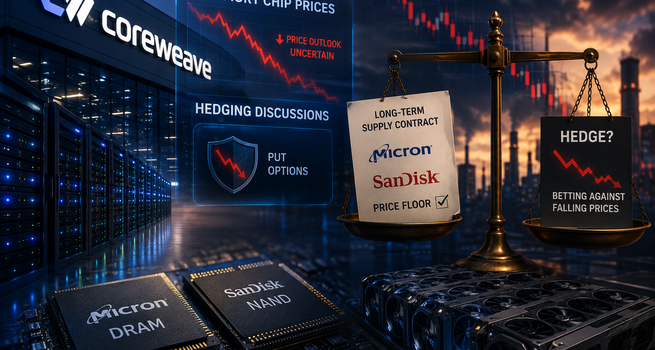
- CoreWeave (NASDAQ: CRWV) has reportedly held early, internal discussions about using derivatives, such as put options on memory-chip stocks, to hedge against a future drop in memory prices.
- The company has separately signed long-term supply contracts with Micron and SanDisk that include price floors, guaranteeing suppliers a minimum price even if the market falls.
- These two facts sit in genuine tension: CoreWeave is contractually locked into paying elevated prices while simultaneously trying to protect itself against those same prices falling.
- Because there is no liquid futures market for memory chips, any hedge would have to work indirectly, through options on the stocks of memory makers, a much blunter and less precise instrument.
- The story is a live signal that even the buyers closest to the AI infrastructure boom are no longer certain today's elevated memory prices will hold.
A Renter of Computers Starts Worrying About the Price of Sand
Think of CoreWeave (NASDAQ: CRWV) as a landlord of computing power. It doesn't design chips or build factories; it buys enormous quantities of processors and memory, bolts them into racks, and rents out the resulting capacity to companies training artificial intelligence models. Its business, in other words, sits downstream of the chip industry, not inside it. Which is what makes a small, quietly-reported detail from mid-July so interesting: executives at CoreWeave have reportedly begun discussing whether to use financial derivatives to protect the company against memory chip prices falling. A landlord, in effect, has started wondering whether the price of bricks is about to drop — and whether it should place a side bet that it will.
To understand why this matters, it helps to separate two things CoreWeave has been doing that, at first glance, look contradictory.
The Contradiction: Locking In High Prices, Then Betting They'll Fall
First, CoreWeave has spent the past year signing long-term supply agreements with memory chipmakers, notably Micron and SanDisk, to secure the DRAM and storage chips its AI servers need. Memory has been in famously short supply as the AI boom has soaked up capacity, so locking in guaranteed supply makes obvious sense for a company whose entire business depends on having enough chips to rent out.
The catch is in the fine print. Many of these contracts reportedly include price floors — a guaranteed minimum price the supplier will receive, no matter what happens to the broader market. That is a sensible thing for Micron and SanDisk to demand: building chip factories is a multi-year, multi-billion-dollar commitment, and no supplier wants to build capacity for a customer who might walk away the moment prices soften. For CoreWeave, though, a price floor is a one-way street. If memory prices rise, CoreWeave still just pays the contracted amount. If memory prices fall, CoreWeave is stuck paying above the going market rate anyway, because it agreed to a floor, not a moving target.
That is the second half of the puzzle: reports say CoreWeave has begun internally exploring the use of derivatives, including put options, to hedge against exactly this scenario — memory prices falling while it remains contractually committed to paying as if they hadn't. A put option is, in essence, an insurance policy that pays out when the price of something drops. Buying puts tied to memory prices would let CoreWeave collect a payout precisely when its fixed-price contracts start looking expensive relative to the market, offsetting some of that pain.
Why a Company Would Hedge Against Its Own Supply Deal
It is worth being clear-eyed about why this isn't as strange as it first sounds. Signing a price-floor contract and buying a hedge against falling prices are not contradictory positions — they are two separate tools solving two separate problems. The supply contract guarantees CoreWeave has enough chips to run its business, regardless of shortages. The hedge, if it goes ahead, would guarantee that if the wider memory market gets cheaper, CoreWeave doesn't take the full financial hit of having pre-committed to yesterday's higher prices.
Put simply: the contract buys certainty of supply. The hedge, if used, would buy protection on price. A sensible business, especially one operating on wafer-thin margins in a capital-intensive industry, tries to solve for both.
The Awkward Part: There's No Clean Way to Do This
Here is where the story gets genuinely tricky, and rather revealing. Unlike oil, wheat, or gold, there is no deep, liquid futures market where you can simply buy a contract betting on the future price of DRAM chips. Memory pricing is set through direct negotiations between buyers and sellers, not through a public exchange with standardized contracts changing hands every second.
That means CoreWeave cannot hedge memory prices directly. Instead, any hedge under discussion would likely be a proxy: buying put options on the shares of memory-chip companies, such as Micron or SanDisk, on the theory that if memory prices fall, those companies' stock prices are also likely to fall, and the options would pay out. It is an imperfect substitute, similar to being unable to insure your specific house against fire and instead buying a policy tied to the average price of houses on your street. It works roughly, but not exactly, and the gap between the two can leave real money on the table in either direction.
What This Really Tells Us About the AI Memory Boom
The most useful way to read this story isn't as a prediction that memory prices are about to crash. Reports describe these discussions as preliminary, with no hedges actually put in place as of mid-July 2026, and CoreWeave has not publicly confirmed any of it. Companies explore all sorts of protective measures that never get executed.
What the story does reveal is something subtler and arguably more important: the buyer with arguably the best, closest view of AI infrastructure demand is no longer treating today's elevated memory prices as a permanent feature of the landscape. That is a meaningful data point, because CoreWeave sits exactly where supply meets demand in the AI compute chain. If it is quietly building a safety net against falling prices, it suggests its own internal models see real probability that new manufacturing capacity, reportedly ramping up significantly from suppliers including SK Hynix and Micron, could soften prices sooner than the market's current, bullish narrative assumes.
None of this proves the memory supercycle is ending. Hedges, like insurance, get bought against risks that are merely possible, not risks that are certain. But when the customer signing the biggest, longest supply contracts is simultaneously shopping for protection against those same contracts becoming a bad deal, it is a useful reminder that even inside an apparent boom, the smartest people in the room are quietly preparing for the boom to turn.


 Nov 13, 2026





 Please wait processing your request...