
 AU
AU
 UK
UK
 CA
CA
 NZ
NZ
 IND
IND

 US
US

 Share
Share
 X (Formerly Twitter)
 Whatsapp
 Facebook
 LinkedIn
 Telegram
 Email This Article
 Copy Link
 Summarize with AI
 Chat GPT
 Perplexity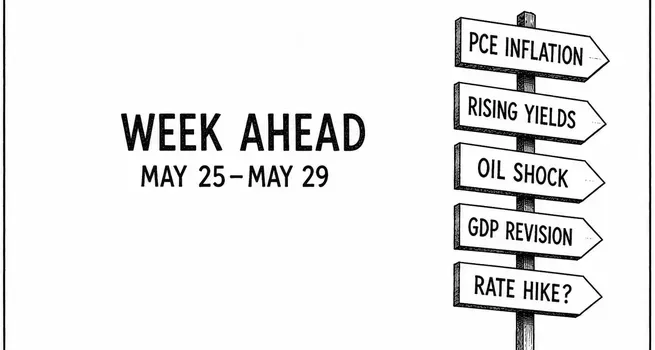
A shortened U.S. trading week delivers its heaviest macro test yet as April PCE Inflation, Q1 GDP revision, and late-cycle Earnings from Salesforce, Dell, Costco, and Best Buy converge against a backdrop of rising Treasury yields and persistent Iran-driven energy price pressure.
As the thirteenth week of the US-Israeli conflict with Iran opens with U.S. markets closed for Memorial Day, the week that follows may be the most consequential macro test the 2026 rally has yet faced. Strength in first-quarter earnings has allowed investors to look past rising yields, surging oil prices, and the ongoing Iran conflict, but with more than 90% of S&P 500 companies having reported, that buffer is now largely spent. The benchmark 10-year Yield/">Treasury Yield hit its highest level since January 2025 this week, while the 30-year touched its highest since 2007.
April's PCE inflation reading on Friday, the Federal Reserve's preferred price gauge, arrives against a backdrop where futures markets have begun pricing the potential for a rate hike later in 2026, a scenario that would have been unthinkable at the start of the year.
Late-cycle earnings from Salesforce, Dell Technologies, Costco, and Best Buy will test whether AI infrastructure spending and consumer resilience can continue to provide an offset as the macro environment takes centre stage.
Monday, May 25
Market Holiday
U.S. financial markets are closed for Memorial Day. No data releases or Fed speakers are scheduled.
Tuesday, May 26
Economic Data
Two housing and sentiment releases open the data week. The S&P Case-Shiller home price index for March, prior at 0.9%, provides a lagged but structurally important read on residential real estate valuations under sustained affordability pressure from elevated Mortgage rates. Consumer confidence for May, prior at 92.8, offers a more immediate sentiment read. The prior reading already reflected a household sector navigating elevated energy costs and inflation anxiety, and a further deterioration would reinforce the cautious spending signals visible across last week's retail earnings.
Wednesday, May 27
Earnings
Wednesday carries the week's most consequential earnings events. Salesforce (NYSE:CRM) reports in the afternoon as the primary AI software read of the week. Its enterprise cloud Demand commentary and guidance will be watched for confirmation that AI-driven software spending is translating into contracted Revenue growth rather than pipeline optimism. The results sit in direct dialogue with Nvidia's strong second-quarter revenue forecast from last week, and any softening in Salesforce's enterprise demand tone would raise questions about the breadth of AI monetisation beyond infrastructure hardware.
Also reporting Wednesday are PDD Holdings (Nasdaq:PDD), Synopsys (NASDAQ:SNPS), and Agilent Technologies (NYSE:A). PDD provides a read on Chinese consumer demand and cross-border E-commerce activity; Synopsys on electronic design automation software demand, a leading indicator for semiconductor complexity and Investment; and Agilent on life sciences and diagnostics Capital spending, a sector sensitive to both institutional budget cycles and broader research investment trends.
Thursday, May 28
Earnings
Dell Technologies (NYSE:DELL) reports in the afternoon, carrying the week's most direct AI infrastructure hardware read after Nvidia. Dell's server and storage demand, particularly its AI-optimised infrastructure segment, will indicate whether enterprise customers are converting AI capex commitments into actual hardware orders. Its commentary on data centre build-out timelines will be read alongside Nvidia's second-quarter revenue forecast as a cross-check on the durability of the current AI investment cycle.
Autodesk (NASDAQ:ADSK) also reports Thursday, offering a read on software spending in construction and Manufacturing, two sectors exposed to both Interest Rate sensitivity and energy cost dynamics.
Economic Data
Thursday's data calendar is the week's most active. Durable goods orders for April, prior at 0.8%, and durable goods minus transportation, prior at 0.9%, provide a read on Business investment momentum. The second estimate of Q1 GDP, released at 8:30 am ET, prior at 2.0%, will be watched closely. A downward revision would introduce a stagflationary read into a session already carrying multiple data releases, compressing the Fed's room to manoeuvre from both directions at once. New home sales for April, prior at 682,000, round out the housing picture alongside Tuesday's Case-Shiller data. Initial jobless claims for the week ending May 23 provide the most current labour market read of the week.
Friday, May 29
Economic Data
Friday is the week's defining data day and one of the most consequential macro sessions of the month. April's personal consumption expenditures price index arrives at 8:30 am ET alongside Personal Income and personal spending. The PCE index prior stands at 0.7% MoM and 3.5% YoY; core PCE prior at 0.3% MoM and 3.2% YoY. The release follows hot CPI and PPI readings earlier this month and arrives as futures markets have begun pricing the potential for a Fed rate hike by year-end. Any reading that meets or exceeds the prior will materially reinforce the rate hike scenario and put further upward pressure on Treasury yields that are already at multi-year highs.
Personal income, prior at 0.6%, and personal spending, prior at 0.9%, provide the demand-side context for the PCE reading, with the spending figure particularly relevant for assessing whether the consumer is beginning to retrench under energy cost pressure. The Chicago Business Barometer PMI for May, prior at 49.2, closes the week with a regional activity composite that has been signalling contraction.
Geopolitical Backdrop
The US-Israeli conflict with Iran enters its thirteenth week with the Strait of Hormuz still largely closed and oil prices near four-year highs. Whether there is any progress in talks between the U.S. and Iran on ending the conflict and freeing up oil Supply will remain a dominant market variable across the week. Peace talk headlines have alternated between conciliatory and escalatory signals without producing a durable de-escalation in the underlying energy risk premium. The inflationary transmission from elevated oil prices is now fully visible in the data sequence: CPI and PPI both came in hot earlier this month, and Friday's PCE reading is expected to confirm that months of elevated oil prices and supply disruptions are feeding through into the broader inflation complex.
The Bond Market has become the most direct channel through which the conflict's macro consequences are being felt. The 10-year Treasury yield at its highest since January 2025 and the 30-year at its highest since 2007 represent a structural tightening of financial conditions that the Federal Reserve has not yet had to formally acknowledge. If PCE confirms the inflation re-acceleration narrative on Friday, the rate hike scenario that futures markets are beginning to price will move from Tail risk to base case discussion, placing the conflict's economic consequences at the centre of the summer policy debate.
Beyond the U.S., the Reserve Bank of New Zealand and Bank of Korea both set interest rates this week, with their decisions offering a read on how other central banks are navigating the inflation consequences of the Middle East conflict. China's official PMI surveys will be watched for signs of resilience in the world's second-largest economy, while inflation data from Tokyo and Singapore will provide fresh clues on price pressures across Asia as the region grapples with sustained energy cost exposure.
The Week in Context
By Friday's close, the 2026 rally will have faced its most direct valuation stress test yet. The question is no longer whether earnings can provide a buffer against rising yields and inflation; with the reporting season effectively complete, that question has been answered. The question now is whether the macro environment, elevated PCE inflation, rising long-term yields, and a Fed increasingly open to rate hikes, can be absorbed by an Equity market sitting less than 1% below its all-time high. Friday's simultaneous release of PCE inflation, GDP revision, personal income, and personal spending will either validate the market's current pricing or force a material reassessment before June begins.

_06_12_2026_23_00_13_327450.jpg)
 Jun 12, 2026




 Please wait processing your request...