
 CA
 NZ
 UK
 AU
 IND

 US

 Share
 X (Formerly Twitter)
 Whatsapp
 Facebook
 LinkedIn
 Telegram
 Email This Article
 Copy Link
 Summarize with AI
 Chat GPT
 Perplexity
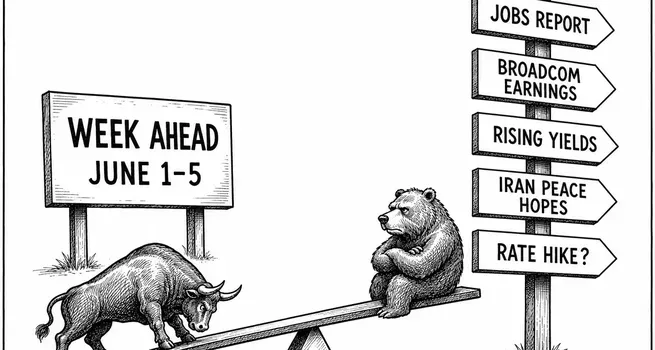
U.S. markets face a defining week as the May nonfarm payrolls report, Broadcom Earnings, ISM PMIs, and the Fed Beige Book converge against a backdrop of Iran peace progress, simmering Inflation, and rising rate hike expectations.
Three months into the US-Israeli conflict with Iran, markets enter June with an unusual mix of optimism and caution. Reports of progress toward a deal that includes restoring trade through the Strait of Hormuz have buoyed risk sentiment, helping the S&P 500 climb more than 10% for the year and the Philadelphia SE Semiconductor index surge approximately 80% from its March low.
Yet the same conflict has driven PCE inflation to 3.8% year-on-year in April, its highest reading since May 2023, and futures markets are now pricing a greater chance of a Fed rate hike this year than a cut. The May jobs report on Friday will be the week's defining data point, arriving just two weeks before Kevin Warsh's first Federal Reserve meeting as chair on June 16-17. Broadcom's results on Wednesday carry the week's most consequential earnings read for the AI trade. The confluence of labour data, leading indicators, Fed communication, and semiconductor earnings makes this one of the most information-dense weeks of the summer.
Monday, June 1
Economic Data
The week opens with two reads on the real economy. ISM Manufacturing PMI for May, prior at 52.7%, will indicate whether the factory sector is sustaining expansion momentum despite energy cost headwinds from the Iran conflict. Construction spending for April, prior at 0.6%, provides a complementary read on Capital deployment in the built environment. Auto sales for May, prior at 15.9 million units, round out Monday's releases, with the figure offering a direct consumer Credit and spending signal at a moment when household budgets remain compressed by elevated fuel costs.
Federal Reserve
Minneapolis Fed President Neel Kashkari speaks in South Korea. Kashkari was among the four dissenters at the May FOMC meeting, opposing the easing bias in the statement. His remarks will be watched for any evolution in his rate posture following the hot April PCE reading released Thursday.
Tuesday, June 2
Earnings
Palo Alto Networks (Nasdaq:PANW) reports in the afternoon, offering the week's first AI and Cybersecurity read. Its results will be watched for evidence that enterprise security spending is holding firm under compressed IT budgets, and for any commentary on AI-driven threat detection Demand translating into Revenue growth.
Economic Data
JOLTS Job openings for April, prior at 6.9 million and consensus at 6.8 million, provide the week's first labour market signal ahead of Friday's payrolls print. A meaningful decline would suggest demand-side labour softening before the Supply-side employment count arrives. The JOLTS openings-to-unemployed ratio will receive particular attention as a gauge of labour market tightness heading into the Fed's June 16-17 meeting.
Federal Reserve
Cleveland Fed President Beth Hammack speaks at 8:55 am ET. Hammack was also among the May FOMC dissenters, opposing the easing bias. Her remarks will be interpreted in the context of Thursday's PCE reading and the week's unfolding labour data.
Wednesday, June 3
Earnings
Broadcom (NASDAQ:AVGO) reports in the afternoon as the week's most consequential earnings event and a primary test for the AI semiconductor trade. Shares have climbed approximately 45% since the March low, and the sixth-largest U.S. company by Market Capitalisation enters the session with elevated expectations. Investors will focus on its AI chip revenue trajectory, custom silicon demand from hyperscalers, and whether its networking infrastructure commentary confirms the Capital Expenditure commitments visible across the AI supply chain. Any softening in guidance would carry consequences well beyond Broadcom, affecting the broader semiconductor sector that has surged approximately 80% from its March low.
CrowdStrike Holdings (NASDAQ:CRWD) also reports Wednesday afternoon, adding a cybersecurity and cloud endpoint protection read alongside Palo Alto's results from Tuesday.
Economic Data
Two leading indicators land Wednesday. ADP private employment for May, prior at 109,000, provides an early directional signal ahead of Friday's official payrolls print. ISM Services PMI for May, prior at 53.6%, is the more consequential of the two — services represent the dominant engine of the U.S. economy, and the prices-paid sub-index will be scrutinised for any re-acceleration signal tied to energy cost pass-through. Factory orders for April, prior at 1.5%, provide a read on manufacturing demand momentum.
Federal Reserve
Federal Reserve Governor Michael Barr speaks at 9:00 am ET. The Fed Beige Book is released at 2:00 pm ET, providing a qualitative assessment of economic conditions across all twelve Federal Reserve districts in the run-up to the June 16-17 meeting. The Beige Book will be read for any district-level evidence of inflation re-acceleration or labour market softening.
Thursday, June 4
Earnings
Ciena (NYSE:CIEN) reports before the open, offering a read on optical networking and data centre interconnect demand, a segment that has seen accelerating Investment as AI workloads drive bandwidth requirements across hyperscaler infrastructure.
Economic Data
Initial jobless claims for the week ending May 30 provide the most current labour market read ahead of Friday's payrolls. Q1 productivity, prior at 0.8%, arrives alongside unit labour costs, with the latter watched for any wage inflation signal that would complicate the Fed's calculus heading into its June meeting.
Federal Reserve
Richmond Fed President Tom Barkin speaks at 8:30 am ET. With the jobs report arriving the following morning, his remarks will be among the final Fed communications before the data resets the policy conversation for the summer.
Friday, June 5
Economic Data
The May nonfarm payrolls report is the week's defining release and one of the most consequential labour market prints of 2026. Consensus clusters around 96,000 jobs added, a material deceleration from April's 115,000, with the Unemployment rate expected to hold at 4.3% for a fourth consecutive month. Hourly earnings are forecast to accelerate to 0.3% month-on-month from 0.2%, reintroducing a wage inflation signal at precisely the moment the Fed least needs it, with YoY wages expected at 3.5% against a prior of 3.6%.
The composition of the report matters as much as the headline. An increase of more than 150,000 jobs risks being read as evidence of an overheating economy that would accelerate the rate hike timeline, putting further upward pressure on Treasury yields that remain at multi-year highs. A miss below 96,000, conversely, would temper rate hike fears but raise Recession risk concerns, given that PCE inflation is simultaneously running at 3.8% YoY. Consumer credit for April, prior at $24.8 billion, closes the week with a read on household borrowing behaviour under sustained inflation pressure.
Geopolitical Backdrop
The US-Israeli conflict with Iran enters its fourteenth week with a meaningful shift in the diplomatic backdrop. Reports of progress toward a deal that includes restoring trade through the Strait of Hormuz represent the most substantive positive development in the conflict's market transmission since hostilities began. Asset prices remain directly susceptible to progress or deterioration in these talks. A credible deal framework would likely trigger a swift repricing of oil, headline inflation expectations, and Fed rate hike probability in a single session.
The conflict's consequences for Monetary Policy have now fully crystallised. PCE inflation at 3.8% YoY in April is the highest reading since May 2023 and arrived entirely on the back of energy cost pass-through. Fed officials are actively mulling rate hikes to curb growing inflation risk, a posture that would have been considered extreme at the start of the year. The June 16-17 meeting, Kevin Warsh's first as chair, will be the most consequential FOMC meeting since the tightening cycle of 2022. The data sequence this week, particularly Friday's payrolls, will materially shape the Options on the table when the committee convenes.
The Week in Context
By Friday's close, two questions will have been answered. First, whether Broadcom's results confirm that the AI semiconductor cycle is sustaining the capital expenditure momentum that has powered an 80% surge in the Philadelphia SE Semiconductor Index from its March low. Second, whether the May jobs report tips the Fed's June calculus decisively toward a rate hike or preserves the optionality of an extended pause. A hot payrolls print alongside continued Broadcom strength would reinforce the market's current positioning, AI spending intact, economy running warm, yields elevated but contained. A payrolls miss alongside any softening in Broadcom's guidance would introduce a more complex picture, one where the AI infrastructure narrative and the macro headwind narrative are no longer running on parallel tracks.


 Nov 24, 2026




 Please wait processing your request...