
 CA
 NZ
 UK
 AU
 IND

 US

 Share
 X (Formerly Twitter)
 Whatsapp
 Facebook
 LinkedIn
 Telegram
 Email This Article
 Copy Link
 Summarize with AI
 Chat GPT
 Perplexity

Key Highlights
- Communication Services Leads: XLC gained 3.56%, making it the strongest-performing sector.
- Technology Also Surges: XLK advanced 2.77%, supported by strong semiconductor and AI-related stocks.
- Consumer Discretionary Advances: XLY increased 1.08% as broader risk appetite improved.
- Health Care and Real Estate Edge Higher: XLV gained 0.37%, while XLRE advanced 0.14%.
- Industrials and Financials Remain Positive: XLI rose 0.14%, while XLF gained 0.07%.
- Materials Declines: XLB fell 0.56% despite the broader market rally.
- Defensive Sectors Weaken: XLP declined 1.06%, while XLU fell 1.07%.
- Energy Records Largest Decline: XLE dropped 2.88% as Crude Oil prices weakened.
- Positive Sector Breadth: Seven of the 11 sectors advanced, while four declined.
- Wide Performance Gap: The 6.44-percentage-point difference between XLC and XLE highlighted strong sector rotation.
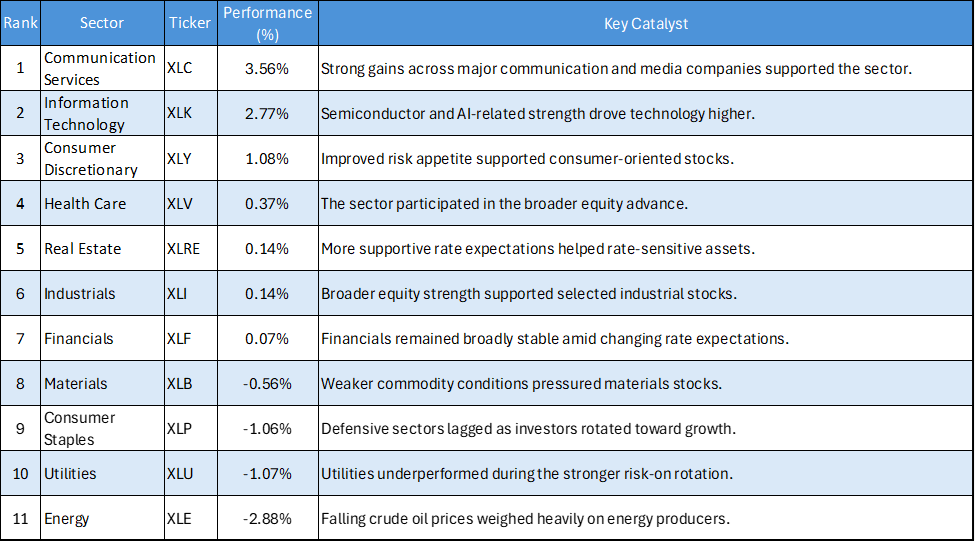
The US sector performance data for 21 September 2026 showed a substantially stronger market than the previous session's narrow Leadership pattern. Communication Services led with a 3.56% gain, followed closely by Technology at 2.77%. Consumer Discretionary also advanced by more than 1%, while several other sectors posted modest gains.
At the opposite end, Energy declined 2.88%, followed by Utilities and Consumer Staples. The session reflected a pronounced rotation toward growth and communication-related companies, while energy and selected defensive sectors remained under pressure.
Performance Breakdown by Sector
Communication Services Leads While Technology Also Surges
Communication Services (XLC) was the strongest-performing sector on 21 September, gaining 3.56%.
The sector's advance represented a significant improvement from the previous session, when Communication Services had been among the weakest-performing sectors. The sharp Reversal highlighted the strength of sector rotation during the latest session.
Information Technology (XLK) also recorded a powerful 2.77% gain. Semiconductor and artificial-intelligence-related stocks remained important sources of momentum, supporting continued Demand for technology companies.
The simultaneous strength of Communication Services and Technology produced a clear growth-oriented leadership pattern. Together, the two sectors accounted for the strongest gains among the 11 major sector ETFs.
Consumer Discretionary Advances While Other Sectors Show Modest Gains
Consumer Discretionary (XLY) gained 1.08%, placing it third among the 11 sectors.
The advance reflected stronger investor participation in economically sensitive and growth-oriented companies. The sector's gain was also notable because it exceeded the performance of most traditional cyclical sectors.
Health Care (XLV) increased 0.37%, while Real Estate (XLRE) and Industrials (XLI) each gained 0.14%. Financials (XLF) added 0.07%, leaving the sector broadly stable.
The relatively modest gains in these sectors indicate that the session's strength was concentrated rather than evenly distributed. Communication Services and Technology accounted for the bulk of the upside momentum.
Materials, Consumer Staples, Utilities and Energy Under Pressure
Materials (XLB) declined 0.56%, making it the first sector below the flat line. Consumer Staples (XLP) and Utilities (XLU) fell 1.06% and 1.07%, respectively.
The weakness in defensive sectors contrasted with the strong performance of growth-oriented areas. As investors increased exposure to Communication Services and Technology, traditional defensive sectors underperformed.
Energy (XLE) recorded the largest decline, falling 2.88%. The sector's performance represented a sharp reversal from the stronger performance that energy can experience when crude oil prices rise.
The contrast between XLC's 3.56% gain and XLE's 2.88% decline created a 6.44-percentage-point gap between the strongest and weakest sectors. This was the widest performance differential in the 11-sector group and highlighted the intensity of the day's rotation.
Strategic Summary
The US sector performance picture on 21 September 2026 was characterised by strong Communication Services and Technology leadership, improving Market Breadth and significant weakness in Energy.
Communication Services led with a 3.56% gain, followed by Technology at 2.77% and Consumer Discretionary at 1.08%. Seven of the 11 sectors advanced, indicating considerably broader participation than the previous session.
At the other end of the ranking, Energy declined 2.88%, followed by Utilities at 1.07% and Consumer Staples at 1.06%. The session therefore showed a pronounced rotation toward growth-sensitive sectors, particularly Communication Services and Technology, while Energy and selected defensive sectors remained under pressure.
The key issue for subsequent sessions is whether Communication Services and Technology can maintain their leadership and whether Energy, Utilities and other lagging sectors can stabilise after their latest declines.

 Nov 02, 2026


 Please wait processing your request...