
 CA
 NZ
 UK
 AU
 IND

 US

 Share
 X (Formerly Twitter)
 Whatsapp
 Facebook
 LinkedIn
 Telegram
 Email This Article
 Copy Link
 Summarize with AI
 Chat GPT
 Perplexity

Key Highlights
- Communication Services Leads: XLC gained 0.60%, making it the strongest-performing sector.
- Consumer Staples Remains Resilient: XLP edged 0.05% higher, making it the only other sector to finish positive.
- Financials Outperform Most Cyclical Sectors: XLF declined 0.33%, limiting losses relative to the broader market.
- Consumer Discretionary Falls Moderately: XLY declined 0.44%, remaining among the more resilient declining sectors.
- Health Care and Energy Weaken: XLV fell 0.55%, while XLE declined 0.58%.
- Industrials and Real Estate Under Pressure: XLI dropped 0.72%, while XLRE declined 0.83%.
- Utilities Continue to Weaken: XLU fell 0.98%.
- Materials and Technology Lag: XLB declined 1.23%, while XLK recorded the largest loss at 1.41%.
- Very Weak Market Breadth: Only two of the 11 sectors advanced, while nine sectors declined.
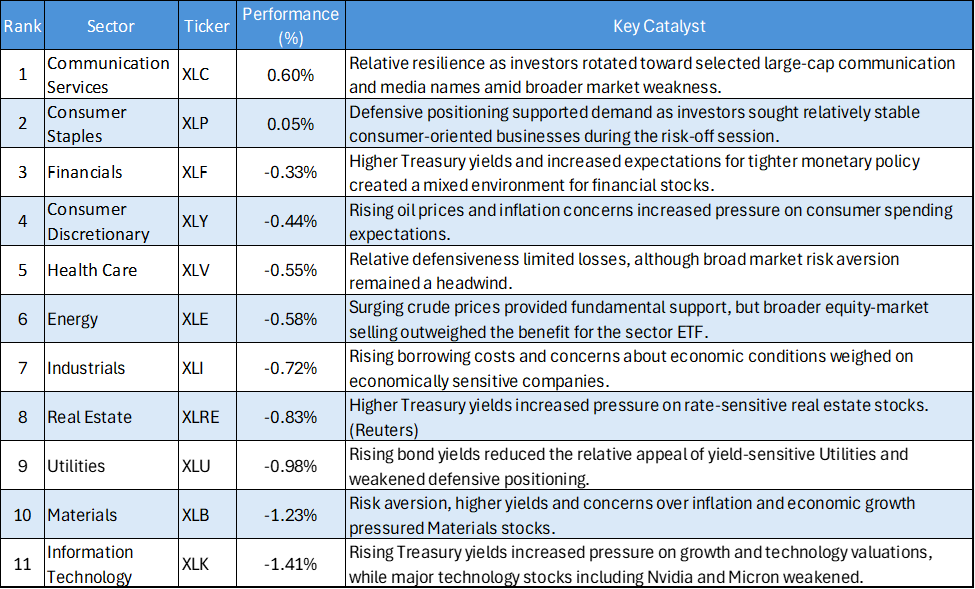
The US sector performance data for 10 September 2026 showed a broad deterioration in market breadth, with only Communication Services and Consumer Staples recording gains. Communication Services led the market with a 0.60% advance, while Consumer Staples edged 0.05% higher. At the opposite end of the ranking, Technology declined 1.41%, followed by Materials at -1.23%. The performance pattern indicates that selling pressure was widespread across US equities, although several defensive and relatively less cyclical sectors demonstrated greater resilience.
Performance Breakdown by Sector
Communication Services Leads While Consumer Staples Shows Resilience
Communication Services (XLC) was the strongest-performing sector on 10 September, gaining 0.60%. Its positive performance clearly separated the sector from most of the US Equity market, as no other sector apart from Consumer Staples managed to record a meaningful advance.
The Leadership of Communication Services is particularly notable because the broader market displayed widespread weakness. When a sector manages to generate positive returns while most other areas decline, it can indicate relative strength and a greater ability to attract or retain investor Capital during periods of market pressure. XLC's 0.60% gain therefore provided the clearest area of relative strength in the latest session.
Consumer Staples (XLP) also demonstrated resilience, rising 0.05%. Although the gain was modest, its ability to remain positive placed the sector second in the performance ranking. Consumer Staples is generally regarded as a relatively defensive area of the market, and its resilience during a broadly negative session suggests that investors were showing some preference for sectors perceived as less sensitive to economic and market volatility.
The contrast between XLC and XLP on one side and the weaker cyclical sectors on the other was one of the most important features of the session.
Financials and Consumer Discretionary Limit Losses
Financials (XLF) declined 0.33%, making it the strongest-performing sector among those that finished lower. The relatively modest decline allowed Financials to outperform most other sectors and placed it third in the overall ranking.
Consumer Discretionary (XLY) followed with a 0.44% decline. Although the sector remained negative, its losses were relatively limited compared with Technology, Materials and Utilities. This suggests that selling pressure was not equally distributed across economically sensitive sectors.
Health Care (XLV) also remained relatively resilient, declining 0.55%. Energy (XLE) fell 0.58%, putting the two sectors close to the middle of the performance ranking.
The relatively narrow range of losses among Financials, Consumer Discretionary, Health Care and Energy indicates that weakness was not concentrated entirely in one segment of the market. Instead, investors appeared to reduce exposure across a wide range of sectors while maintaining stronger relative support for Communication Services and Consumer Staples.
Industrials and Real Estate Move Lower
Industrials (XLI) declined 0.72% on 10 September, placing it in the middle of the sector ranking. The decline was larger than the losses recorded by Financials, Consumer Discretionary, Health Care and Energy, but it remained considerably smaller than the declines in Materials and Technology.
Industrials can be particularly sensitive to changes in expectations for economic activity because many companies in the sector are linked to Business investment, manufacturing, transportation and infrastructure spending. A decline in the sector therefore contributed to the broader evidence of risk reduction during the session.
Real Estate (XLRE) was also under pressure, falling 0.83%. Its performance placed it eighth among the 11 sectors. The decline extended weakness into another area that can be sensitive to financial-market conditions and interest-rate expectations.
Although Real Estate did not record one of the largest losses in the latest session, its negative performance reinforced the breadth of the market decline. Only two sectors managed to avoid the broader selling pressure.
Utilities Fall Despite Their Defensive Characteristics
Utilities (XLU) declined 0.98%, making it one of the weaker-performing sectors on 10 September. The decline was notable because Utilities are often viewed as a relatively defensive area of the equity market.
The weakness in Utilities therefore suggested that defensive positioning was not sufficient to protect the sector from the broader market decline. This was a meaningful contrast with Consumer Staples, which managed to gain 0.05% and emerge as one of the strongest areas of the market.
The difference between the performance of XLP and XLU illustrates that defensive sectors did not behave uniformly during the session. Investors appeared to favour some defensive exposure while continuing to reduce positions in other areas.
The shift is particularly relevant when assessing market breadth. The previous reference session had already shown a significant deterioration in breadth, with only one sector advancing while nine declined. The latest data shows that positive participation improved only slightly in terms of the number of advancing sectors, but overall market conditions remained weak.
Materials and Technology Record the Largest Declines
Materials (XLB) declined 1.23%, making it the second-worst-performing sector. The decline was substantially larger than the losses recorded by Financials, Consumer Discretionary, Health Care and Energy, indicating stronger selling pressure across materials-related equities.
The weakest performance came from Information Technology (XLK), which declined 1.41%. Technology had been one of the more resilient sectors in the previous session, when it finished unchanged and ranked second in daily performance behind Energy.
The latest decline therefore represents a notable deterioration in Technology's short-term performance. Rather than providing relative stability, Technology became the weakest sector in the latest session. This Reversal is important because Technology is a major component of the US equity market, meaning sustained weakness in the sector could have a significant influence on broader market performance.
The decline in XLK also widened the gap between the strongest and weakest sectors. XLC gained 0.60%, while XLK fell 1.41%, producing a performance spread of 2.01 percentage points. Such a wide gap highlights the extent of sector rotation and the uneven distribution of market pressure.
Market Breadth Remains Very Weak
The most important feature of the 10 September session was the breadth of the decline. Only two of the 11 sectors advanced, while nine sectors finished lower. This means that approximately 82% of sectors declined during the session.
Although this was marginally better than the previous session, when only one sector advanced, the overall breadth remained weak. The reference article described the previous session as being characterised by very narrow positive participation, with Energy providing the only meaningful source of positive momentum.
The latest data shows a different leadership structure. Communication Services replaced Energy at the top of the ranking, while Consumer Staples also generated a positive return. At the same time, Energy moved sharply lower in the ranking, declining 0.58%.
This change indicates that sector leadership is becoming less stable. Instead of one consistent sector continuing to dominate, leadership is shifting while overall participation remains weak. Such conditions can make it more difficult to identify a broad-based market trend based solely on daily performance.
Sector Rotation Becomes More Defensive
The performance pattern on 10 September points toward a more defensive element in sector positioning. Communication Services and Consumer Staples were the only sectors to advance, while Technology, Materials, Utilities and Industrials recorded some of the larger declines.
However, the rotation should not be interpreted as a complete move into defensive sectors because Communication Services is a broad sector with companies that can respond differently to economic and market conditions. The more important observation is that investors appeared to favour selected areas of relative strength while reducing exposure elsewhere.
This creates a market environment in which sector selection becomes increasingly important. When most sectors are declining, identifying areas that can preserve capital or outperform the broader market may be more useful than simply assuming that all sectors will move together.
The Leadership Gap Widens
The difference between the top-performing and weakest sectors provides another useful measure of market conditions. Communication Services gained 0.60%, while Technology fell 1.41%. The resulting 2.01-percentage-point spread indicates a meaningful divergence in sector performance.
The performance gap is important because it shows that the market was not experiencing uniform selling. Instead, investors were allocating capital differently across sectors. Some areas attracted enough Demand to generate positive returns, while others experienced significantly stronger selling pressure.
A widening performance gap can therefore be an early indication of stronger sector rotation. Whether this develops into a sustained trend will depend on whether the leading sectors can maintain their relative strength over subsequent sessions.
Strategic Summary
The US sector performance picture on 10 September 2026 was characterised by broad weakness, narrow leadership and a clear divergence between the strongest and weakest sectors. Communication Services led with a 0.60% gain, followed by Consumer Staples with a modest 0.05% advance. The remaining nine sectors declined, with Technology falling 1.41% and Materials dropping 1.23%.
The latest session also marked a significant change from the previous performance pattern. Energy, which had led the market with a 0.83% gain on 9 September, declined 0.58% in the latest session. Technology, which had previously remained unchanged and displayed relative resilience, became the weakest sector at -1.41%.
Overall, the market remained characterised by weak breadth, with only two of 11 sectors advancing. Communication Services and Consumer Staples provided the strongest relative performance, while Technology and Materials were the primary sources of weakness. The key consideration for the next sessions is whether the recent strength in Communication Services and Consumer Staples develops into sustained leadership, or whether continued weakness across the majority of sectors leads to further deterioration in the broader US equity market.


 Nov 05, 2026





 Please wait processing your request...