
 AU
AU
 UK
UK
 CA
CA
 NZ
NZ
 IND
IND

 US
US

 Share
Share
 X (Formerly Twitter)
 Whatsapp
 Facebook
 LinkedIn
 Telegram
 Email This Article
 Copy Link
 Summarize with AI
 Chat GPT
 Perplexity
Key Highlights
- Consumer Staples Lead the Market: Consumer Staples (XLP) advanced 1.87%, emerging as the strongest-performing sector as investors rotated aggressively toward defensive and stable earnings opportunities.
- Real Estate and Health Care Gain Strength: Real Estate (XLRE) and Health Care (XLV) both rose 1.41%, highlighting growing demand for interest-rate-sensitive and defensive sectors.
- Broad Rotation Toward Defensive Assets: Five of the six best-performing sectors were defensive in nature, indicating a significant shift in investor sentiment away from higher-risk growth sectors.
- Technology and Industrials Underperform: Information Technology (XLK) plunged 4.14% while Industrials (XLI) fell 2.01%, making them the weakest-performing sectors of the session.
The US equity market experienced a pronounced defensive rotation on June 23, 2026, with investors reducing exposure to growth-oriented sectors and reallocating capital toward traditionally defensive industries. Consumer Staples, Real Estate, Health Care, and Utilities all posted strong gains, while Technology, Industrials, and Materials suffered notable declines.
The session reflected a significant shift in risk appetite as investors prioritized earnings stability, dividend income, and lower-volatility sectors amid heightened uncertainty surrounding economic growth and market valuations.
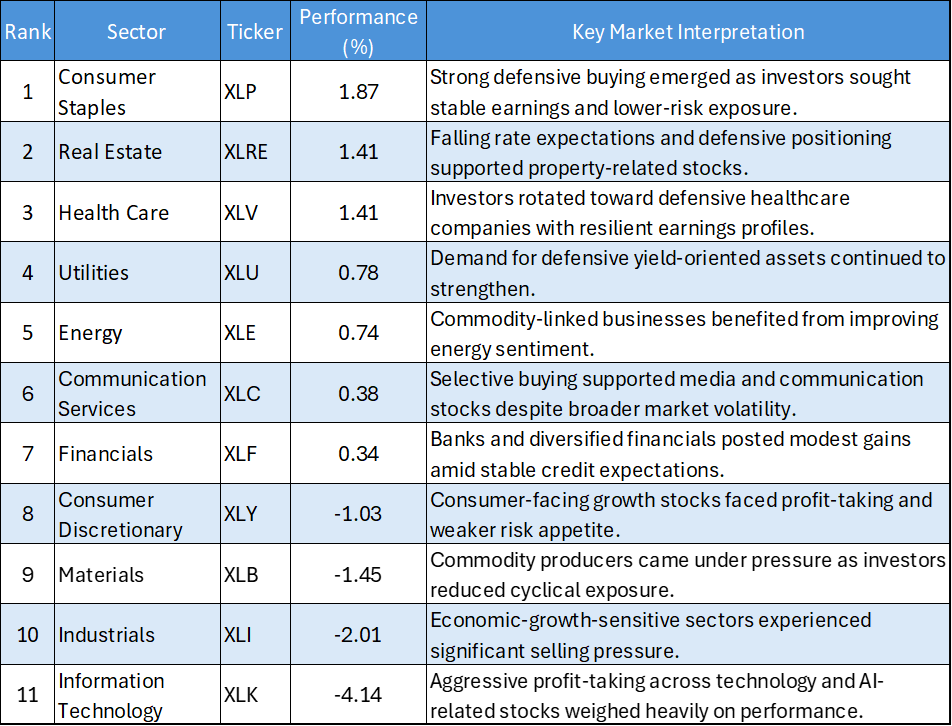
Daily US Sector Performance Summary
Key Market Themes
Defensive Sectors Dominate Market Leadership
- Consumer Staples (XLP) emerged as the strongest-performing sector, rising 1.87%, while Real Estate (XLRE), Health Care (XLV), and Utilities (XLU) all delivered strong gains. The outperformance of these traditionally defensive sectors suggests investors are increasingly prioritising capital preservation and earnings stability.
- The broad strength across defensive industries reflects a notable reduction in risk appetite and growing caution toward higher-beta areas of the market.
Real Estate Benefits from Defensive Rotation
- Real Estate (XLRE) gained 1.41%, ranking among the session's strongest performers. The sector's advance suggests investors are becoming more constructive toward interest-rate-sensitive assets while simultaneously seeking sectors capable of delivering stable income streams.
- The strength in Real Estate alongside Utilities further reinforces the defensive tone that characterised the session.
Technology Experiences Significant Selling Pressure
- Information Technology (XLK) suffered the largest decline of the day, falling 4.14%. The sharp selloff suggests investors engaged in substantial profit-taking following an extended period of outperformance by technology and AI-related companies.
- The magnitude of the decline indicates that market participants are becoming more selective toward growth-oriented sectors and may be reassessing valuation risks.
Cyclical Sectors Lose Momentum
- Industrials (XLI) and Materials (XLB) declined 2.01% and 1.45%, respectively, highlighting investor reluctance to maintain exposure to sectors most sensitive to economic growth expectations.
- The weakness across cyclical industries contrasts sharply with the strength in defensive sectors and points to a more cautious outlook regarding future economic activity.
Financials and Energy Remain Relatively Resilient
- Despite the broader risk-off environment, Financials (XLF) and Energy (XLE) both managed to post gains. Their resilience suggests investors continue to maintain exposure to sectors supported by relatively stable earnings prospects and favourable industry fundamentals.
- The ability of these sectors to remain positive helped offset some of the broader market weakness generated by the selloff in Technology and Industrials.
Bottom Line
The June 23 session highlighted a powerful defensive rotation across the US market. Consumer Staples, Real Estate, Health Care, and Utilities attracted substantial investor interest, while Technology, Industrials, and Materials experienced significant selling pressure.
The sharp decline in Technology, combined with broad gains across defensive sectors, suggests investors are adopting a more cautious stance toward risk. Going forward, continued leadership from defensive sectors may indicate a preference for capital preservation, while any recovery in Technology and other cyclical sectors will be closely watched for signs of improving market confidence.


 Jun 23, 2026




 Please wait processing your request...