
 CA
 NZ
 UK
 AU
 IND

 US

 Share
 X (Formerly Twitter)
 Whatsapp
 Facebook
 LinkedIn
 Telegram
 Email This Article
 Copy Link
 Summarize with AI
 Chat GPT
 Perplexity
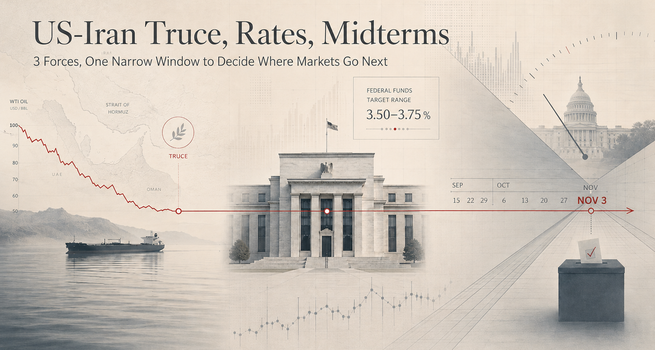
A US-Iran truce, Fed decision and midterm calendar form three forces with one narrow window. Here's how they interact, and what it means for markets through November.
Key Highlights:
- A framework truce to end the 4-month US-Iran war sent oil to a 2-month low and lifted gold, equities and bonds in a single session
- The Fed's two-day meeting, Kevin Warsh's first as chair, sits roughly 4.5 months from the November 3 midterms, the most distance the Fed will have from election day all year
- The truce's 60-day talks window and the Fed's remaining 2026 meeting calendar, including an October meeting just 6 days before voters go to the polls, define how much room the Fed has to act before the political cost of doing so rises
Three Forces, One Narrow Window
Three developments that would each, on their own, be significant macro events are landing in the same narrow window. A framework truce between the United States and Iran was announced over the weekend, ending a 4-month war that had closed the Strait of Hormuz to much of the region's oil traffic. The Federal Reserve begins a two-day meeting on Tuesday, with Wednesday's decision marking Kevin Warsh's first as chair. And both are unfolding against a midterm election calendar that, this year, intersects with the Fed's own schedule in a way worth mapping out in detail.
None of these forces operates in isolation. The truce changes the inflation backdrop the Fed is reading, the Fed's response shapes how markets price the durability of the truce, and the calendar running to November 3 conditions how much latitude the Fed has to act on either, not just this week, but across its remaining meetings of the year.
Force One: A Truce With Conditions Attached
The agreement, brokered with Pakistan's mediation, calls for an immediate halt to hostilities on all fronts, including in Lebanon, with a formal signing ceremony scheduled for Friday in Switzerland and a reopening of the Strait of Hormuz timed to that event. Iran's Supreme National Security Council confirmed that a memorandum of understanding had been finalised, while broader talks on sanctions relief and Tehran's nuclear programme are set to continue over a 60-day window, a window that becomes one of the more important dates on this article's calendar.
Markets moved quickly to reprice the conflict's risk premium. West Texas Intermediate fell close to 5% to around $80 a barrel, its lowest level since early March, while Brent declined by a similar margin to the low $80s. Both remain well above the pre-war level of roughly $66 and well below the levels above $100 reached during the worst of the Strait closure, so Monday's move is better read as a partial unwind than a return to pre-war conditions. Gold's reaction was less straightforward: rather than retreating in a risk-on session, it extended its rebound from a near 7-month low touched last week to trade close to $4,340, up roughly 2.5%, a sign that part of the market is hedging against the possibility this framework follows the pattern of earlier announcements that did not hold.
Force Two: The Fed's First Test Under Warsh
The committee's two-day meeting, the first under its new chair, arrives just as one of the inputs to its inflation outlook has shifted meaningfully. Pricing ahead of Wednesday points to a high probability of a 4th consecutive hold, with the more consequential question being whether the statement's policy bias language moves from its recent leaning toward future easing to something closer to neutral.
A sustained decline in energy prices would, over time, ease a persistent source of upside pressure on headline inflation, but the Fed has typically wanted several months of confirming data before adjusting its stance, particularly when the catalyst is a geopolitical development whose durability is still unproven on the day of the meeting. Retail fuel prices have lagged the move in crude, with the national average for regular gasoline still close to $4 a gallon despite a roughly 15% decline from its spring peak, and production facilities in several Gulf states sustained damage during the conflict, meaning a full restoration of pre-war supply is likely to take months. Bond markets appear to be pricing in some of this disinflationary potential already, with yields easing modestly across the curve and the curve bull steepening, consistent with reduced near-term inflation risk rather than an imminent change in policy.
Force Three: The Midterm Clock
The Federal Reserve has historically been reluctant to make significant policy shifts as election cycles near, preferring to let incoming data rather than the political calendar drive any change in bias. With midterm elections set for Tuesday, November 3, the calendar of the Fed's remaining 2026 meetings becomes a relevant input in its own right, not just a backdrop.
This week's meeting sits roughly 4.5 months before election day, the most distance the Fed will have from the midterms at any point this year. The next meeting, on July 28 and 29, is still close to 3 months out. By the meeting on September 15 and 16, which also comes with updated economic projections, that gap narrows to about 7 weeks. The meeting on October 27 and 28 lands only 6 days before voters go to the polls, the closest a scheduled FOMC decision will sit to a national election all year. December's meeting, on the 8th and 9th, is the first to fall after the result is known.
Read against this calendar, this week's meeting and July's represent the cleanest window the Fed has this year to adjust its bias in response to a changing inflation picture without the move being read through an election lens. By October, any shift, in either direction, would arrive at the most politically charged point of the cycle, exactly the kind of timing the Fed's institutional caution is designed to avoid.
How the Three Forces Interact
This is where the calendar becomes genuinely useful rather than just descriptive. The truce's 60-day window for broader talks on sanctions and Iran's nuclear programme runs to roughly mid-August, meaning its outcome, whether the framework holds through to a durable settlement or unravels, should largely be known well before the Fed's September meeting. If the truce holds and lower energy prices persist through the summer, September's meeting, with its updated projections, becomes the natural point for the Fed to formally register that shift, still comfortably ahead of October's election proximity.
If instead the truce falters during that window, as earlier de-escalation signals in this conflict have done, the caution shown this week and in July would look better justified in hindsight, and the Fed would face its October meeting with both a less favourable inflation picture and the least convenient timing of the year to address it.
Either way, Wednesday's decision carries more weight than a single hold might suggest. It is less about what changes this week and more about whether the Fed's language leaves it room to act in July or September, while that room still exists, rather than being pushed toward a decision in October, when the political cost of acting, or of visibly not acting, rises sharply.
The Macro Read for the Week Ahead
The most immediate signals are Wednesday's Fed statement, particularly any change to its policy bias language, and Friday's scheduled signing in Switzerland alongside the planned reopening of the Strait of Hormuz. Beyond this week, the progress of the 60-day talks window through mid-August, and whether the September meeting brings any shift in language, will determine whether the Fed used its widest window of the year or let it close unused, leaving the October meeting, 6 days from the midterms, to absorb whatever decision was deferred.


 Nov 13, 2026




 Please wait processing your request...