
 CA
 NZ
 UK
 AU
 IND

 US

 Share
 X (Formerly Twitter)
 Whatsapp
 Facebook
 LinkedIn
 Telegram
 Email This Article
 Copy Link
 Summarize with AI
 Chat GPT
 Perplexity
Key Highlights
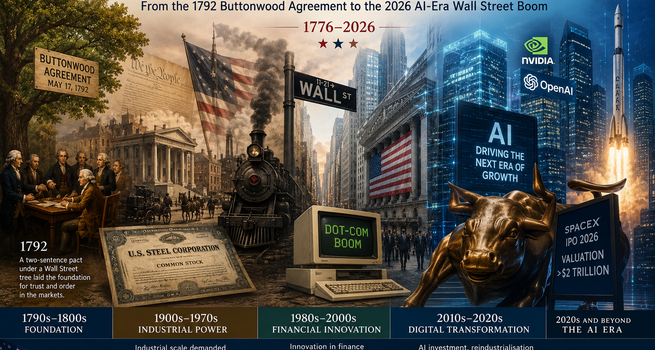
• A two-sentence pact signed under a Wall Street tree in 1792 became the institutional bedrock of the world's most liquid stockmarket.
• Manufacturing's share of American private payrolls collapsed from 26% in 1980 to 9% by December 2025, even as the economy grew into the world's largest by a wide margin.
• AI-related investment in 2025 has already eclipsed the contribution of information technology to growth during the dot-com boom, both in dollars and as a share of GDP.
• The average 2026 IPO is three times last year's size, with SpaceX's June listing the largest flotation in history at a valuation above $2trn.
Nations seldom mark their birthdays by auditing their balance-sheets. America might consider making an exception. Two and a half centuries after a group of colonists concluded they would rather not be taxed from London, the United States commands the largest economy on earth and the deepest, most liquid capital markets ever assembled. Neither outcome was inevitable. Neither, more to the point, happened in isolation from the other.
The pattern that runs through 250 years is stubbornly consistent. Every structural shift in what America produces has forced a matching shift in how America raises, allocates and prices its money. Agrarian expansion ran on merchant credit. Industrial scale demanded organised equity. The services economy invented derivatives and platform multiples. The age of artificial intelligence is demanding something new again. That co-evolution, rather than any single anniversary statistic, is the story worth telling on the country's 250th birthday.
A tree on Wall Street (1776 to the 1800s)
The economy that declared independence in 1776 was, in essence, a farm. Tobacco, cotton and timber were its principal exports; capital formation was informal, scattered across merchant networks and land titles. What modernised American finance was not trade but debt, and specifically the debt of war.
Alexander Hamilton, the republic's first treasury secretary, made the decision that mattered. He consolidated the Revolution's tangled obligations into federally issued bonds and, in doing so, created the first genuinely liquid financial instrument in the country's history. A liquid instrument needs a market. What it first acquired instead was mania. Early in 1792 a speculative frenzy in scrip of the Bank of the United States drove prices from $25 to $325 before they collapsed. William Duer, a former Treasury official, had borrowed heavily to corner the trade and defaulted when it turned against him. The resulting Panic of 1792 left the young financial system with no rules, no trust and no orderly way to discover a price.
The remedy arrived on May 17th 1792. Twenty-four of New York's leading brokers gathered, by tradition beneath a buttonwood tree at 68 Wall Street, and signed a document of two sentences. Its terms were spare but exact: the signatories would deal only with one another, cutting out unregulated auctioneers, and would charge no more than one quarter of one percent in commission. The Buttonwood Agreement created no wealth. It created the precondition for wealth. It supplied trust between counterparties, a central place to set prices, and a defined set of rules that made the market legible to outsiders. Five securities changed hands at the outset. Within decades the same framework was financing railroads, industrial empires and the settlement of a continent.
Union Pacific (NYSE:UNP), which linked the coasts by 1869, and Standard Oil, chartered in 1870 and eventually holding some 90% of American refining before the courts dismantled it in 1911, proved the point. The Buttonwood model could fund enterprise at genuinely national scale. From that moment the market and the economy were, structurally, inseparable.
The machine age and its guardrails (1900s to 1970s)
By the early twentieth century, manufacturing had become the engine. US Steel, assembled in 1901 in a merger arranged by JPMorgan (NYSE:JPM) and the first billion-dollar company in American history, set the tone. General Motors (NYSE:GM), Ford, AT&T (NYSE:T) and General Electric anchored the New York Stock Exchange through the 1920s, as equity ownership reached a genuinely mass public for the first time.
That democratisation of ownership carried a familiar consequence. The wider the participation, the wilder the speculation, and 1929 duly obliged. The crash that followed was not merely a bad week for prices. It was a systemic failure to allocate capital, and it rebuilt the architecture of American finance for good. The Securities and Exchange Commission, created in 1934, and the disclosure rules written into the Securities Act of 1933 were not arbitrary impositions. They were the direct institutional answer to misallocation at industrial scale. The lesson first taught under the buttonwood tree, that organised markets survive only on enforceable trust, was relearned at ruinous cost. Every later expansion of participation would repeat the same sequence: growth, excess, correction, and upgraded guardrails. The republic is a slow but reliable student.
From steel to software: the NASDAQ era (1980s to the 2010s)
The shift that began in the 1980s was the largest recomposition of the American economy since it first industrialised. Manufacturing's share of private payrolls fell from 26% in 1980 to single digits by the mid-2020s. Services, finance and, in time, technology took its place. IBM (NYSE:IBM) told the whole story in a single company: a hardware firm that had defined industrial-era computing turned decisively toward software and consulting in the 1990s, a corporate restructuring that mirrored a national one in miniature. When Goldman Sachs (NYSE:GS) went public in 1999, the symbolism was hard to overlook. The firm that had arranged a century of industrial mergers had itself become a traded financial product.
NASDAQ, once merely a venue for the smaller over-the-counter names that NYSE's listing standards excluded, redefined what a large company was supposed to look like. Microsoft (NASDAQ:MSFT), Apple (NASDAQ:AAPL) and Intel (NASDAQ:INTC), in their early listed lives, were industrial in no meaningful sense. Their advantages were intellectual property and network effects, assets that appear nowhere on a balance-sheet and that resist the traditional earnings multiple. The consequence for markets was profound. The tools built to value railroads and steel mills could not value businesses whose worth lay entirely in the future. New methods duly emerged. Some were rigorous. Many were not, a distinction the dot-com collapse of 2000 drew with considerable brutality.
The age of the private unicorn (2010s to the early 2020s)
The decade after the financial crisis of 2008 produced the strangest anomaly in the modern history of American markets. The most valuable and fastest-growing companies simply declined to be public, for a stretch without real precedent. Amazon (NASDAQ:AMZN), Alphabet (NASDAQ:GOOGL) and Meta Platforms (NASDAQ:META) had listed early in their ascent. The generation behind them did not bother. Venture capital, and later-stage private equity flush with sovereign-wealth and institutional money, removed any urgency to list at all.
The unicorn era that followed was, in large part, a mispricing dressed up as innovation. Private rounds sustained valuations that quarterly scrutiny and the attentions of short-sellers would have punctured far sooner. WeWork reached a private valuation of $47bn before its botched 2019 flotation exposed the fragility beneath. Hundreds of lesser names traced the same arc: inflated marks, delayed or abandoned listings, and quiet write-downs that limited partners absorbed without comment. By the early 2020s the zombie unicorn, a company carrying a paper value it could not defend in public, had become a fixture of private portfolios. Public investors, meanwhile, were shut out of the fastest-growing phase of the era's most consequential companies. That exclusion is now, at last, ending.
The inflection of 2026: AI, reindustrialisation and the return to public markets
The present moment compresses three structural forces that rarely arrive together, and whose collision is reshaping the economy and its markets in real time.
The first is a deliberate reversal of industrial policy. In January 2026 a Section 232 investigation concluded that semiconductor imports threatened national security, and a 25% tariff on chips and chipmaking equipment promptly followed. Intel (NASDAQ:INTC), in which the federal government now holds a direct equity stake, has committed more than $100bn to domestic fabrication in Arizona, Ohio and Oregon. The logic is old and legible: raise import barriers until home production becomes commercially viable, precisely as nineteenth-century protection did for steel and rail. Whether it succeeds is a separate question. Tariffs are a blunt instrument, and advanced chipmaking is an exquisitely subtle business.
The second force is an investment cycle without a modern parallel. Goldman Sachs projects roughly $765bn of AI capital spending in 2026, and some $7.6trn cumulatively between 2026 and 2031, across compute, data centres and power. NVIDIA (NASDAQ:NVDA), which listed in January 1999 at $12 a share and now carries a market value above $4.8trn, is the cycle's most concentrated beneficiary. In its 2026 fiscal year the company's data-centre revenue reached $193.7bn, more than 89% of its total. So much of the world's AI spending now runs through the product architecture of a single firm that not even IBM, at the zenith of its mainframe dominance, matched the concentration.
The third force is the structural reintegration of the great private companies into public life. SpaceX (NASDAQ:SPCX) listed on June 12th 2026 at $150 a share and rose to a valuation above $2trn, the largest flotation in history. OpenAI filed confidentially with the SEC in June, and Anthropic is targeting an October debut. Together the three could ask public markets for north of $200bn, against a total American IPO market that raised just $45bn in the whole of 2025. The echoes of 1999, when a wave of large technology listings preceded a painful correction, are lost on no one. Whether the parallel holds turns on a question that private funding rounds, by design, never had to answer: whether these businesses can generate the revenue to survive the discipline of quarterly public disclosure.
The structural question at 250
The 250-year pattern is plain enough. Each new economic era has summoned the market architecture required to fund and price it. Buttonwood financed farms and early industry. The SEC lent industrial scale the confidence of enforceable rules. NASDAQ's listing model bankrolled the platform economy. The current transition, toward an economy that is at once AI-driven and partly re-industrialised, is demanding another evolution: valuation methods fit for trillion-dollar AI firms, rules capable of governing capital allocated by algorithm, and disclosure regimes that can make AI revenue legible to ordinary investors. Goldman Sachs reckons broad AI adoption could add between 0.3 and 3.0 percentage points to annual American productivity growth over the coming decade, a range wide enough to accommodate both a boom and a bitter disappointment.
Whether the institutions evolve quickly enough to convert that productivity into durable capital formation is the open question at 250 years. History offers one consolation and one warning, which happen to be the same thing. The guardrails always lag. They also always arrive.
Disclaimer: This article has been produced for informational purposes only and does not constitute financial advice, investment recommendations, or an offer or solicitation to buy or sell any securities. Kalkine Media does not hold positions in any of the securities mentioned. Readers should conduct their own due diligence and consult a licensed financial adviser before making any investment decisions.

 Nov 27, 2026





 Please wait processing your request...