
 AU
AU
 UK
UK
 CA
CA
 NZ
NZ
 IND
IND

 US
US

 Share
Share
 X (Formerly Twitter)
 Whatsapp
 Facebook
 LinkedIn
 Telegram
 Email This Article
 Copy Link
 Summarize with AI
 Chat GPT
 Perplexity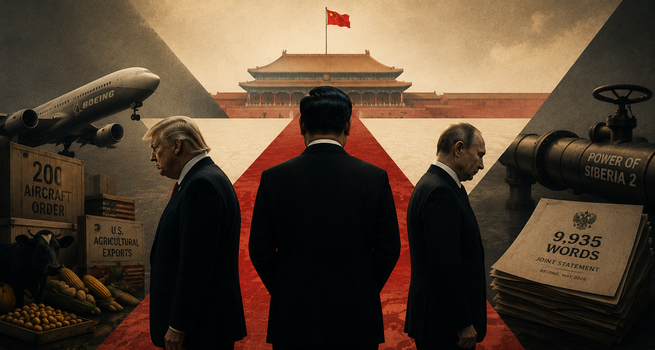
Trump left Beijing with Boeing orders and agricultural deals. Putin left with a 9,935-word joint statement and no pipeline deal. One week, two summits, two very different outcomes. A macro analysis of who actually won.
Key Highlights
- Trump secured Boeing orders and agricultural deals but left without a joint statement, progress on Iran, or resolution on Taiwan.
- Putin signed a 9,935-word joint statement but failed to secure the Power of Siberia 2 pipeline deal, his central objective.
- Beijing held out on gas pricing, leaving Moscow without the energy agreement it urgently needs.
- Xi Jinping exits the week with Leverage over both relationships and commitments to neither.
The Setup
Within six days in May 2026, Xi Jinping hosted the leaders of the United States and Russia in Beijing. Trump arrived on May 14. Putin followed on May 20. Both visits carried full state ceremony. Both produced signed documents.
The similarity ends there. Each leader arrived with a specific objective. Each left with a different version of that objective either met or denied. Measuring the outcomes requires holding those objectives clearly in view.
Notably absent from the week's strategic calculus was Europe. Beijing framed both summits around bilateral power management, engaging Washington and Moscow on separate tracks without reference to multilateral frameworks or European interests. That architecture was itself a signal.
Trump: Commerce Delivered, Strategy Deferred
Trump's delegation was built for a transaction. Three cabinet officials. Eighteen Business leaders drawn from technology, finance, and aviation. The frame was commercial, and Beijing met it on those terms.
China agreed to purchase 200 Boeing aircraft, reopen American beef imports, and commit to billions in agricultural purchases. A Tariff reduction framework was agreed without a binding timeline. These are real deliverables with measurable economic weight.
Markets were less convinced. Boeing shares fell 4 percent on Wall Street, reflecting expectations of a larger symbolic reset in US-China aviation trade. Investors had anticipated an order closer to 500 aircraft, a figure Trump himself had floated before the trip. Beyond the headline number, order timing and delivery schedules remain uncertain, and Supply-chain constraints on Boeing's widebody production add further ambiguity to the near-term Revenue impact. The commercial win is real. Its Market Value is qualified.
The strategic layer was a different matter. Beijing issued no joint statement, a deliberate choice that preserved its flexibility on Taiwan, trade architecture, and technology. Xi warned Trump directly that mishandling Taiwan would put the bilateral relationship into great jeopardy. Iran produced nothing. The two sides released separate readouts, allowing each Capital to frame outcomes independently.
Trump returned with a trade narrative. He did not return with a changed strategic relationship.
Putin: The One Deal That Mattered Did Not Close
Putin did not come to Beijing for ceremony. He came for the Power of Siberia 2 pipeline.
Since the 2022 invasion of Ukraine, Gazprom's European shipments have reportedly collapsed by 44 percent. Western Siberian gas reserves are stranded without a buyer at scale. The proposed 2,600-kilometre pipeline through Mongolia, capable of carrying 50 billion cubic metres annually, is the only viable route to replacing that lost revenue. A binding memorandum was signed in September 2025. May was supposed to finalise pricing, timelines, and financing.
It did not. Beijing held its position at approximately 12 to 13 cents per cubic metre, near Russia's domestic rate. Moscow needed terms closer to Power of Siberia 1, which analysts estimate at more than double that figure. The Kremlin confirmed no timelines, offering only that the two sides had reached a general understanding of main parameters.
Putin left with a 9,935-word joint statement covering nuclear security, Taiwan, and the multipolar world order. Twenty additional documents were signed. None of it moves gas or generates revenue. Russia's fiscal problem entering the summit is Russia's fiscal problem leaving it.
Beijing's Leverage Is Now Structural
The outcomes of both visits point to the same underlying condition: Beijing is not managing two relationships. It is managing two dependencies.
Washington depends on Chinese cooperation across trade, supply chains, and regional stability. The commercial deliverables Trump received were real, but they were sized and structured by Beijing, not negotiated from a position of equivalence. The absent joint statement is the tell. A partner willing to commit strategically signs a shared document. A counterpart managing your dependency does not.
Moscow's position is more acute. Russia has no alternative buyer for its stranded gas at the Volume Power of Siberia 2 would require. Every quarter the pipeline remains unsigned, Beijing's pricing leverage hardens further. The joint statement keeps Russia diplomatically functional and strategically aligned at zero cost to China. Withholding the pipeline deal costs Beijing nothing and preserves its most valuable instrument of leverage over Moscow indefinitely.
Neither dependency was created this week. Both were deliberately left unresolved.
The Verdict
The conventional read of the week is that Trump underdelivered and Putin was rebuffed. That framing is accurate but incomplete.
The more consequential observation is what the week reveals about the durability of Beijing's position. China is now the only major power that holds meaningful leverage over both Washington and Moscow simultaneously, has demonstrated the willingness to deploy that leverage selectively, and faces no structural pressure to resolve either relationship on the other party's terms.
Europe's absence from this calculus compounds the picture. A week in which the world's two other major powers travelled to Beijing, accepted its terms, and returned home without a countervailing multilateral framework in sight is not just a diplomatic outcome. It is a structural shift in how global power is being organised.
Trump got commerce. Putin got words. Xi got something more durable than either: confirmation that both relationships will continue on Beijing's terms, for as long as Beijing chooses.

_06_12_2026_23_00_13_327450.jpg)
 Jun 12, 2026




 Please wait processing your request...