
 AU
AU
 UK
UK
 CA
CA
 NZ
NZ
 IND
IND

 US
US

 Share
Share
 X (Formerly Twitter)
 Whatsapp
 Facebook
 LinkedIn
 Telegram
 Email This Article
 Copy Link
 Summarize with AI
 Chat GPT
 Perplexity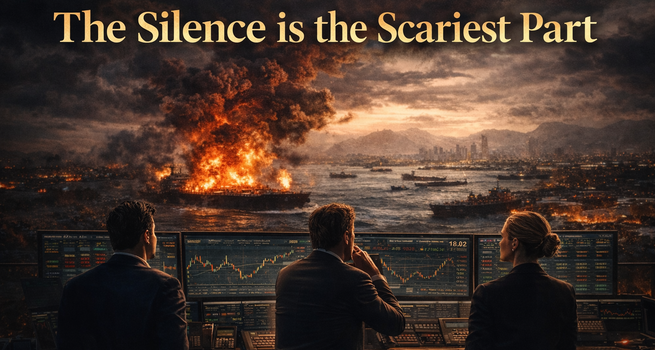
Key Highlights
- Oil prices surged after strikes on Iran’s Kharg Island, yet equity markets barely reacted.
- The VIX volatility index remains historically subdued near 18.
- AI-driven capital expenditure optimism is sustaining market risk appetite.
- Elevated valuations suggest risk premiums remain compressed.
- Market calm may indicate complacency rather than resilience.
Introduction: When Markets Refuse to Panic
Financial markets often speak through volatility. Sudden geopolitical shocks, supply disruptions, or policy surprises typically trigger visible reactions in equities, bonds, and commodities. Yet the current environment presents an unusual contradiction. Oil prices are climbing, geopolitical tensions in the Middle East are escalating, and global macro risks are accumulating. Despite this, equity markets remain remarkably calm.
Recent developments illustrate the contrast. Military strikes targeted infrastructure near Iran’s primary oil export hub on Kharg Island, a location critical to global energy flows. Oil markets reacted quickly, with Brent crude rising as traders priced in potential disruptions. Meanwhile, the broader equity market showed little sign of stress. S&P 500 futures even moved higher in premarket trading.
This divergence between geopolitical reality and market behaviour raises an important question for investors. Is the calm evidence of resilience, or does it signal complacency that could become costly if risks intensify?
Global Market Trends and Geopolitical Risk
Oil Market Shock and Energy Supply Concerns
The Strait of Hormuz remains one of the most important energy chokepoints in the global economy. Approximately one fifth of global oil supply moves through this narrow passage connecting the Persian Gulf with international markets. Any disruption to traffic through the strait has the potential to reverberate through the global economy.
Recent tensions involving Iran have brought this vulnerability back into focus. The strikes on infrastructure linked to the Kharg Island export hub triggered immediate reactions in oil markets. Traders began pricing in the possibility of supply disruptions or retaliatory measures that could slow shipping through the strait.
Energy markets are particularly sensitive to such developments. Oil remains a central input for transportation, manufacturing, and energy production worldwide. When supply risks increase, prices typically rise quickly as traders attempt to anticipate shortages.
However, the reaction outside commodity markets has been far more subdued.
Equity Markets Remain Composed
While oil prices climbed, equity markets displayed surprising stability. Major indices held near record levels and volatility indicators barely moved. The CBOE Volatility Index, commonly known as the VIX or the market's fear gauge, hovered around 18.
Historically, the VIX spikes sharply during periods of significant stress. During the pandemic crisis of 2020 it surged above 50. Even during more routine market corrections it often rises above 30. A level near 18 indicates relatively calm conditions.
This behaviour suggests that investors believe the geopolitical shock will remain contained or short lived.
But that assumption may deserve closer scrutiny.
Market Complacency and Investor Psychology
Historical Market Responses to Geopolitical Events
One reason markets remain calm is history. Over the past several decades, geopolitical crises have rarely produced long lasting declines in global equities.
Studies of market reactions to conflicts, terrorist attacks, and regional wars show a consistent pattern. Equity markets often fall modestly during the initial shock, but tend to recover quickly once uncertainty stabilizes.
On average, the S&P 500 has historically declined only around 4 to 5 percent following geopolitical events, with recovery typically occurring within a few weeks. Investors have learned that panic selling often proves unnecessary.
This historical experience has shaped investor psychology. Many market participants have internalized the lesson that geopolitical shocks rarely derail long term bull markets.
The Rise of the "Buy the Dip" Mentality
Another factor reinforcing market calm is the widespread adoption of a buy the dip strategy. Over the past decade, investors who purchased equities during market declines have frequently been rewarded as central bank support and corporate earnings growth pushed markets higher.
This pattern has created a strong behavioural bias. Instead of reacting defensively to negative news, investors often view volatility as an opportunity to increase exposure.
The result is a market that absorbs shocks quickly. Instead of cascading selloffs, negative headlines often trigger only brief pullbacks before buying resumes.
Yet this conditioning may also reduce the market's ability to price risk accurately when the underlying environment changes.
Structural Drivers Supporting Equity Markets
The AI Capital Expenditure Boom
One of the most powerful forces supporting investor optimism is the rapid expansion of artificial intelligence infrastructure investment. Major technology companies are allocating enormous amounts of capital toward data centers, advanced chips, and cloud computing platforms.
Semiconductor and networking companies are reporting strong demand as enterprises race to build AI capacity. Revenue growth linked to AI infrastructure has become a central narrative driving market expectations.
This investment cycle has convinced many investors that corporate earnings will remain strong even if macroeconomic conditions become less favorable.
As long as the AI expansion continues, equity markets may feel insulated from external shocks.
Corporate Balance Sheet Strength
Corporate financial health also contributes to the sense of resilience. Many large companies entered the current cycle with strong balance sheets and significant cash reserves. Debt maturities are manageable and profit margins remain historically elevated.
These factors create a perception that businesses can withstand temporary disruptions without significant damage to earnings.
For investors focused on long term growth, geopolitical turbulence may appear less threatening than structural economic trends.
Financial and Market Implications
Elevated Valuations and Compressed Risk Premiums
Despite the reassuring narratives supporting markets, valuation levels deserve attention. Equity multiples remain elevated relative to historical averages. At the same time, the risk premium that investors demand for holding equities appears compressed.
In simple terms, investors are accepting relatively low compensation for taking on risk.
This dynamic can persist for extended periods during strong economic expansions. However, it can also leave markets vulnerable if unexpected shocks materialize.
When valuations are high and risk premiums are low, even modest changes in sentiment can trigger significant repricing.
The VIX and the Information Problem
Volatility indicators such as the VIX are designed to reflect market expectations of future risk. When uncertainty rises, option prices increase and volatility measures typically spike.
Yet in the current environment, volatility remains subdued even as geopolitical tensions intensify. This creates an unusual situation in which traditional market signals may not fully reflect underlying risks.
If markets stop reacting to incremental shocks, investors may lose an important early warning system.
Prices serve as signals in financial markets. When those signals become muted, it becomes more difficult to distinguish between genuine stability and hidden fragility.
Strategic Outlook: What Investors Should Watch
Oil Prices and Inflation Risks
Energy prices represent one of the most immediate channels through which geopolitical tensions could affect the global economy. Sustained increases in oil prices would raise transportation and production costs across multiple industries.
Higher energy costs could also complicate central bank efforts to bring inflation under control. If inflation remains elevated, interest rates may stay higher for longer than investors currently expect.
This scenario could place pressure on equity valuations.
Trade Routes and Global Supply Chains
Another critical factor is the stability of global shipping routes. The Strait of Hormuz is not only important for oil flows but also for broader trade networks connecting the Middle East and Asia with global markets.
Any prolonged disruption could increase shipping costs and create supply chain bottlenecks similar to those experienced during earlier global crises.
Markets may be underestimating the economic consequences if such disruptions persist.
Investor Sentiment and Market Positioning
Finally, the behaviour of investors themselves will play a key role. If geopolitical developments intensify or economic data deteriorates, sentiment could shift rapidly.
Markets that have grown accustomed to stability sometimes react abruptly when expectations change. In such situations, volatility can rise quickly after long periods of calm.
Conclusion: When Calm Becomes a Warning Signal
Financial markets are often praised for their ability to process information efficiently. Prices adjust rapidly to new data, reflecting collective expectations about future outcomes.
Yet the current environment suggests a more complicated reality. Despite rising geopolitical tensions, energy market disruptions, and macroeconomic uncertainty, equity markets remain strikingly composed.
This calm may ultimately prove justified. History shows that markets frequently recover quickly from geopolitical shocks.
But investors should remain cautious about assuming that every crisis will follow the same pattern. When risk increases but market signals remain muted, the absence of volatility can itself become a source of uncertainty.
Sometimes the most unsettling development in markets is not panic. It is silence.
FAQ
Why is the VIX considered the market’s fear index?
The VIX measures expected volatility in the S&P 500 based on options pricing. When investors anticipate large market moves, option premiums rise and the VIX increases. Higher levels typically indicate heightened uncertainty or fear in financial markets.
Why did oil prices rise after the Kharg Island strikes?
Kharg Island is a major oil export hub for Iran. Military strikes near such infrastructure raise concerns about supply disruptions or retaliation affecting shipping routes through the Strait of Hormuz, which carries a large share of global oil exports.
Why have equity markets remained calm despite geopolitical tensions?
Several factors support investor confidence, including strong corporate earnings, the ongoing AI investment cycle, and historical evidence that markets often recover quickly from geopolitical shocks. These factors may be dampening immediate reactions to global events.
Could rising oil prices affect global inflation?
Yes. Oil prices influence transportation and manufacturing costs across the economy. Sustained increases can feed into broader inflation, which may influence central bank policy and interest rate expectations.
What risk should investors monitor most closely now?
Investors should watch energy markets, shipping routes such as the Strait of Hormuz, and shifts in investor sentiment. Any escalation that disrupts oil supply or global trade could trigger broader market volatility.

_06_12_2026_23_00_13_327450.jpg)
 Jun 12, 2026




 Please wait processing your request...