
 CA
 NZ
 UK
 AU
 IND

 US

 Share
 X (Formerly Twitter)
 Whatsapp
 Facebook
 LinkedIn
 Telegram
 Email This Article
 Copy Link
 Summarize with AI
 Chat GPT
 Perplexity
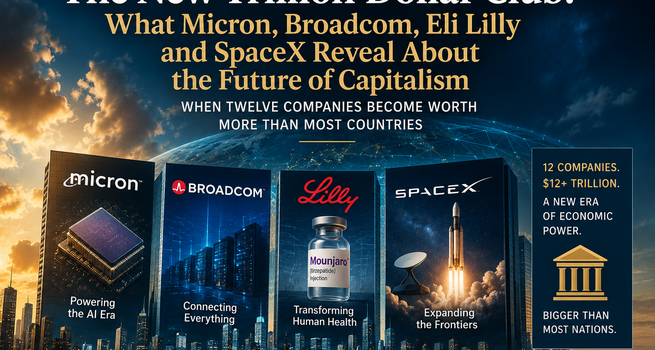
When Twelve Companies Become Worth More Than Most Countries
The most important event on Wall Street in 2026 is not a Federal Reserve meeting, an election cycle, or even another artificial intelligence breakthrough.
It is the quiet expansion of the trillion-dollar club.
Just a few years ago, reaching a market capitalization of one trillion dollars was considered extraordinary. Today, the club has expanded from eight members to twelve, with Micron Technology (NASDAQ: MU), Broadcom (NASDAQ: AVGO), Eli Lilly (NYSE: LLY), and SpaceX (NASDAQ: SPCX) joining an elite group that already includes giants such as Nvidia (NASDAQ: NVDA), Microsoft (NASDAQ: MSFT), Apple (NASDAQ: AAPL), Amazon (NASDAQ: AMZN), Alphabet (NASDAQ: GOOG), Meta Platforms (NASDAQ: META), Saudi Aramco, and Berkshire Hathaway (NYSE: BRK.B).
At first glance, these companies appear to operate in completely different industries.
One manufactures memory chips.
One builds communications and infrastructure semiconductors.
One develops pharmaceuticals.
One launches rockets and satellites.
Yet the deeper one examines these businesses, the clearer it becomes that they are manifestations of the same economic phenomenon.
Modern capitalism increasingly rewards firms that dominate critical bottlenecks.
The trillion-dollar club is no longer simply a collection of large companies.
It is increasingly a collection of companies controlling indispensable infrastructure.
The Great Consolidation of Economic Power
For most of the twentieth century, industrial capitalism rewarded scale.
The largest manufacturers produced goods more cheaply than competitors.
The twenty-first century has introduced a different model.
Today, economic value accrues disproportionately to firms controlling intellectual property, data, networks, platforms, or technological bottlenecks.
This shift explains why trillion-dollar valuations are becoming more common.
The world's largest companies are not merely bigger than competitors.
They are structurally embedded in economic systems.
Removing them would disrupt entire industries.
Micron Technology (NASDAQ: MU) offers a compelling example.
The company does not produce a consumer product that most people actively think about.
Yet every AI server, cloud data center, autonomous system, smartphone, and enterprise computing platform increasingly relies upon advanced memory technologies.
High-Bandwidth Memory has become as strategically important to artificial intelligence as processors themselves.
The result is a remarkable transition.
Memory chips, historically viewed as cyclical commodities, are becoming strategic assets.
Investors are beginning to value Micron accordingly.
Broadcom and the Economics of Invisible Infrastructure
If Nvidia (NASDAQ: NVDA) became the face of artificial intelligence, Broadcom (NASDAQ: AVGO) became the plumbing.
The company's ascent to trillion-dollar status reflects one of the least appreciated truths in investing.
The greatest fortunes are often created not by consumer brands but by infrastructure providers.
Broadcom occupies critical positions across networking, connectivity, data-center architecture, enterprise software, and custom silicon.
Every year, the digital economy becomes more dependent on moving, storing, and processing information.
Broadcom's products increasingly sit at the center of that process.
The company represents what Charlie Munger once described as a "toll bridge."
The best businesses do not necessarily sell the most exciting products.
They simply ensure that everyone else must pass through their gate.
Broadcom has spent years systematically acquiring, integrating, and strengthening such gates.
The market is finally rewarding that strategy.
Eli Lilly and the Monetisation of Human Longevity
Among the newest trillion-dollar companies, Eli Lilly (NYSE: LLY) may be the most fascinating.
Historically, pharmaceutical companies rarely sustained premium valuations.
Patent expirations eventually eroded pricing power.
Scientific uncertainty limited predictability.
The obesity revolution has changed that equation.
For perhaps the first time in modern medical history, a pharmaceutical company possesses products capable of addressing one of humanity's largest healthcare challenges.
Obesity affects hundreds of millions globally.
Its downstream consequences include diabetes, cardiovascular disease, kidney disorders, and numerous other chronic illnesses.
Investors increasingly recognise that Eli Lilly's addressable market may extend far beyond traditional pharmaceutical categories.
The company is effectively monetising improved human healthspan.
This is a very different proposition from selling a drug for a niche disease.
It is closer to owning a platform that reshapes healthcare economics.
When viewed through that lens, the trillion-dollar valuation becomes easier to understand.
SpaceX and the Commercialisation of Space
Perhaps no company better illustrates twenty-first-century capitalism than SpaceX (NASDAQ: SPCX).
Historically, space exploration was a government activity.
Today, it is becoming a commercial industry.
The most obvious business is launch services.
Yet investors increasingly view launch capability as merely the foundation.
Starlink has already demonstrated that space-based infrastructure can generate substantial recurring cash flows.
Future opportunities may include:
- Global connectivity
- Satellite communications
- Earth observation
- Defence infrastructure
- Space-based computing
- Orbital manufacturing
In many respects, SpaceX resembles railroads during the nineteenth century.
Railroads did not merely transport goods.
They created entirely new economic ecosystems.
SpaceX may ultimately perform a similar function for orbital infrastructure.
The trillion-dollar valuation reflects expectations about that future rather than current earnings alone.
Why Artificial Intelligence Is Accelerating Concentration
Artificial intelligence is frequently discussed as a technological revolution.
Less attention is paid to its economic implications.
AI rewards scale.
Large datasets improve models.
Large computing clusters improve performance.
Large capital budgets enable faster deployment.
These dynamics naturally favour dominant firms.
Consequently, AI is not merely creating new companies.
It is strengthening existing leaders.
Micron Technology (NASDAQ: MU), Broadcom (NASDAQ: AVGO), Nvidia (NASDAQ: NVDA), Microsoft (NASDAQ: MSFT), and SpaceX (NASDAQ: SPCX) all benefit from this trend.
Each occupies a position within an ecosystem that becomes more valuable as AI adoption expands.
This creates a feedback loop.
Higher demand generates higher cash flows.
Higher cash flows enable larger investments.
Larger investments reinforce competitive advantages.
Over time, such dynamics produce extraordinary market concentration.
The Real Driver Is Not Technology. It Is Capital Intensity.
Investors often focus on innovation.
The more important factor may be capital intensity.
The modern economy increasingly requires enormous investments before meaningful competition becomes possible.
Building an advanced semiconductor fabrication ecosystem costs tens of billions of dollars.
Training frontier AI models requires massive computing resources.
Launching satellite constellations requires extraordinary capital expenditure.
Developing breakthrough medicines can consume billions in research spending.
These barriers naturally reduce competition.
The winners become stronger because potential challengers cannot easily replicate the required infrastructure.
This phenomenon partly explains why trillion-dollar companies are becoming more common.
The economic moat surrounding successful firms is becoming wider.
Why Investors Should Pay Attention
The expansion of the trillion-dollar club offers several lessons.
First, markets increasingly reward dominant franchises.
Second, competitive advantages matter more than ever.
Third, the biggest investment opportunities often emerge from infrastructure rather than consumer-facing products.
The most valuable companies today are not necessarily those with the most recognizable brands.
They are the companies enabling entire industries to function.
Micron Technology (NASDAQ: MU) supplies memory.
Broadcom (NASDAQ: AVGO) supplies connectivity.
Eli Lilly (NYSE: LLY) supplies medical innovation.
SpaceX (NASDAQ: SPCX) supplies orbital infrastructure.
Each controls a critical node within a larger economic system.
That is the defining characteristic of modern wealth creation.
Could the Trillion-Dollar Club Continue Expanding?
Almost certainly.
Several candidates appear positioned to join over the coming years.
Companies involved in artificial intelligence infrastructure, advanced semiconductors, healthcare innovation, cybersecurity, and energy transition technologies could eventually reach similar valuations.
However, investors should avoid a common mistake.
Not every company exposed to these themes will become a trillion-dollar winner.
The critical question is not whether an industry grows.
The critical question is whether a company controls a bottleneck.
History suggests that industries generate wealth unevenly.
Air travel transformed transportation but destroyed shareholder capital for decades.
Railroads revolutionised commerce but produced mixed investment outcomes.
The greatest fortunes accrued not to participants but to dominant operators.
The same principle applies today.
The Next Decade of Capitalism
The expansion from eight trillion-dollar companies to twelve is more than a market milestone.
It is evidence of a broader economic transformation.
Modern capitalism increasingly concentrates value in firms controlling intellectual property, infrastructure, networks, and irreplaceable platforms.
Micron Technology (NASDAQ: MU), Broadcom (NASDAQ: AVGO), Eli Lilly (NYSE: LLY), and SpaceX (NASDAQ: SPCX) may appear unrelated.
In reality, they are united by a common characteristic.
Each occupies a strategic position within a system that the global economy increasingly depends upon.
That dependence creates pricing power.
Pricing power creates cash flow.
Cash flow creates reinvestment opportunities.
Reinvestment strengthens competitive advantages.
And competitive advantages ultimately create trillion-dollar companies.
The lesson for investors is straightforward.
Do not merely search for growth.
Search for indispensability.
The future belongs not to the companies growing fastest today, but to the companies the world cannot function without tomorrow.
This mirrors Saurabh Mukherjea's style: focusing on economic moats, dominant franchises, capital intensity, compounding, market structure, and long-duration competitive advantages, rather than short-term stock-price movements.

 Nov 03, 2026




 Please wait processing your request...