
 AU
AU
 UK
UK
 CA
CA
 NZ
NZ
 IND
IND

 US
US

 Share
Share
 X (Formerly Twitter)
 Whatsapp
 Facebook
 LinkedIn
 Telegram
 Email This Article
 Copy Link
 Summarize with AI
 Chat GPT
 Perplexity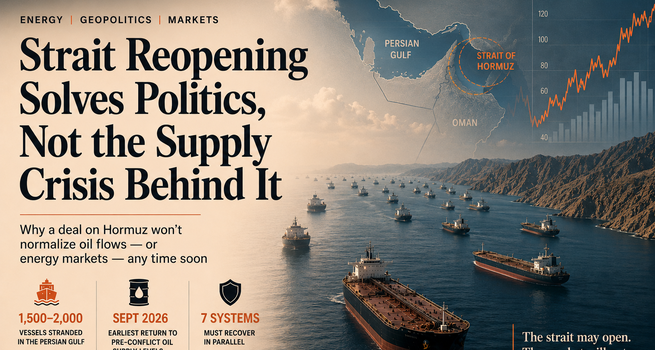
Key Highlights
- Between 1,500 and 2,000 vessels remain stranded in the Persian Gulf, representing one of the largest maritime backlogs in modern shipping history
- Global Crude Oil Supply is not expected to recover to pre-conflict levels before September 2026, with full passage normalisation unlikely before the first half of 2027
- Seabed mines, hull degradation, jurisdictional disputes, and dormant oil fields each constitute independent bottlenecks requiring resolution in sequence
- Energy price Volatility is structurally embedded in the near-term outlook regardless of deal timing
- Insurance premiums, tanker availability, and refining throughput constraints will suppress supply recovery even as vessels begin moving
A Deal Is Not a Solution
Diplomatic progress on the Strait of Hormuz has generated considerable market attention. It deserves considerably less optimism than it is receiving.
An agreement to reopen the waterway resolves one dimension of the crisis: geopolitical access. It leaves untouched a compounding series of operational, physical, and logistical constraints that have accumulated over three months of blockade. Global crude supply will remain under structural strain well beyond any signing ceremony, as assessments from JP Morgan and S&P Global make clear.
The distinction between political resolution and operational normalisation is not a technical footnote. It defines the timeline for energy market recovery, shapes insurance pricing, and determines how quickly inventory depletion at refineries worldwide can be reversed. For integrated majors such as Exxon Mobil (NYSE:XOM) and Chevron (NYSE:CVX), both of which carry significant Gulf region exposure, the supply normalisation curve matters as much as the diplomatic headline. Markets that treat a Hormuz deal as a supply inflection point will likely be disappointed.
Logistics: The Geometry of the Problem
The Strait of Hormuz is not simply a gate that opens and closes. At its narrowest, it spans 21 nautical miles. Within that width, international navigation standards allocate inbound and outbound lanes of approximately 2 nautical miles each, separated by a 2-nautical-mile buffer zone. In practical terms, the world's largest crude carriers transit a corridor roughly 4 nautical miles wide in total.
Ultra-large crude carriers exceeding 300 metres in length require several kilometres to arrest forward motion when fully loaded. In a waterway where 2,000 vessels may attempt transit within weeks of reopening, any failure of sequencing or speed management risks catastrophic collision. A single grounding in the navigation channel could close the strait more effectively than the conflict that preceded it.
Passage must be prioritised by hazardous cargo classification, vessel type, destination port capacity, and logistical urgency. None of these protocols are in place.
The authority responsible for issuing passage permits remains contested. Iran has established a regulatory agency claiming operational Jurisdiction. Western maritime powers regard the Strait as an international waterway. Shipping companies have no confirmed channel through which to request passage clearance. The Baltic and International Maritime Council has indicated that speed restrictions will likely be imposed, but the administering authority for those restrictions remains undefined.
Safety - Mines: The Variable That Cannot Be Rushed
Among the operational barriers to normalisation, mine clearance carries the longest and least compressible timeline.
The threat is not purely physical. Analysts have assessed that even a single confirmed mine is sufficient to invalidate insurance cover and shut down commercial transit entirely, independent of how many were actually deployed. Uncertainty about mine locations produces the same shipping paralysis as a fully documented minefield.
Iran has not officially confirmed where or how many mines were placed. Its own IRGC communications directed vessels to alternative routes citing "the likelihood of the presence of various types of anti-ship mines in the main traffic zone." While U.S. airstrikes have degraded an estimated 90% of Iran's mine-laying capacity, the residual risk remains operationally determinative.
Clearance operations are staged but not yet deployed. Hundreds of British sailors aboard RFA Lyme Bay are docked off Gibraltar, awaiting a peace agreement before sailing to the Persian Gulf to begin operations. Until independent verification of clearance is complete, major shipowners will not move vessels through the strait regardless of what any diplomatic agreement states.
Fleet Condition: Three Months at Anchor
The stranded vessels themselves present a separate problem. The Persian Gulf's elevated water temperatures have accelerated biofouling across the fleet. Barnacles, shellfish, and algae accumulate on submerged hulls, increasing drag and reducing maximum achievable speed. The degradation is not cosmetic.
Hapag-Lloyd, among the world's largest container carriers, reported that extracting a single vessel during the blockade required substantial hull cleaning expenditure, and that maximum speed remained meaningfully below pre-blockade performance even after cleaning. The experience is likely representative of the broader stranded fleet. For tanker operators with significant Persian Gulf exposure, including Frontline (NYSE:FRO) and International Seaways (NYSE:INSW), the maintenance burden on stranded vessels translates directly into delayed Revenue recovery and elevated operating costs in the near term. Engines and mechanical systems dormant for over three months require precision inspection before vessels can safely operate at commercial speeds.
Upstream: Oil Fields Cannot Restart Overnight
Even if every vessel in the Persian Gulf were to transit the strait within weeks, the oil they carry must first exist. Many producing facilities across the region suspended operations entirely during the conflict. Resuming output is not a mechanical switch. Fields require pressure management, pipeline integrity assessments, storage Facility inspections, and safety certification before production can be restored. S&P Global projects that some facilities may require up to seven months to reach normalised output levels.
The disruption extends beyond crude. The Gulf accounts for a significant share of global LNG supply, and the blockade has compressed seaborne LNG availability meaningfully. Cheniere Energy (NYSE:LNG), the largest U.S. LNG exporter, has faced indirect Demand pressure from competing Gulf LNG supply being taken offline. When Gulf LNG production resumes, it will reintroduce supply-side competition into a market that has partially adjusted to its absence.
When production does resume more broadly, initial Volume will not flow immediately to global markets. Depleted commercial and strategic reserves accumulated over three months of supply disruption will absorb initial output. JP Morgan has assessed that inventory depletion has reached critical levels and that supply shortages are likely to persist well into the second half of 2026. ConocoPhillips (NYSE:COP), with upstream exposure across multiple producing regions, has flagged the extended supply normalisation window as a key variable in its near-term output planning.
System View: A System, Not a Switch
ADNOC, the Abu Dhabi National Oil Company, has offered the most structurally grounded timeline. Recovering passage volume to 80% of pre-conflict levels will require at least four months from reopening. Full normalisation is not projected before the first half of 2027. The reason is systemic: restoring passage is not one problem but seven concurrent ones.
Seven systems must recover in parallel:
- Vessel movement - sequenced passage, speed controls, permit authority
- Production resumption - Oil Field restart across halted facilities
- Storage restoration - replenishment of depleted commercial and strategic reserves
- Transportation logistics - tanker availability, refining throughput, port normalisation
- Maritime insurance - premiums remain elevated until mine risk is cleared
- Trade finance - Credit and Capital flows tied to residual risk premiums
- Port operations - destination ports absorbing backlogged cargo simultaneously
Failure in any single dimension constrains the others. Maritime data firm Kpler estimates that even under orderly transit conditions, traffic will reach only 40 to 50 percent of normal levels within the first three to four weeks. The Red Sea corridor, subject to ongoing Houthi drone and missile activity since 2023, offers no reliable alternative routing for the foreseeable future.
What Markets Should Expect
A Hormuz agreement, when it arrives, will reduce Tail risk. It will not resolve the supply Deficit. Energy prices are unlikely to fall sharply on deal announcement. The structural conditions underpinning elevated prices - vessel shortage, constrained refining capacity, depleted inventories, elevated insurance costs, and uncertain passage authority - will persist for months regardless of what is signed.
Institutional frameworks for capital allocation in the energy and shipping sectors should be calibrated to a recovery curve extending through late 2026 and into 2027, not to the date a diplomatic agreement is announced.
The strait may open. The market will not.

_06_12_2026_23_00_13_327450.jpg)
 Jun 12, 2026




 Please wait processing your request...