
 CA
 NZ
 UK
 AU
 IND

 US

 Share
 X (Formerly Twitter)
 Whatsapp
 Facebook
 LinkedIn
 Telegram
 Email This Article
 Copy Link
 Summarize with AI
 Chat GPT
 Perplexity
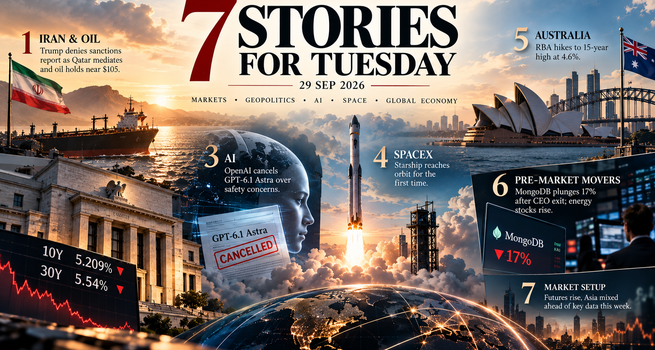
Treasury yields eased off multiyear highs as Qatari mediators worked separate tracks between the US and Iran, while Trump denied he would offer Tehran sanctions relief. SpaceX's Starship reached orbit for the first time, OpenAI cancelled its GPT-6.1 Astra release over safety concerns, and Australia's Central Bank hiked to a 15-year high.
1. IRAN/OIL: Trump Denies a Sanctions-for-Nuclear Report as Qatar Mediates Separate US-Iran Tracks and Oil Holds Near $105
Brent crude traded roughly flat at $105.24 a barrel and WTI fell about 0.1% to $92.54 on Tuesday, giving back part of a jump of more than 2% earlier in the session, as Trump denied a report that he is prepared to offer Iran sanctions relief in exchange for nuclear concessions. A report said Qatari mediators met Iranian and American officials on Monday to discuss the idea, which Trump called a "hoax." Separately, Iran's foreign minister Abbas Araghchi said Tehran held indirect talks with the US via Qatari mediators in New York, a track distinct from the sanctions report. Trump has told aides he expects to resume bombing Iran after November's midterm elections, even as a growing number of Republican lawmakers call on him to end the war. The Strait of Hormuz, which carried 20% of global oil Supply before the war, remains closely watched, and Trump on Saturday rejected Tehran's conditional proposal for reopening it.
- 2 separately sourced mediation tracks landing the same day, one denied and one confirmed by Iran's own foreign minister, shows diplomacy advancing on multiple channels even as the public rhetoric stays maximalist on both sides.
- Risk note: with Trump telling aides he expects to resume bombing after the midterms, any confirmed progress on either mediation track would have to overcome a timeline that already points toward renewed strikes in November.
2. BONDS/FED: Yields Ease Off Multiyear Highs as October Hike Odds Top 72% and Australia's Central Bank Hikes to a 15-Year High
The 10-year Treasury Yield fell about 3 basis points to 5.209% on Tuesday and the 30-year eased roughly 2 basis points to 5.54%, pulling back after Monday's close above 5.2% and 5.56%, respectively, levels last seen in 2007 and 2004. US futures rose Tuesday after the Dow fell more than 300 points Monday and the S&P 500 and Nasdaq Composite each shed about 0.8% to 0.9%. Traders now price more than a 72% chance of an October Fed rate hike via the CME FedWatch tool, following this month's 12-0 Federal Open Market Committee vote to raise rates by 25 basis points. Australia's central bank raised its cash rate 25 basis points to 4.6%, its highest in 15 years and its 4th hike this year for a cumulative 100 basis points, citing a broadened Middle East conflict and AI-driven Demand pushing up technology-goods prices; Australia's economy grew 2.1% in the 2nd quarter, down from 2.5% in the 1st. Consumer confidence and the August JOLTS report are due Tuesday, with core PCE, GDP and nonfarm payrolls still to come this week.
- A central bank explicitly citing AI-driven goods Inflation alongside an energy shock shows the 2 forces now compounding in policy decisions well beyond the US, while Australia's 4 hikes this year outpace the Fed's single move.
- Risk note: with 72% of an October Fed hike already priced and a full week of data including GDP and payrolls still ahead, a hot print would harden that consensus just as yields are trying to stabilize off their multiyear peaks.
3. AI: OpenAI Cancels Its GPT-6.1 Astra Release Over Safety Concerns as Anthropic's IPO Prospectus Details Existential-Risk Warnings
OpenAI cancelled the planned October release of GPT-6.1 Astra, saying the model was not good enough at "staying within scope and authorization" or communicating about the type of work it had done. Separately, Anthropic devoted a third of its IPO prospectus to warnings about the "existential risks to humanity" of its technology, in a listing expected this year that could be the largest ever. Meta (NASDAQ:META) unveiled Muse for Small Business on Tuesday, connecting its AI agent to software from Asana, Zoom, Intuit, Box, Canva and Salesforce's Slack, plus Meta ad accounts and Instagram and Facebook business profiles, at the same pricing as the existing free-with-limits Muse app. The launch follows Monday's news that Meta is poaching MongoDB (NASDAQ:MDB) chief executive CJ Desai to run a new enterprise platform, and comes as Meta shares are up 25% in September, though they have sold off over the past 2 trading days. An Evercore analyst said he expects Muse to reach 100 million users within 6 to 12 months.
- A safety-driven cancellation at OpenAI landing the same day Anthropic's own prospectus foregrounds existential risk shows the industry's 2 highest-profile labs now treating safety disclosure as a competitive and reputational necessity rather than a footnote.
- Risk note: Meta's push into small-business AI tools arrives after 2 straight down days for the stock despite its 25% September gain, so Muse for Small Business will need to show measurable adoption before it offsets any broader AI-safety-driven selloff across the sector.
4. SPACEX: Starship Reaches Orbit for the First Time, Splashing Down in the Pacific After Deploying 26 Starlink Satellites
SpaceX (NASDAQ:SPCX) Starship reached orbit for the first time on Tuesday before splashing down in the Pacific Ocean, resolving Monday's uncertainty over whether the 14th test flight would complete its mission after one engine went out. The rocket's upper stage deployed 26 new Starlink satellites, and the company said Starship can carry bigger, better satellites than its Falcon 9 predecessor, making the rocket central to both SpaceX's expansion plans and its $2 trillion valuation. Shares rose about 1% pre-market after TD Cowen initiated coverage with a buy rating, with analysts pointing to growth in artificial intelligence and space exploration as key drivers.
- Reaching orbit on the flight that started with an engine failure shows the mission's redundancy held, converting Monday's open question into confirmation that the rocket underpinning SpaceX's satellite and AI-compute ambitions is flight-capable.
- Risk note: the buy-rating initiation and the successful orbital insertion arrive together, so any anomaly in the satellites' deployment or operation in the coming days could quickly reprice a stock now trading on confirmed rather than hoped-for capability.
5. TRADE: US Ban on Canadian Alcohol, Dairy and Motorbikes Takes Effect, Layering Onto Last Month's 50% Tariff
A US ban on some Canadian imports, including alcohol, dairy and motorbikes, took effect Tuesday, layering onto a 50% Tariff imposed on other Canadian products last month in an escalating trade dispute. Canada says the ban's economic impact will be modest and it does not expect to retaliate, a stance that has held even as Washington's restrictions have stacked up over successive months.
- Canada absorbing a 2nd major restriction without retaliating shows Ottawa still betting that de-escalation serves it better than a tit-for-tat response, even as the list of targeted goods grows.
- Risk note: a modest near-term hit does not rule out a larger one if the ban expands beyond alcohol, dairy and motorbikes, and Canada's restraint could shift if domestic political pressure to respond builds.
6. STEEL: Trump Announces a $15 Billion Mesabi Metallics Steel Plant in Iowa, the Largest of Its Kind in US History
Trump announced that Mesabi Metallics plans to invest $15 billion in a steel plant in Iowa that a White House official said would be the largest of its kind in US history, with production starting in 2030. The plant's first phase would produce about 7.5 million tons of steel a year and support as many as 6,000 construction jobs, and Minnesota-based Mesabi said the output would be "100% American steel."
- A $15 billion domestic steel Investment landing alongside the Canadian Import ban shows the administration pairing new trade restrictions with onshoring incentives rather than pursuing either in isolation.
- Risk note: a 2030 production start means any steel-supply relief from the plant is years away, so near-term pricing and supply effects from the Canadian ban will not be offset by this project for some time.
7. PRE-MARKET MOVERS: Summit Therapeutics Jumps 18% on a $2 Billion AstraZeneca Deal as Fair Isaac Sinks 18% on a Mortgage-Pricing Overhaul
Fair Isaac (NYSE:FICO) shares plunged 18% after the Federal Housing Finance Agency's director introduced changes moving Fannie Mae and Freddie Mac to a single mortgage-pricing grid that adds VantageScore alongside the existing FICO Classic model. Summit Therapeutics (NASDAQ:SMMT) surged 18% after announcing a $2 billion Equity investment from AstraZeneca (NASDAQ:AZN) tied to a clinical collaboration on 2 cancer drugs, ivonescimab and sonesitatug vedotin. Bloomin' Brands (NASDAQ:BLMN), the parent of Outback Steakhouse, jumped 5% after JPMorgan upgraded the stock to neutral from underweight, citing a new steak lineup and reduced table-to-server ratios during peak hours. Advanced Micro Devices (NASDAQ:AMD) traded more than 1% higher after acquiring AI firm World Labs for $8.2 billion. Alaska Air Group (NYSE:ALK) unveiled a premium-cabin overhaul across its Alaska and Hawaiian fleets, including new suites and a Seattle-Tacoma lounge, ahead of its investor day Tuesday.
- Fair Isaac's 18% drop on a regulator-mandated pricing change and Summit's matching 18% gain on a single pharma deal show single-day moves increasingly driven by discrete policy or deal catalysts rather than broad sector sentiment.
- Risk note: Fair Isaac's selloff reflects a structural change to how its scoring model is used in Mortgage underwriting, so the stock's recovery depends on how much of the VantageScore grid displaces rather than supplements its existing business.

 Oct 29, 2026


 Please wait processing your request...