
 CA
 NZ
 UK
 AU
 IND

 US

 Share
 X (Formerly Twitter)
 Whatsapp
 Facebook
 LinkedIn
 Telegram
 Email This Article
 Copy Link
 Summarize with AI
 Chat GPT
 Perplexity
Key Highlights
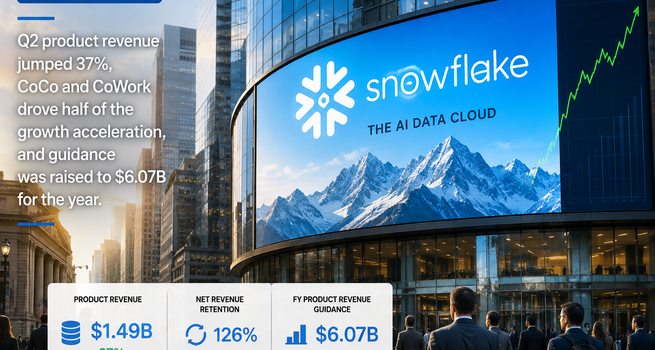
- Snowflake shares surged roughly 22 percent in after-hours trading and nearly 24 percent in the following pre-market session, approaching a fresh all-time high.
- Product Revenue grew 37 percent year-over-year to $1.49 billion, marking the company's third consecutive quarter of growth acceleration.
- Full-year product revenue guidance was raised to $6.07 billion from $5.84 billion, a jump far larger than a routine beat-and-raise quarter typically produces.
- AI-native products CoCo and CoWork now account for roughly half of the quarter's growth acceleration, with CoCo accounts up more than 2,000 in a single quarter to over 9,100.
- Non-GAAP Operating Margin expanded more than 400 basis points year-over-year to 15 percent, even as AI workloads carry a lower gross contribution margin than the core platform.
A Rally Built on Three Quarters, Not One
Single-quarter beats happen often enough in software Earnings that markets have grown numb to them. What moved Snowflake (NYSE:SNOW) was different: this is the third straight quarter in which growth has accelerated, not merely held steady or edged past a lowered bar. Product revenue growth climbed from 30 percent year-over-year as recently as the fourth quarter of the prior fiscal year to 37 percent today, a seven-point swing in two quarters for a company already generating billions in quarterly revenue. Growth that compounds upward instead of decaying as the base gets larger is rare enough at this scale that it reset how investors are pricing the stock overnight.
Second-quarter revenue reached $1.55 billion, up 35 percent year-over-year, ahead of the $1.48 billion analysts had modeled. Product revenue, the company's primary growth metric, came in at $1.49 billion, up 37 percent. Adjusted Earnings Per Share hit 62 cents against a 45 cents consensus estimate, and the net loss narrowed to $191.7 million from $297.9 million a year earlier. Shares jumped roughly 22 percent in after-hours trading immediately following the release and extended into the next morning's pre-market session, at one point trading up nearly 24 percent from the prior close and within reach of a record high. Sell-Side desks responded quickly with a wave of price target increases, and the strength carried into at least one data-platform peer trading sympathetically higher in the same session, a sharp contrast to the more cautious reception given to other software names earlier in the week.
The AI Products Are No Longer a Side Story
For two years, enterprise software companies have promised investors that AI would eventually show up in the numbers. Snowflake's quarter is one of the cleanest examples yet of that promise being kept.
The company's AI-native products, an agentic automation tool called CoCo and a broader workspace assistant called CoWork, are compounding fast. CoCo accounts surpassed 9,100, up more than 2,000 in a single quarter, while CoWork adoption reached 5,800 accounts. Management was specific about the mechanics: these tools bring new workloads onto the platform, generate direct usage revenue of their own, and customers who adopt them tend to consume more of Snowflake's core data platform as a result. Executives attributed roughly half of the quarter's growth acceleration to this AI product suite, with the rest coming from continued core platform strength, including a wave of large-scale migrations that AI tools are now helping customers complete in a fraction of the time such projects used to take.
A large Australian bank moved its financial crime detection platform onto Snowflake, processing 17 billion transactions with a tenfold improvement in query speed, and is now using AI agents to migrate the rest of its data estate. A network equipment manufacturer completed a Teradata migration in under three quarters, a project management said would historically have taken two to three years. These are not marginal efficiency gains. They compress the timeline between a customer signing a contract and that customer consuming at scale, which is exactly the lever that turns bookings into recognized revenue faster.
Retention Numbers Say the Growth Is Sticky
Net revenue retention held at 126 percent, meaning the existing customer base is spending well beyond original contract levels. Customers spending more than $1 million annually reached 828, up 27 percent year-over-year, and 65 customers have now crossed $10 million in trailing twelve-month product revenue. Remaining performance obligations, a proxy for contracted future revenue, grew 30 percent year-over-year to $9 billion.
What stood out in management's commentary was a shift in who is buying. Sales conversations that once sat almost entirely with data and engineering teams now regularly include chief financial officers, chief revenue officers, and chief Marketing officers, as AI tools pull the platform into functions that never touched a data Warehouse directly before. That broadening of buyer personas is the core reason executives gave for believing the acceleration reflects durable Demand rather than a short-lived AI enthusiasm spike.
Snowflake is also treating its own operations as a live case study. Marketing eliminated roughly $400,000 in annual agency spend by bringing search optimization in-house through CoCo, cutting content production time from about a day to two hours. Finance replaced a three-person planning team and more than 50 spreadsheets with a single analyst supported by AI-driven models. Sales automated prospecting across more than 125,000 contacts, with most initial outbound emails for inbound leads now generated before a sales rep ever touches them. That internal usage has become a selling point in its own right, giving the sales team specific, quantified outcomes to point to instead of hypothetical use cases.
Margins Expanded Despite a Lower-Margin Product Mix
Non-GAAP operating margin reached 15 percent, up more than 400 basis points year-over-year, driven by revenue growth outpacing a deliberate slowdown in hiring. The company added 334 employees year-to-date, well below the 935 added over the same period a year earlier, with part of that total tied to a recent Acquisition rather than organic growth.
The more interesting detail is that this margin expansion happened despite AI workloads carrying a lower gross contribution margin than the core data platform. Full-year non-GAAP product gross margin guidance was trimmed slightly to 74 percent to reflect that mix shift, yet full-year operating margin guidance was raised, from 13.5 percent to 14.5 percent. Management's explanation is straightforward: AI product revenue is growing fast enough to outpace the incremental cost of delivering it, generating Operating Leverage even as gross margin absorbs pressure from a heavier AI mix. The company reiterated that it remains on track for GAAP profitability in the fourth quarter of fiscal 2028.
A Guidance Raise Too Large to Ignore
Full-year product revenue guidance moved to $6.07 billion, representing 36 percent year-over-year growth, up from a prior forecast of $5.84 billion and 31 percent growth. Third-quarter guidance of $1.588 billion to $1.593 billion implies 37 to 38 percent growth, signaling management expects the acceleration to hold rather than fade.
That is a substantially larger raise than a typical beat-and-raise quarter produces, and it is the likely driver behind how widespread the post-earnings price target increases were. Management emphasized that guidance is still built entirely from observed consumption behavior rather than forward assumptions, meaning the raised outlook reflects patterns already visible in the data rather than optimism about what AI adoption might eventually deliver.
What Would Change the Story
The open questions sit around durability, not demand. Management acknowledged it does not yet have precise data on how much additional lifetime consumption AI adoption generates per customer, leaning instead on cohort-level trends and the breadth of new use cases as evidence the uplift reflects genuine expanded usage rather than projects simply pulled forward from later quarters. Gross margin pressure from the AI mix shift is also worth tracking over several quarters, since the current operating leverage story depends on AI revenue growth continuing to outrun the cost of delivering it at scale.
For now, the signal from this quarter is hard to dismiss. Three consecutive quarters of accelerating growth, margin expansion in the same quarter gross margin came under pressure, retention holding above 125 percent, and a guidance raise large enough to force analyst models to be rebuilt. Enterprise AI spending is not just showing up in Snowflake's pipeline anymore. It is showing up in the revenue line, quarter after quarter.


 Nov 04, 2026





 Please wait processing your request...