
 CA
 NZ
 UK
 AU
 IND

 US

 Share
 X (Formerly Twitter)
 Whatsapp
 Facebook
 LinkedIn
 Telegram
 Email This Article
 Copy Link
 Summarize with AI
 Chat GPT
 Perplexity
Key Highlights
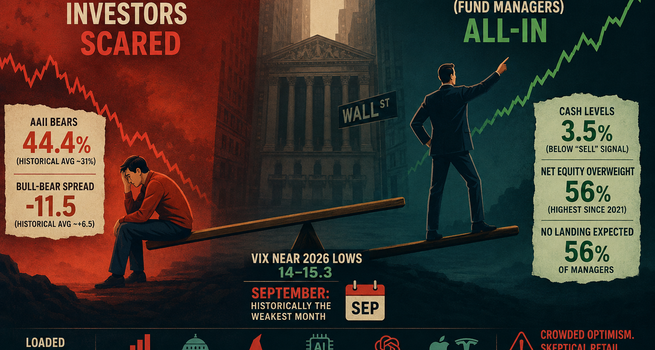
- Retail investors are the most bearish in two months, with AAII bears at 44.4% against a historical average near 31%
- Fund managers are the most bullish since 2021, holding just 3.5% cash, below BofA's own "sell signal" threshold
- The VIX sits near 2026 lows even as September opens, historically the market's weakest month
- A loaded September calendar (CPI, the Fed, and mega-cap AI earnings) could force one side to capitulate
Two investors look at the same market and see two different worlds. One is nervous, hedged, and bracing for trouble. The other is fully invested, low on cash, and betting the good times keep rolling. As September 2026 opens, historically the worst month of the year for the S&P 500, that gap has rarely been wider.
The retail investor is scared
The American Association of Individual Investors' weekly survey, for the week ending August 26, tells a clear story. Bulls: 32.9%, below the long-run average of 37.5%. Bears: 44.4%, well above the historical norm of roughly 31% and a two-month high. Neutral sentiment has collapsed to 22.6%: investors are picking a side, and the side is fear.
The bull-bear spread now sits at minus 11.5 points, against a long-run average near plus 6.5. Bears have outnumbered bulls for six straight weeks, and in 21 of the last 26. That is elevated pessimism. It is not, however, a historic extreme; those readings typically run above 50% bearish. AAII's own back-tested history carries an ironic twist: sustained readings in the 40–45% bearish range have more often preceded decent six- to twelve-month returns than market crashes. Retail fear here reads as a soft contrarian cushion, not a warning siren.
Fund managers are the opposite: all-in
Bank of America's Global Fund Manager Survey, taken in early-to-mid August, shows professional money leaning the hardest into risk it has in years. Cash levels have fallen to 3.5% of assets, the sixth-lowest reading since 1998, and below the 4% threshold that triggers BofA's own contrarian "cash rule" sell signal. Net Equity overweight stands at 56%, the highest since November 2021, and the 14th consecutive month that global fund managers have run overweight equities.
The survey ranked as the third-most bullish since 2022. A record 56% of respondents now expect a "no landing" scenario: no meaningful economic slowdown at all. Confidence in double-digit Earnings growth is the strongest since August 2021, and 71% of managers don't expect AI Capital spending to be cut this year. Tellingly, the single biggest Tail risk managers cite isn't recession; it's an AI Bubble bursting.
This is a crowded trade. Full portfolios and empty cash reserves mean institutions have little dry powder left to buy a dip if one arrives.
The corroborating gauges
The picture holds up across other institutional measures. BofA's own Bull & Bear Indicator sits near 9.7 on a 0–10 scale, the highest since 2021, and above the 8.0 level the bank treats as a sell signal, which it first crossed back in late May. Investors Intelligence, which tracks newsletter writers, shows a bull-bear ratio near 3.9 with bulls at roughly 57%, elevated, though short of the 4-to-1-plus readings some technicians treat as a true extreme.
The NAAIM Exposure Index, which measures active managers' reported equity exposure, last printed publicly at 79.7 in late July, down from a June spike near 99 (the series went behind a paywall on August 1, so live August readings aren't freely available). High, but not maxed out. Goldman's US Equity Sentiment Indicator, by contrast, has cooled to 0.27, its lowest since early June, suggesting even bullish positioning is losing a bit of momentum beneath the surface.
Volatility markets: calm, maybe too calm
If institutions are worried, Options markets aren't pricing it. The VIX has recently traded between 14 and 15.3, near 2026 lows after a quiet summer. Historically, the VIX tends to drift higher from late August through September and October, a seasonal pattern that has nothing to do with an actual crisis. A 14-handle leaves plenty of room for Volatility to rise without implying anything close to a crash.
CNN's Fear & Greed index sits around 50–54: neutral, neither euphoric nor panicked. Put-call activity in VIX options has stayed generally quiet, though mid-August saw sporadic bursts of VIX call buying, hedges creeping in even as spot volatility stayed subdued. Speculators in VIX futures remain net short volatility, a typical posture in a grinding-higher tape, but one that can amplify any sudden spike.
What could break the calm
September's calendar is unusually loaded. The labor and Inflation data stack (jobs, PPI, and CPI around September 11, followed by PCE later in the month) sets the stage for the FOMC meeting around September 16–17, complete with a fresh dot plot and press conference, followed immediately by triple-witching. Any hawkish surprise would land squarely on a consensus that has priced in "no landing" and no near-term rate hikes.
Layer on mega-cap and AI-related earnings (Broadcom, Oracle, Micron), OpenAI's DevDay, and product events from Apple and Tesla, all capable of moving the narrow Leadership group that has carried the index all year. Add the midterm-year overlay: history shows weaker August-through-October stretches in midterm years, with larger average intra-year drawdowns and lows often clustering in September and October. That's a pattern, not a forecast, but it's one more reason September carries its well-worn reputation as the only calendar month with a negative average S&P return going back to the late 1920s, around -0.6% across all years and somewhat worse in midterm years.
The bottom line
Retail investors are hedging emotionally. Professional fund managers are positioned for growth to continue uninterrupted, with almost no cash cushion if it doesn't. Options markets aren't charging much of a premium for a September surprise. None of these signals time the next two weeks; they simply show who has already committed capital and who still has room left to buy or sell. That combination (crowded institutional optimism, skeptical retail, and cheap volatility heading into a seasonally weak, headline-heavy month) tends to produce wider two-way trading ranges rather than a clean trend in either direction. Watch the next AAII print, due Thursday, and any fresh read from BofA's fund manager survey: a further spike in retail fear alongside a still-dormant VIX would keep this divergence firmly intact.


 Nov 04, 2026




 Please wait processing your request...