
 AU
AU
 UK
UK
 CA
CA
 NZ
NZ
 IND
IND

 US
US

 Share
Share
 X (Formerly Twitter)
 Whatsapp
 Facebook
 LinkedIn
 Telegram
 Email This Article
 Copy Link
 Summarize with AI
 Chat GPT
 Perplexity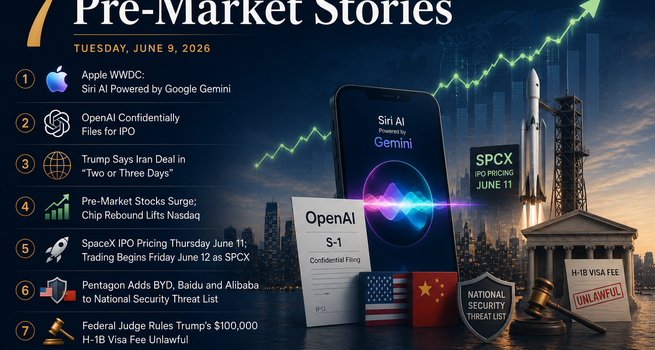
Apple unveiled Siri AI powered by Google Gemini at its final WWDC under Tim Cook, OpenAI confidentially filed for an IPO, and Trump says an Iran deal could arrive in two or three days. S&P 500 futures up 0.43%, Nasdaq 100 futures up 0.72%, Dow futures up 0.26%. South Korea's Kospi rebounded 8.18% to 8,096.93. Nikkei up over 2% to 65,416.63.
1. Technology: Apple WWDC Recap, Siri AI Powered by Google Gemini; iOS 27; AFM Cloud Pro on Nvidia GPUs; Stock Falls 1.89%
Apple's (NASDAQ: AAPL) Worldwide Developers Conference keynote Monday unveiled Siri AI, the biggest upgrade in Siri's history. Siri AI is powered by Google's (NASDAQ: GOOGL) Gemini models; Apple is paying Google $1 billion annually for a custom 1.2 trillion parameter Gemini LLM. Siri AI is rebuilt with deep system-wide understanding of personal context and on-screen awareness, is more conversational, supports cross-device continuity, and gets a new dedicated app.
Apple's most advanced AI model, AFM Cloud Pro, runs on Nvidia (NASDAQ: NVDA) GPUs in Google's cloud. iOS 27 and macOS Golden Gate were announced. Siri AI will not be available in the EU or China at launch due to regulatory challenges. The stock fell 1.89% to $301.54, turning negative just after 2:00 PM ET after opening up 2%. Tim Cook wiped a tear at the end of the keynote, his last WWDC as CEO. John Ternus takes over on September 1; Cook becomes executive chairman.
- Apple's strategy bets that ensuring its devices are the main way users access AI is the smarter and cheaper path than competing in the model wars, Craig Federighi scoffed at companies "doing AI for the sake of AI, without clear regard to the people it's ultimately meant to serve."
- AFM Cloud Pro running on Nvidia GPUs in Google's cloud creates a three-way commercial relationship between Apple, Nvidia, and Google, directly relevant to all three stocks.
- Risk note: Siri AI unavailable in the EU and China removes two of Apple's largest markets from day-one adoption; the stock's negative close despite strong announcements suggests investors remain skeptical the overhaul is transformative enough to drive a new hardware upgrade cycle.
2. Capital-markets/">Capital Markets: OpenAI Confidentially Files for IPO; All Three Major AI Labs Now Filed Simultaneously
OpenAI confidentially filed for a U.S. IPO, completing the three-way AI IPO race alongside Anthropic and SpaceX. OpenAI raised $122 billion in March at an $852 billion valuation. Sam Altman fended off a legal challenge from Elon Musk last month, clearing a key hurdle to a public listing. OpenAI said: "We recently submitted a confidential S-1. We expect it to leak so we're just announcing it. We have not decided on timing yet; it may be a while because there are things we want to do that are likely easier as a private company." The company could go public as soon as Q4 2026. Anthropic filed on June 1 at a $965 billion valuation with a $47 billion Revenue run rate. SpaceX prices Thursday June 11 with trading beginning Friday June 12 on Nasdaq as SPCX. The combined Demand for capital from all three will be so considerable that analysts have warned it is likely to create disruptions in capital markets.
- The three-way simultaneous filing is without precedent in U.S. capital markets history; three companies each valued above $800 billion are racing to public markets within weeks of each other.
- Anthropic's $965 billion valuation surpasses OpenAI's $852 billion, making it the most valuable private AI company in the world heading into its own listing.
- Risk note: the combined capital raise from all three could exceed $100 billion, competing for a finite pool of institutional investor capital and potentially crowding out other listings scheduled for the same window.
3. Geopolitics and Energy: Trump Says Iran Deal in "Two or Three Days"; Israel Stops Strikes at Trump's Request; Brent at $94
Iran halted military strikes against Israel on Monday but warned it would resume attacks if Israeli forces continue operations in Lebanon, Tehran's foreign ministry confirmed. Hours later, Netanyahu said the conflict was "not yet over" despite both adversaries being "significantly weakened." Trump posted on Truth Social that Israel and Iran "are looking to do an immediate ceasefire" and said a deal could be reached in "two or three days." Brent fell to around $94. The 60-day MOU still awaits Trump's signature; Iran must clear Hormuz mines within 30 days under the proposed terms with no tolls permitted on shipping.
- Iraq and UAE are racing to establish alternative oil pipelines as Hormuz exports dry up, a structural development that will affect Supply routes regardless of whether the deal is signed.
- Iran has made a Lebanon ceasefire a condition for a deal with Washington; the Lebanon-Israel ceasefire is currently holding, partially restoring that precondition.
- Risk note: Trump's "two or three days" language has appeared before without producing a signed deal; oil markets are pricing optimism that could reverse sharply if the MOU falls apart again this week.
4. Markets: Monday Close and Tuesday Pre-Market, Chip Rebound Lifts Nasdaq; Kospi Jumps 8.18%
The S&P 500 gained 0.30% to 7,405.73 Monday. The Nasdaq rose 0.86% to 25,929.66. The Dow fell 0.16% to 50,786.01. Micron (NASDAQ: MU) surged close to 10% after falling 13% Friday, leading the chip rebound. Nvidia and Broadcom also closed higher. Tuesday pre-market: S&P futures up 0.43%, Nasdaq 100 futures up 0.72%, Dow futures up 0.26%. South Korea's Kospi rebounded 8.18% to 8,096.93. Nikkei rose over 2% to 65,416.63.
Pre-market movers: Nuvalent (NASDAQ: NUVL) up 39% after GSK announced a $10.6 billion Acquisition agreement. J.M. Smucker (NYSE: SJM) up 3.5% after Q4 Earnings of $2.77 per share beat the $2.64 FactSet estimate; revenue of $2.27 billion also topped forecasts. SailPoint (NYSE: SAIL) down 12% after full-year guidance disappointed; the company projects adjusted EPS of $0.30 to $0.34, below the $0.32 FactSet consensus. Alibaba (NYSE: BABA) up 0.9% after the Pentagon added the company, along with Baidu and BYD, to a list of entities believed to have aided the Chinese military. Vail Resorts (NYSE: MTN) down 4.9% after Q3 EPS of $8.81 missed the $8.96 estimate. Chip stocks continued their rebound, with the VanEck Semiconductor ETF (NASDAQ: SMH) up 1.8%; Micron (NASDAQ: MU) gained 5% and Qualcomm (NASDAQ: QCOM) rose 2.6%.
- The Kospi's 8.18% single-day rebound after Monday's 8% decline is the most volatile two-day swing for a major index since the Iran war began.
- Risk note: the chip rebound is a "buy the dip" reaction, not a fundamental re-rating; CPI Wednesday and the June 16-17 FOMC remain the two events that could validate or reverse the recovery.
5. Capital Markets: SpaceX IPO Pricing Thursday June 11; Trading Begins Friday June 12 as SPCX
SpaceX confirmed $135 per share for its IPO, targeting a $75 billion raise at a $1.75 trillion valuation. Pricing expected after the market close Thursday June 11, with trading beginning Friday June 12 on Nasdaq as SPCX. Up to 30% of the offering is being allocated to individual investors, with access via Robinhood and SoFi. S&P Global blocked SpaceX from S&P 500 inclusion due to its $4.94 billion net loss in 2025; Nasdaq 100 inclusion remains on track.
- SPCX trading on June 12 coincides with the FIFA World Cup opening match in the U.S., creating a unique retail investor awareness moment for the listing.
- Nasdaq 100 inclusion will force Index Funds to buy a sizeable portion of publicly available SpaceX shares, generating significant forced buying pressure in the days following listing.
- Risk note: SpaceX's AI segment lost $2.47 billion in Q1, V3 booster reusability remains unproven, and Musk's 85.1% voting control leaves public investors with no meaningful governance rights.
6. Geopolitics: Pentagon Adds BYD, Baidu and Alibaba to National Security Threat List; U.S.-China Summit Implications
The Pentagon added a slew of Chinese companies including Alibaba (NYSE: BABA), Baidu (NASDAQ: BIDU), and BYD (OTC: BYDDY) to its "1260H list" of entities believed to have aided China's military. The designations do not impose explicit sanctions but mean the Pentagon will be prohibited from contracting directly with listed companies starting later this month, and from procuring their products through third parties beginning 2027. The announcement may complicate upcoming U.S.-China summits and the new U.S.-China Board of Trade discussions announced last week.
- China's May exports rose 19.4% year over year beating the 15% consensus, with U.S.-bound shipments soaring 35.4%, the highest growth since March 2021; AI-related technology goods, EVs, batteries, and solar products are driving the surge, a direct rebuttal to the Tariff pressure narrative.
- The simultaneous tariff proposals, Pentagon security designations, and China export surge signal a contradictory dynamic: U.S. pressure is escalating while Chinese exports to the U.S. are accelerating, suggesting supply chain decoupling is slower than policy suggests.
- Risk note: the contradictory policy environment of simultaneous pressure and engagement creates uncertainty for multinational companies with exposure to both U.S. defence contracts and Chinese supply chains.
7. Legal: Federal Judge Rules Trump's $100,000 H-1B Visa Fee Unlawful; Tech Sector Hiring Costs Relieved
A federal judge ruled that Trump's proposed $100,000 charge on new H-1B visa applications is unlawful. Several states had sued after the fee was announced in September. The H-1B visa is mostly used by technology firms hiring foreign graduates for software engineering, AI research, and data science roles. The ruling directly relieves a major cost burden on U.S. technology companies. The decision adds to a pattern of courts striking down Trump administration policies, the Supreme Court previously struck down broad Liberation Day tariffs under the International Emergency Economic Powers Act.
- The $100,000 fee would have effectively ended new international tech hiring for small and mid-cap companies, which cannot absorb per-visa costs at that level.
- The ruling arrives as the FIFA World Cup begins in the U.S., where immigration enforcement has already barred a Somali referee from entry, signalling continued friction between the administration's immigration stance and international engagement.
- Risk note: the administration is likely to appeal; the ruling may be temporary pending a higher court review, leaving the $100,000 fee as a latent risk for tech hiring costs until a final determination is made.


 Jun 08, 2026




 Please wait processing your request...