
 CA
 NZ
 UK
 AU
 IND

 US

 Share
 X (Formerly Twitter)
 Whatsapp
 Facebook
 LinkedIn
 Telegram
 Email This Article
 Copy Link
 Summarize with AI
 Chat GPT
 Perplexity
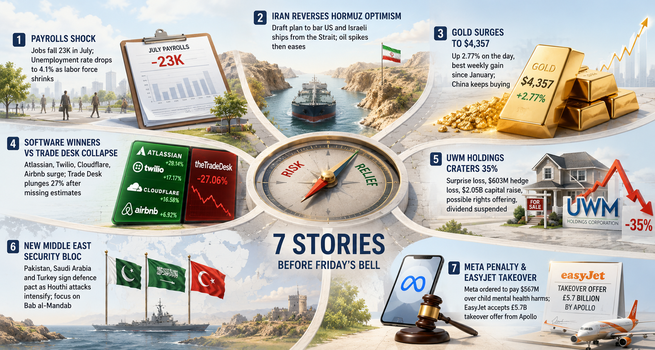
July payrolls unexpectedly fell 23,000 against a forecast 83,000 gain, yet the unemployment rate dropped to 4.1% as hundreds of thousands left the workforce. Iranian state media reported a new draft plan barring US and Israeli ships from the Strait of Hormuz, reversing this week's deal optimism and sending oil higher before it eased this morning. Gold surged 2.77% to $4,357 and silver jumped 5.24% on the uncertainty, while Atlassian, Cloudflare, Twilio, and Airbnb all posted strong earnings and UWM Holdings suffered its worst day on record.
1. JOBS: Payrolls Fall 23,000, Worst Miss Since the Series Began; Unemployment Rate Drops to 4.1% as Participation Falls to a Five-Year Low
Nonfarm payrolls fell by 23,000 in July, against a forecast gain of 83,000, while June's initially reported 57,000 gain was revised down to just 20,000, leaving May and June combined 103,000 lower than previously reported. Employment declined in local government education and retail trade, while healthcare continued its upward trend, though at a slower pace than its 12-month average. Despite the payroll miss, the unemployment rate fell to 4.1% from 4.2%, as the labor force contracted by 264,000 to 169.094 million and the participation rate dropped to 61.4%, its lowest level since March 2021; the employment-population ratio fell to a four-year low of 58.9%. The broader U-6 measure of underemployment held steady at 7.9%. Average hourly earnings rose 2 cents to $37.62, up 3.2% over the year. Futures rose on the report: Nasdaq 100 futures gained 0.8%, S&P 500 futures added 0.4%, and Dow futures rose 110 points.
- A falling unemployment rate driven by workers leaving the labor force rather than finding jobs is a materially weaker signal than the headline 4.1% figure suggests, and the 264,000 person contraction in the labor force is the more important number in today's release.
- The 103,000 combined downward revision to May and June, on top of July's outright decline, extends a pattern of payroll growth being revised away after the fact that has now persisted for several months running.
- Risk note: futures rising on a weak jobs report reflects the market pricing faster Fed rate cuts rather than genuine economic strength; if next month's data confirms a genuine labour market slowdown rather than a one-off participation drop, today's rally could prove to have been reading the wrong signal from the same release.
2. IRAN/HORMUZ: Iranian State Media Reports New Draft Plan Barring US and Israeli Ships From the Strait, Reversing This Week's Deal Optimism; Oil Spikes Then Eases
Iranian state media reported that a new draft plan for managing the Strait of Hormuz would bar ships from the United States, Israel, and other countries it considers hostile, a sharp reversal from the toll-free shipping route agreement with Oman reported earlier this week. Iran's parliament is reviewing the proposal. Oil prices jumped on the report, reversing course after this week's decline on hopes for a deal, though prices have eased since: WTI fell 0.6% to $76.85 and Brent slipped 0.7% to $81.90 this morning. Separately, a global shortage in refining capacity could push US gasoline prices to a record high around the Labor Day holiday regardless of where crude prices ultimately settle.
- The whiplash between this week's toll-free Iran-Oman agreement and today's reported ship-barring proposal illustrates how unstable the underlying negotiating position remains, even as both reports originate from Iranian state-linked sources within days of each other.
- The refining capacity shortage decoupling pump prices from crude oil direction means a resolved Hormuz standoff would no longer guarantee relief at the gas station, a distinction that changes how much disinflationary benefit markets should expect even from a genuine de-escalation.
- Risk note: if Iran's parliament formally adopts a plan barring US and Israeli shipping, it would represent a direct rather than ambiguous provocation, a different category of escalation than the strikes and counter-strikes that have characterised this conflict so far, and one with less room for face-saving de-escalation on either side.
3. GOLD/SILVER: Gold Heads for Biggest Weekly Gain Since January, Up Over 7%; September Hike Odds Fall to 55% From 67%; China Buys Most Reserves Since 2023
Gold surged to $4,357.19 an ounce, up 2.77% on the day and on track for its biggest weekly rise since January with gains of more than 7% for the week; silver jumped 5.24% to $64.717. The move accelerated after this week's Middle East de-escalation lowered rate-hike expectations, and traders now see a 55% chance of a September rate increase, down from 67% a week earlier, according to the CME FedWatch Tool; one analyst attributed the move to fading conviction that Fed Chair Warsh will be as hawkish as previously expected. Gold broke above its 50-day moving average this week, which now offers support near $4,151, with the 100-day average acting as resistance around $4,389. China's central bank added to its gold reserves for a fifth straight month in July, its largest monthly addition since October 2023. Platinum rose 1.7% to $1,758.13 and palladium gained 0.7% to $1,380.50, with both metals also headed for weekly gains.
- A rate-hike probability falling from 67% to 55% in a single week is a substantial repricing for a policy variable that typically moves gradually, and it confirms gold's rally is being driven primarily by Fed expectations rather than a pure safe-haven bid.
- China's fifth consecutive month of reserve accumulation, at its fastest pace in nearly two years, adds a structural buyer beneath the market independent of this week's rate-driven momentum, a distinction that matters for how durable today's move proves to be.
- Risk note: gold sits just below its 100-day moving average resistance at $4,389; a nonfarm payrolls print strong enough to revive rate-hike expectations would remove the primary driver of this week's rally and could see gold retreat toward the 50-day support level near $4,151, though today's weaker-than-expected jobs report makes that scenario less likely for now.
4. EARNINGS: Atlassian Jumps 29%, Twilio Surges 17%, Cloudflare Up 16.5%; Trade Desk Craters 27% on a Big Miss; Airbnb Rises 7% on a Beat and Raised Guidance
Atlassian (NASDAQ:TEAM) shares jumped more than 29% after beating on revenue and issuing guidance for 13% year-over-year growth, narrowly short of the 13.4% consensus. Twilio (NYSE:TWLO) surged more than 17% after guiding third-quarter adjusted earnings to $1.42-1.47 per share on revenue of $1.51-1.52 billion, both above consensus, and raising full-year revenue growth guidance to 18-18.5% from a prior 14-15% range. Cloudflare (NYSE:NET) jumped more than 16.5% after issuing third-quarter guidance of $0.34 adjusted EPS on $736-737 million in revenue, above the $0.32 and $722 million consensus, with second-quarter results also beating estimates. Akamai Technologies (NASDAQ:AKAM) rose 8.3% after beating on both lines.
Airbnb (NASDAQ:ABNB) surged nearly 7% after posting second-quarter earnings of $1.37 per share on revenue of $3.61 billion, ahead of the $1.25 and $3.58 billion consensus; revenue grew 17% year over year, nights and seats booked rose 10%, and the company raised full-year guidance, now expecting revenue growth of at least mid-teens and adjusted EBITDA margin of at least 35.5%. First Solar (NASDAQ:FSLR) and other solar names rose 2-5% after Trump imposed a 15% tariff on polysilicon-based imports and set minimum prices on related products aimed at protecting domestic solar supply chains from Chinese competition. On the downside, Trade Desk (NASDAQ:TTD) tanked 27% after second-quarter adjusted earnings of $0.34 missed the $0.40 estimate and revenue of $715 million missed the $751 million forecast, and Wendy's (NASDAQ:WEN) fell 2% after global sales declined more than 6%, driven by an 8.2% US decline, prompting the company to withdraw its 2026 outlook despite beating on earnings, revenue, and adjusted EBITDA.
- The cluster of software and cloud names beating and raising guidance by wide margins, Twilio and Cloudflare both lifting full-year growth expectations by roughly 3-4 percentage points, suggests enterprise cloud and communications spending is accelerating broadly rather than in isolated pockets.
- Airbnb's guidance raise stands out for citing AI-driven operational improvements directly, including a roughly 16% reduction in customer support costs per booking, as a specific margin driver rather than only volume growth.
- Risk note: Trade Desk's 27% collapse on a revenue miss, arriving the same week as several other advertising and consumer-facing misses in this series, raises the question of whether digital ad spending is genuinely softening even as enterprise software spending accelerates in the same market.
5. UWM HOLDINGS: Shares Crater 35% in Worst Day on Record After Surprise Loss, $603 Million Hedge Loss, and Dilutive $2.05 Billion Capital Raise
UWM Holdings (NYSE:UWMC) plunged roughly 35% in its worst single-day decline on record after swinging to a surprise second-quarter adjusted loss of $0.23 per share against an expected $0.07 profit, driven partly by a $603.2 million derivatives and hedge loss tied to a failed bid for Two Harbors, despite revenue beating estimates at $888 million. The selloff intensified after the company announced a dilutive $2.05 billion capital infusion from the Ishbia family, via SFS Group Capital, and Oaktree Capital in preferred equity and warrants, alongside a potential $400 million rights offering to Class A shareholders at a minimum $2 per share and suspension of its common dividend to prioritise debt paydown.
- A $603 million hedge loss tied to a failed acquisition bid is an unusually large single-item charge relative to the company's size, and it converts what might otherwise have been read as a manageable earnings miss into a genuine balance-sheet stress event.
- The combination of dilutive capital raising, a rights offering, and a suspended dividend in a single announcement is the kind of package companies typically reserve for addressing real liquidity or leverage concerns rather than routine capital management.
- Risk note: rising Treasury yields have already been pressuring mortgage lenders broadly by souring refinancing activity and housing demand; UWM's collapse raises the question of whether this is an isolated failed-bet story or an early signal of stress building more broadly across the mortgage lending sector as the K-shaped housing market widens.
6. MIDDLE EAST SECURITY: Pakistan, Saudi Arabia and Turkey Sign Trilateral Defence Pact; Houthis Escalate Yemen Attacks; Saudi Arabia Reportedly Preparing Offensive Over Bab al-Mandab
Pakistan, Saudi Arabia, and Turkey signed a trilateral defence pact after nearly a year of negotiations, pledging to retaliate together if any of the three is attacked; Pakistan's foreign ministry said the agreement would strengthen collective deterrence. Separately, the Houthis intensified attacks against Yemen's government, reportedly killing at least 30 troops and injuring 17 civilians in shelling; Saudi Arabia is reportedly preparing an offensive against the group in an effort to break its chokehold on Saudi oil exports passing through the Bab al-Mandab strait. Trump separately lashed out at reports of a US munitions shortage stemming from strikes on Iran, vowing long-term jail sentences for anyone found to have leaked the information.
- A formal trilateral defence pact between three major regional and Muslim-majority powers is a structural realignment distinct from the day-to-day escalation and de-escalation cycle running through the Iran conflict, and it signals regional states are hedging against the conflict's unpredictability with independent security guarantees.
- A potential Saudi offensive against the Houthis over Bab al-Mandab opens a second major maritime chokepoint to direct military conflict, layering onto the Hormuz uncertainty in story 2 rather than replacing it.
- Risk note: Trump's threat of jail sentences over munitions-shortage leaks suggests the reported shortage is significant enough to prompt an aggressive suppression response; if the underlying shortage is confirmed independently, it would validate the operational constraint on US strike capacity that has been an intermittent theme throughout this conflict.
7. META/EASYJET: Judge Orders Meta to Pay $567 Million Over Child Mental Health Harms; EasyJet Accepts £5.7 Billion Takeover From Apollo After Castlelake Withdraws
A US judge ordered Meta (NASDAQ:META) to pay $567 million toward the treatment and prevention of mental health problems in children, adding to a prior $375 million penalty in the same case over the company's failure to warn users that content on its platforms posed risks to children's safety; Meta said it would appeal. Separately, EasyJet accepted a £5.7 billion ($7.7 billion) takeover offer from Apollo, the American investment firm, after rival suitor Castlelake abandoned its own bid; unlike Castlelake, which was seen as likely to break up the airline, Apollo has pledged to invest in EasyJet's fleet upgrades and expand its holiday packages business.
- A combined $942 million in penalties against Meta in a single case over child safety disclosures is among the largest such awards in this series, and the company's decision to appeal rather than settle signals it expects to contest the underlying legal theory rather than simply the amount.
- Apollo's pledge to invest in EasyJet's operations rather than break it up, in contrast to Castlelake's presumed strategy, suggests the winning bid was shaped as much by strategic positioning against shareholder and regulatory scrutiny as by price alone.
- Risk note: Meta's appeal keeps the ultimate financial exposure from this case unresolved, meaning today's $567 million figure could still be reduced, increased, or expanded to cover additional related claims depending on how the appellate process unfolds.
Markets Intelligence Briefing is an informational and analytical publication. Nothing contained herein constitutes investment advice, a recommendation to buy or sell any security, or a price target. All analysis is presented for informational purposes only. Investors should conduct their own due diligence before making any investment decision.


 Nov 26, 2026





 Please wait processing your request...