
 AU
AU
 UK
UK
 CA
CA
 NZ
NZ
 IND
IND

 US
US

 Share
Share
 X (Formerly Twitter)
 Whatsapp
 Facebook
 LinkedIn
 Telegram
 Email This Article
 Copy Link
 Summarize with AI
 Chat GPT
 Perplexity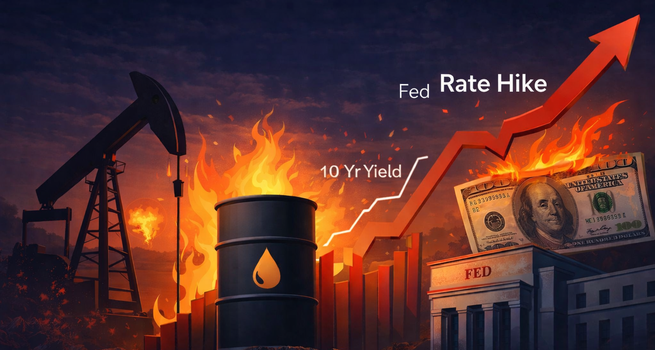
Key Highlights
- Markets now price a 50 percent probability of a Fed rate hike by end 2026
- Oil above $100 per barrel is reigniting inflation concerns globally
- US 10 year yields have risen sharply, tightening financial conditions
- ECB policy is shifting toward further tightening despite weak growth
- Sustained energy prices could push US inflation back above 3 percent
Introduction: A Sudden Shift in Market Expectations
Financial markets are undergoing a sharp and unexpected repricing of monetary policy. Only months ago, investors were positioning for an aggressive easing cycle from the US Federal Reserve, with expectations of multiple rate cuts in 2026. That narrative has now reversed.
A surge in oil prices, driven by geopolitical tensions and supply disruptions, has reintroduced inflation risk into the global economy. As a result, markets are now assigning a meaningful probability to further rate hikes by the Federal Reserve before the end of 2026. This shift has occurred rapidly, catching both investors and policymakers off guard.
The re-emergence of inflation risk is not just a macroeconomic concern. It has immediate implications for asset allocation, bond yields, housing markets, and equity valuations. The return of a higher for longer interest rate regime is no longer a tail risk. It is becoming a base case.
Global Macro Trends and Energy Market Shock
The current market shift is rooted in a classic macroeconomic trigger. Energy prices.
Oil has surged above $100 per barrel, driven by escalating geopolitical tensions, particularly in the Middle East. Supply disruptions, combined with constrained spare capacity among major producers, have tightened global energy markets at a time when demand remains resilient.
Gasoline prices have risen nearly 50 percent over a four month period, feeding directly into consumer inflation expectations. Energy remains one of the most visible and politically sensitive components of inflation, amplifying its impact on sentiment.
Historically, energy shocks have had an outsized influence on monetary policy. They act as both a direct inflation driver and an indirect tax on consumers, reducing discretionary spending while increasing headline CPI.
At the same time, global central banks are responding differently to this new reality. The European Central Bank, despite weak growth in the eurozone, is now expected to deliver additional rate hikes. This reflects a broader concern that inflation expectations could become unanchored if policymakers appear complacent.
The combination of rising energy prices and synchronized tightening signals marks a shift away from the disinflationary environment that dominated recent quarters.
Bond Market Reaction and Financial Conditions
The bond market has been the first to respond to this changing macro backdrop.
The US 10 year Treasury yield has risen by approximately 40 basis points since the onset of geopolitical tensions. This move reflects both higher inflation expectations and a repricing of the terminal policy rate.
Rising yields have a direct transmission mechanism into the broader economy. Mortgage rates have climbed to new highs for 2026, putting renewed pressure on the housing market. Higher borrowing costs also affect corporate financing, capital expenditure decisions, and equity valuations.
Importantly, this tightening in financial conditions is occurring without any formal action from the Federal Reserve. Markets are effectively doing the Fed’s job by pricing in tighter policy.
This dynamic creates a feedback loop. As yields rise, they reinforce expectations that the Fed will need to maintain or even increase restrictive policy settings to contain inflation.
Inflation Outlook: Energy as the Key Driver
The resurgence of inflation risk is closely tied to the trajectory of energy prices.
Current models suggest that if oil prices remain at elevated levels for an extended period, US CPI inflation could rise to approximately 3.3 percent. This would represent a meaningful deviation from the Fed’s 2 percent target and could delay any easing cycle.
Energy price shocks tend to have both immediate and lagged effects on inflation. While gasoline and utilities feed directly into headline CPI, higher transportation and production costs eventually pass through to core inflation.
There is also a psychological component. Rising fuel prices are highly visible to consumers, shaping inflation expectations more strongly than less tangible components. If expectations begin to drift higher, the Fed may be forced to act more aggressively to maintain credibility.
This is particularly important in the current environment, where the disinflation trend had only recently gained traction. A reversal at this stage risks undoing progress and complicating policy decisions.
Central Bank Policy Outlook: From Cuts to Constraints
The Federal Reserve now faces a more complex policy landscape.
Earlier expectations of multiple rate cuts were based on a steady decline in inflation and signs of economic moderation. However, the resurgence in energy driven inflation challenges this narrative.
Markets are now pricing a roughly 50 percent probability of a rate hike by the end of 2026. While this does not represent a consensus view, it signals a significant shift in expectations.
For the Fed, the key question is whether the current inflation pressures are transitory or persistent. If energy prices stabilize or decline, policymakers may still proceed with gradual easing. However, if elevated prices persist, the Fed may need to maintain restrictive policy or even tighten further.
The European Central Bank’s stance adds another layer of complexity. Expected rate hikes in Europe suggest that global monetary policy may remain tighter for longer than previously anticipated. This reduces the likelihood of coordinated easing and increases the risk of policy divergence.
Financial and Market Implications
The implications of this shift are broad and significant.
Equity Markets and Valuation Pressure
Higher interest rates generally compress equity valuations by increasing discount rates. Growth stocks, which rely on future earnings, are particularly sensitive to rising yields.
At the same time, sectors linked to energy and commodities may benefit from higher prices. This creates a divergence within equity markets, favoring value and cyclical sectors over high growth names.
Fixed Income and Yield Repricing
Bond markets are undergoing a repricing of both inflation expectations and policy rates. Investors face a more uncertain outlook, with increased volatility in yields.
Long duration assets are particularly vulnerable in this environment. Shorter duration instruments may offer relative stability, but at the cost of lower yield potential.
Housing and Consumer Impact
Rising mortgage rates are likely to dampen housing demand. This could slow activity in one of the most interest rate sensitive sectors of the economy.
Higher energy costs also reduce disposable income, affecting consumer spending patterns. This creates a dual headwind for economic growth.
Capital Allocation and Asset Ownership
The return of higher inflation and interest rates shifts the focus toward real assets. Commodities, real estate, and infrastructure tend to perform better in inflationary environments.
The broader implication is a growing divergence between asset owners and non asset holders. Inflation erodes purchasing power, while asset prices often adjust upward, creating a widening wealth gap.
Investment Strategy and Market Positioning
Investors are now navigating a more complex and less predictable environment.
The key challenge is balancing inflation risk with potential growth slowdown. Traditional diversification strategies may be less effective if both equities and bonds face simultaneous pressure.
Portfolio positioning is likely to shift toward:
- Inflation hedges such as commodities and energy equities
- Shorter duration fixed income instruments
- Selective exposure to sectors with pricing power
At the same time, liquidity and risk management become increasingly important. Market volatility is likely to remain elevated as policy expectations continue to evolve.
Strategic Outlook: What Comes Next
The outlook hinges on several key variables.
First, the trajectory of oil prices will be critical. Sustained levels above $100 per barrel would reinforce inflation pressures and increase the likelihood of further tightening.
Second, geopolitical developments will play a central role. Any escalation or resolution could significantly impact energy markets and investor sentiment.
Third, central bank communication will be closely watched. The Fed’s ability to manage expectations without triggering market instability will be crucial.
Finally, the resilience of the global economy will determine how much tightening it can absorb. A stronger than expected economy may support higher rates, while a slowdown could force policymakers to reconsider.
Conclusion: The Return of Policy Uncertainty
The rapid shift from rate cut expectations to the possibility of rate hikes underscores the fragile nature of the current macro environment.
Energy prices have once again emerged as a dominant force, reshaping inflation dynamics and monetary policy outlooks. The return of higher for longer is no longer a theoretical scenario. It is increasingly reflected in market pricing.
For investors, the message is clear. The era of easy policy support may not return as quickly as expected. Navigating this environment requires adaptability, disciplined risk management, and a renewed focus on real assets and inflation resilience.
The gap between those positioned for inflation and those reliant on stable prices is likely to widen. In this context, asset ownership becomes not just a strategy, but a necessity.
FAQ Section
- Why are markets now expecting a Fed rate hike instead of cuts?
Markets are reacting to rising inflation risks driven by higher energy prices. Oil above $100 per barrel is pushing inflation expectations higher, reducing the likelihood of rate cuts and increasing the probability of further tightening. - How do oil prices affect inflation so strongly?
Oil impacts transportation, production, and consumer costs directly. Higher fuel prices increase headline inflation and influence consumer expectations, which can spill over into broader price increases across the economy. - What does higher bond yield mean for investors?
Higher yields increase borrowing costs and reduce the present value of future cash flows. This typically pressures equity valuations and makes fixed income investments more attractive relative to risk assets. - Why is the European Central Bank also tightening policy?
The ECB is concerned about persistent inflation despite weak economic growth. Rising energy prices and inflation expectations are forcing policymakers to prioritize price stability over short term growth concerns. - What investment strategy works in a higher inflation environment?
Investors often favor real assets such as commodities, energy stocks, and real estate. Short duration bonds and companies with strong pricing power also tend to perform better during periods of elevated inflation.

_06_12_2026_23_00_13_327450.jpg)
 Jun 12, 2026




 Please wait processing your request...