
 AU
AU
 UK
UK
 CA
CA
 NZ
NZ
 IND
IND

 US
US

 Share
Share
 X (Formerly Twitter)
 Whatsapp
 Facebook
 LinkedIn
 Telegram
 Email This Article
 Copy Link
 Summarize with AI
 Chat GPT
 Perplexity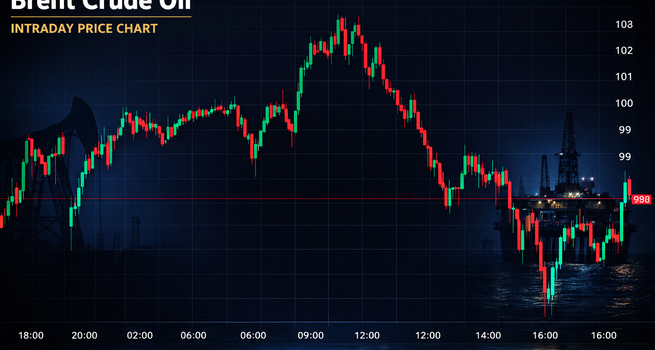
Key Highlights
- Oil prices fell below $97 per barrel after the US allowed Iranian oil shipments through the Strait of Hormuz.
• The move signals a temporary easing of supply risks in global energy markets.
• Traders rapidly unwound geopolitical risk premiums embedded in crude prices.
• The decision could add incremental Iranian barrels to already fragile global supply balances.
• Investors now reassess the near term oil price outlook amid shifting geopolitical dynamics.
Introduction: Oil Markets React to Sudden Policy Shift
Global oil markets moved sharply lower after a significant geopolitical development in the Middle East. Crude prices slipped below $97 per barrel following news that the United States would allow Iranian oil shipments to pass through the Strait of Hormuz.
The decision represents a notable shift in the delicate balance of energy geopolitics. For months, crude prices had been supported by rising tensions around the Persian Gulf, where the Strait of Hormuz serves as one of the most critical arteries for global oil transportation.
Roughly one fifth of the world's oil supply flows through this narrow maritime corridor each day. Any disruption to this route immediately introduces supply fears into the global energy market.
The US decision to allow Iranian crude shipments through the passage has therefore triggered a rapid repricing across oil futures markets.
Investors are now reassessing whether the geopolitical premium that had been embedded in oil prices remains justified.
Global Oil Market Outlook: The Strategic Importance of the Strait of Hormuz
The Strait of Hormuz is arguably the most strategically sensitive chokepoint in the global energy system. Located between Oman and Iran, the narrow passage connects the Persian Gulf to international shipping routes.
Approximately 20 million barrels of oil per day transit the strait. This includes exports from Saudi Arabia, the United Arab Emirates, Kuwait, Iraq, and Iran.
Because of its strategic significance, even minor disruptions can create immediate volatility in global energy markets.
Recent tensions in the region had already elevated risk perceptions among traders and institutional investors. Insurance premiums on tanker routes had increased, and shipping companies had begun reassessing transit risks.
This environment had pushed Brent crude prices toward the $100 mark.
However, the US decision to allow Iranian oil flows through the strait effectively signals a short term de escalation of supply disruptions. That message alone was enough to trigger a rapid unwind in oil futures positions.
Oil Supply Dynamics: Iranian Barrels Return to the Market
One of the most important implications of the decision is the potential return of additional Iranian crude to global markets.
Iran possesses one of the largest proven oil reserves in the world and has the capacity to increase exports relatively quickly if logistical constraints are removed.
Even limited incremental flows can influence market sentiment.
Analysts estimate that Iran has the ability to add between 500,000 and 1 million barrels per day to global supply if export channels remain open. While actual flows depend on sanctions enforcement and shipping capacity, the mere possibility of additional barrels can shift market expectations.
For traders, oil prices are determined as much by future expectations as by current supply.
If market participants believe that Iranian oil will re-enter global supply chains, the tightness that previously supported prices begins to ease.
This dynamic explains why crude prices reacted almost immediately after the policy announcement.
Global Energy Market Trends: Risk Premium Unwinds
Oil prices are not only a reflection of physical supply and demand. They also incorporate geopolitical risk premiums.
Over the past several months, tensions in the Middle East had embedded a substantial premium into crude markets. Traders feared that any escalation could disrupt tanker routes or regional production.
The possibility of a blockade or military confrontation around the Strait of Hormuz had been one of the largest drivers of upward price pressure.
When the US announced it would allow Iranian oil shipments to pass through the corridor, that geopolitical risk premium rapidly deflated.
Energy markets tend to move quickly when narrative shifts occur.
In this case, the narrative changed from imminent disruption to cautious normalization.
As a result, speculative positions betting on higher prices were unwound, contributing to the sudden drop below the $97 threshold.
Oil Market Supply and Demand Analysis
Despite the immediate price decline, the structural dynamics of the global oil market remain complex.
Demand growth continues to be supported by emerging economies, particularly across Asia. China and India remain major drivers of incremental consumption as industrial activity and mobility trends continue to expand.
At the same time, supply growth outside the Middle East remains uneven.
US shale production has stabilized but is not expanding at the same pace seen earlier in the last decade. Capital discipline among American producers has limited aggressive output expansion.
Meanwhile, OPEC+ production policies remain a central variable.
Several producers have maintained voluntary output constraints to support price stability. If Iranian barrels return to the market in meaningful volumes, OPEC may need to reconsider its supply management strategy.
This creates an interesting balancing act for global energy policymakers.
Financial and Market Implications for Investors
The immediate impact of the price drop was felt across energy equities and commodity linked assets.
Oil producers tend to trade closely with the trajectory of crude prices. A decline below $97 per barrel therefore introduces short term valuation pressure on upstream energy companies.
However, the broader picture remains nuanced.
Even at current levels, oil prices remain historically elevated relative to long term averages. Many producers remain highly profitable at prices well below $90 per barrel.
For institutional investors, the key question is whether this decline represents a temporary correction or the beginning of a larger trend.
If Iranian supply flows remain consistent, crude prices could stabilize within a broader range rather than continuing their recent upward trajectory.
At the same time, geopolitical uncertainty has not fully disappeared.
The Middle East remains one of the most volatile regions in global energy markets. Any escalation in tensions could quickly reverse the current price movement.
As a result, volatility is likely to remain a defining feature of oil markets in the coming months.
Oil Price Outlook: Key Catalysts to Watch
Several factors will determine the next phase of the oil market cycle.
First, the scale of Iranian export flows will be closely monitored. If shipments increase significantly, global supply expectations could shift meaningfully.
Second, OPEC production strategy will remain critical. The cartel has historically adjusted output to maintain price stability.
Third, global demand trends will play a decisive role. Slower economic growth in major economies could dampen consumption growth and weigh on prices.
Finally, geopolitical developments across the Middle East will continue to shape investor sentiment.
Even temporary disruptions around the Strait of Hormuz can introduce dramatic price swings.
For now, the market appears to be transitioning from panic driven risk pricing to a more balanced supply outlook.
Strategic Outlook for the Global Energy Market
The recent price drop highlights how sensitive energy markets remain to geopolitical developments.
Structural energy demand continues to grow, particularly across developing economies. At the same time, supply growth remains constrained by capital discipline and regulatory pressures.
This combination means that oil markets are likely to remain structurally tight over the medium term.
However, short term volatility will continue to emerge whenever geopolitical dynamics shift.
The US decision regarding Iranian oil shipments represents a clear example of how quickly market sentiment can change.
For investors, the lesson is clear. Energy markets are increasingly shaped by political decisions as much as by physical supply.
Understanding this intersection between geopolitics and commodity markets will remain essential for navigating the evolving oil landscape.
Conclusion
Oil prices falling below $97 per barrel following the US decision to allow Iranian oil shipments through the Strait of Hormuz illustrates the powerful role geopolitics plays in global energy markets.
While the move has temporarily eased supply fears, the underlying structural tightness of the oil market remains intact.
For investors, the coming months will hinge on the pace of Iranian exports, OPEC production policy, and broader geopolitical developments across the Middle East.
In a market defined by uncertainty, volatility remains the only constant.
FAQ
Why did oil prices fall after the US allowed Iranian oil shipments?
Oil prices declined because the decision reduces fears of supply disruptions through the Strait of Hormuz. Traders quickly removed the geopolitical risk premium that had been supporting crude prices in recent weeks.
How important is the Strait of Hormuz to global oil markets?
The Strait of Hormuz handles roughly 20 percent of global oil shipments. Any disruption in this narrow corridor can immediately impact supply expectations and trigger large price movements in energy markets.
Could Iranian oil significantly increase global supply?
Yes. Iran has the potential to add between 500,000 and 1 million barrels per day if export restrictions ease. Even modest increases can influence market sentiment and affect global oil price dynamics.
Will oil prices continue to fall from here?
Future price movements will depend on Iranian export levels, OPEC production decisions, and global economic growth. Geopolitical developments in the Middle East will also remain a major driver of oil market volatility.
How does this affect energy sector investments?
Short term oil price declines can pressure energy stocks, but many producers remain profitable at current price levels. Investors will focus on supply trends, capital discipline, and long term demand growth in global energy markets.

_06_12_2026_23_00_13_327450.jpg)
 Jun 12, 2026




 Please wait processing your request...