
 CA
 NZ
 UK
 AU
 IND

 US

 Share
 X (Formerly Twitter)
 Whatsapp
 Facebook
 LinkedIn
 Telegram
 Email This Article
 Copy Link
 Summarize with AI
 Chat GPT
 Perplexity
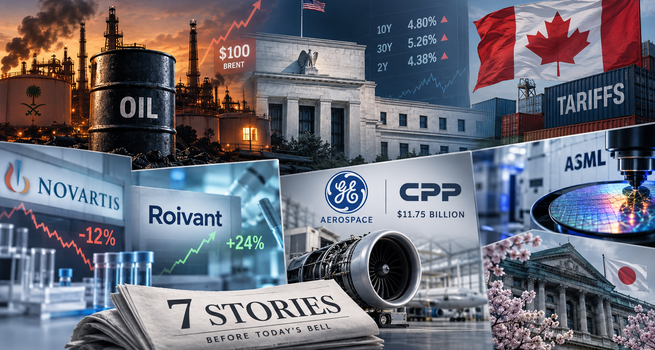
Brent crude hurtled toward $100 a barrel after Saudi Arabia's energy ministry said operations at certain facilities halted following Houthi strikes, pushing Treasury yields toward their highest since November 2023 ahead of this week's Inflation data. Novartis suffered its third clinical trial setback in a week while Roivant surged on a positive pulmonary hypertension readout, GE Aerospace agreed to buy castings supplier CPP for $11.75 billion, and Canada's retaliatory tariffs took effect.
1. OIL/YIELDS: Brent Nears $100 as Saudi Facilities Halt Operations After Houthi Strikes; 10-Year Yield Approaches 2023 High
Brent crude rose as much as 2.3% to $99.22 a barrel and WTI climbed 3.3% to $94.54, extending a third straight day of gains to six-week highs, after Saudi Arabia's energy ministry said operations at certain facilities halted following strikes by Iran-backed, Yemen-based Houthi militants. The move came as Iran and Oman appeared to be nearing a deal to manage shipping through the Strait of Hormuz, which AJ Bell's head of markets said merely underlines Tehran's continued control of the waterway. The US 10-year Treasury Yield rose more than 2 basis points to 4.804%, approaching last week's high, its highest since November 2023, while the 30-year climbed to 5.264% and the 2-year held flat near 4.383%. The CME FedWatch tool prices a 60% probability of a quarter-point hike at next week's September 15-16 meeting, with wholesale inflation data due Thursday and consumer prices Friday as the last major signals. Yardeni Research's president said a run of Central Bank meetings over the coming weeks will test whether Equity composure holds, with the ECB and Bank of Japan also expected to raise rates this month.
- Saudi Arabia disclosing halted operations rather than a confirmed attack signals widening Houthi strike capability beyond Yemen's borders, a geographic expansion that could reprice Gulf Supply risk beyond Iran-US hostilities alone.
- Risk note: with global central banks moving in the same tightening direction simultaneously, a hot US inflation print this week could trigger a coordinated repricing across currencies and bond markets rather than a US-isolated move.
2. HEALTHCARE: Novartis Craters 12.74% on Third Clinical Setback in a Week as Roivant Soars 24% on Pulmonary Hypertension Data
Novartis (NYSE:NVS) shares fell as much as 12.74% pre-market after del-desiran failed to meet its primary endpoint in the Phase III HARBOR study for myotonic dystrophy type 1, marking a third clinical trial setback within a week following last week's pelacarsen cardiovascular trial failure and the suspension of eight CAR-T cell therapy trials after three patient deaths. The stock, already down sharply Monday on the pelacarsen miss, is on track for one of its worst single-day declines on record, with investors questioning the depth of the late-stage pipeline even as management reaffirmed its 2025-2030 Revenue growth target of 5% to 6% compound annual growth. Some analysts, including Bank of America and Jefferies, maintained bullish or hold ratings citing pipeline Assets such as remibrutinib in multiple sclerosis, though concerns are mounting that additional M&A may be needed to offset the setbacks.
Roivant Sciences (NASDAQ:ROIV) shares rallied as much as 24% after Subsidiary Pulmovant reported Phase 2 results showing mosliciguat achieved a 56.3% placebo-adjusted reduction in pulmonary vascular resistance at Week 16 in patients with pulmonary hypertension associated with interstitial lung disease, among the largest such reductions ever reported in a randomized controlled trial; the drug also showed a 35.2-meter improvement in six-minute walk distance and a 53.2% decline in NT-proBNP, with a Phase 3 study now underway targeting a disease affecting up to 200,000 patients.
Separately, AstraZeneca (NASDAQ:AZN) published full Phase III results showing tozorakimab reduced moderate and severe COPD exacerbations by 29% to 34% across a broad population, the first biologic to demonstrate such efficacy regardless of blood eosinophil count or smoking status, with its US application accepted under Priority Review.
- Three separate late-stage failures within a single week represents pipeline attrition unusual even by large pharma standards, suggesting investors are pricing execution risk across Novartis's entire remaining clinical portfolio.
- Risk note: Roivant's rally rests on a single Phase 2 readout in a disease area with a history of late-stage disappointments, meaning enthusiasm ahead of Phase 3 data carries more binary risk than the initial move suggests.
3. SEMICONDUCTORS: Samsung and TSMC Commit to ASML's High NA EUV Machines as AI Chip Complexity Drives Demand
Samsung and TSMC (NYSE:TSM), the world's two biggest chipmakers, committed to using ASML's High NA extreme ultraviolet lithography machines, tools costing roughly $400 million each that print smaller, more intricate circuit patterns than prior-generation equipment. Samsung said it would use the machines to produce DRAM memory starting in 2028 and adopt the broader technology in 2030, while TSMC said it would use the tools for advanced chips, citing increasingly complex transistor architectures required for AI applications. The two join Intel (NASDAQ:INTC), which began using High NA EUV technology in July, as customers for the machines. Barclays said the announcements provide more visibility on adoption, calling the news a positive and noting ASML faces a decision on whether to expand EUV capacity beyond its already-raised targets given clearly strong demand. Samsung and TSMC will also join an industry initiative to advance next-generation 12-inch photomask technology, upgrading from the current 6-inch format. ASML shares traded flat to lower Tuesday despite the news, following a 120% run over the past year.
- Two of the industry's largest chipmakers committing to the same next-generation lithography platform within the same announcement window suggests the technology has crossed from experimental adoption to an industry standard faster than ASML's guidance anticipated.
- Risk note: with ASML facing a decision on further capacity expansion, any mismatch between committed customer Demand and the company's willingness to invest ahead of orders could create supply bottlenecks rippling through the broader AI chip production timeline.
4. GE AEROSPACE: Company to Buy Castings Supplier CPP for $11.75 Billion to Bolster In-House Manufacturing
GE Aerospace (NYSE:GE) said it will buy castings supplier Consolidated Precision Products from Investment firms Warburg Pincus and Berkshire Partners for $11.75 billion, as the company seeks greater control over a key source of precision castings used in jet engines. CEO Larry Culp said investing in mission-critical casting capacity is needed to support strong simultaneous demand across commercial engines, aftermarket, and defense, with the deal expected to expand capacity and accelerate new engine technologies. CPP is one of the world's largest producers of investment and precision sand castings, supplying components for commercial and military aircraft, helicopters, weapon systems, and industrial gas turbines, and has been a GE Aerospace supplier for more than 15 years across a workforce of about 6,600 employees at more than 20 facilities worldwide. The deal, expected to close in the second half of 2027, is projected to boost adjusted profit per share and free Cash Flow in its first year; GE Aerospace is paying 26 times CPP's expected 2027 core profit before integration benefits, or 18 times projected 2027 EBITDA including those benefits. Shares were largely flat pre-market. Visa (NYSE:V) also advanced its own infrastructure buildout Tuesday, saying it will pair settlement data with onchain lending platforms to support the roughly 160 stablecoin-linked card programs it now operates, up nearly 200% year over year.
- Paying 26 times core profit before integration benefits, well above typical industrial supplier multiples, signals GE Aerospace views owning this capacity as a strategic necessity rather than an opportunistic financial transaction.
- Risk note: with the deal not expected to close until the second half of 2027, GE Aerospace remains exposed to CPP's existing supply constraints for well over a year, meaning the capacity relief this Acquisition is meant to provide will not arrive quickly enough to address near-term production bottlenecks.
5. CANADA: Retaliatory Tariffs on $20 Billion of US Goods Take Effect as Trump Threatens Bombardier's Market Access
Canada's retaliatory tariffs on roughly $20 billion of US goods took effect Tuesday, escalating the trade dispute between the two countries. President Trump said Monday that Canadian aircraft manufacturer Bombardier cannot sell its products in the United States unless Canada begins Manufacturing them domestically. The tariffs arrive as US stock futures came under broader pressure Tuesday, with Wall Street also monitoring the US-Iran war, marking a shortened trading week following Monday's Labor Day closure.
- Trump's Bombardier comment tying market access directly to domestic manufacturing location signals the administration may extend the same reciprocity logic used in the broader Tariff dispute to individual companies and sectors.
- Risk note: with tariffs now in effect on both sides simultaneously, the dispute has moved from threatened to realized economic cost, removing the negotiating flexibility that existed while measures remained prospective.
6. PRE-MARKET MOVERS: Lockheed Rises on UBS Upgrade as Peloton Falls on Downgrade, Boston Scientific Cites Cyberattack Impact
Lockheed Martin (NYSE:LMT) shares rose 0.7% after UBS upgraded the stock to buy from neutral, citing underappreciated Earnings growth potential. Peloton Interactive (NASDAQ:PTON) shares fell more than 4% after Morgan Stanley downgraded the stock to underweight from equal weight, saying the company faces structural headwinds in fitness. Boston Scientific (NYSE:BSX) shares slipped more than 2% after saying a recent cyberattack likely impacted sales and profit targets for 2026.
- The same morning producing an upgrade grounded in earnings potential and two warnings tied to structural and operational risk shows analysts differentiating sharply between company fundamentals even as broader sentiment stays cautious.
- Risk note: Boston Scientific's disclosure that a cyberattack has already affected full-year guidance, rather than merely posing a future risk, suggests the impact may still be developing and could require further revisions.
7. MARKET SETUP: US Futures Fall as Asia Sinks Broadly, Small Business Optimism Deteriorates, Gold Slips Below $4,400
US stock futures fell Tuesday, with S&P 500 futures down 0.4% and Dow futures shedding 491 points, or 0.9%, as markets reopened after the Labor Day holiday. Asian markets closed broadly lower, with Japan's Nikkei 225 falling 1.7% and the Topix down 1.83%, South Korea's Kospi losing 0.58% and the Kosdaq dropping 1.25%, Australia's ASX 200 down 1%, and Hong Kong's Hang Seng and mainland China's CSI 300 both modestly lower. The NFIB Small Business Optimism index fell to 98.7 in August from 99.8 in July, below a 99.3 forecast, with a net negative 9% of owners reporting higher sales over the past three months, the lowest reading since November 2025, while inflation tied with taxes as owners' second-biggest concern at 16%. Gold slipped below $4,400 an ounce, extending losses from the prior session, pressured by expectations that major central banks will raise rates this month.
- The NFIB survey's sales component hitting its weakest level since November 2025 just as inflation concerns rise suggests Main Street is beginning to feel the cost pressures already showing up in Treasury markets.
- Risk note: gold's decline despite ongoing geopolitical tension shows rate-hike expectations are currently the dominant driver for the metal, meaning a dovish surprise from this week's inflation data could reverse the move quickly.


 Nov 13, 2026





 Please wait processing your request...