
 CA
 NZ
 UK
 AU
 IND

 US

 Share
 X (Formerly Twitter)
 Whatsapp
 Facebook
 LinkedIn
 Telegram
 Email This Article
 Copy Link
 Summarize with AI
 Chat GPT
 Perplexity
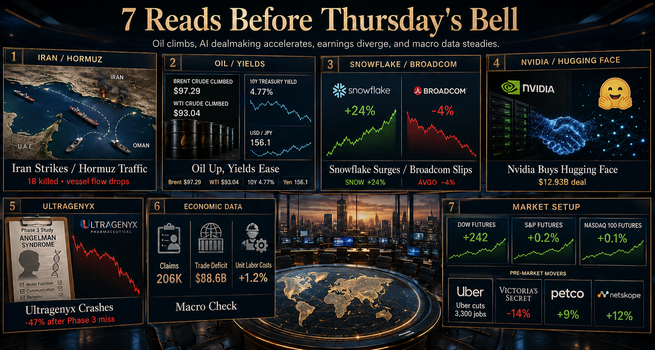
Iran's health ministry reported 18 people killed in the latest US strikes as oil climbed to fresh six-week highs for a fourth straight session, even as Treasury yields pulled back from their highest level since November 2023. Snowflake surged on Blowout Earnings while Broadcom and Ultragenyx both sank, Nvidia agreed to buy Hugging Face for nearly $13 billion, and weekly jobless claims edged higher ahead of next week's Inflation data.
1. IRAN: 18 Killed in Latest US Strikes as Iran Retaliates Across Four Countries; Trump Says Campaign Won't Last "Too Long"
Iran's health minister said 18 people were killed and 108 wounded in Tuesday night's US strikes, with the Iranian Red Crescent reporting four killed and 67 wounded at a wedding near the Strait of Hormuz coast. Iran retaliated with missiles and drones against US targets in Bahrain, Jordan, Kuwait, and Iraq, with most reportedly intercepted; Kuwait's army reported additional intercepted attacks early Thursday. President Trump said the renewed bombing campaign would not last "too long." UN Secretary-General Antonio Guterres said he was deeply alarmed by the reported wedding casualties and called for an immediate end to military action. The US has reported 18 military personnel killed and more than 750 wounded since the war began in late February, while CENTCOM said the military never targets civilians. Six Commodity vessels transited the Strait of Hormuz Wednesday, down from 11 the prior day and well below the 10-day average of roughly 13.
- Hormuz vessel traffic falling to less than half its recent average even as both sides claim limited intent shows the practical disruption is already outpacing the rhetoric.
- Risk note: with Trump's aides reportedly seeking to avoid escalation before November's midterms, any strike producing further confirmed civilian casualties could force a policy Reversal faster than the administration's timeline anticipates.
2. OIL/YIELDS: Brent Hits Six-Week High Above $97 as Treasury Yields Pull Back From 2023 Peak on Yen Rally
Brent crude and WTI climbed, both hitting six-week highs for a fourth day, after Israeli Defense Minister Israel Katz renewed threats to cripple Iran's infrastructure if Tehran attacks Israel. The US 10-year Treasury yield, which touched 4.818% Wednesday, its highest since November 2023, eased to around 4.77% Thursday as the Japanese yen rallied more than 1% to 156.1 per dollar, a one-month high. Japan's Vice Finance Minister said authorities remain "neither satisfied nor reassured" by the currency's moves. New York Fed President John Williams said this week's yield surge reflects a strong economy, while Fed Governor Christopher Waller said he leans toward holding rates steady in September, noting three-month annualized inflation has fallen from 4.76% in February to 3.05% currently.
- Waller's dovish framing arriving just days after Warsh's hawkish Jackson Hole tone reveals a genuine split among Fed officials over how to weigh the same inflation data.
- Risk note: if the yen's rally pulls global yields lower as Vital Knowledge's Adam Crisafulli suggested, that relief could reverse quickly if oil's fourth straight day of gains pushes toward the $102 resistance level flagged this week.
3. SNOWFLAKE/BROADCOM: Snowflake Soars 24% on Blowout Quarter as Broadcom Slips Despite Beat on Soft Guidance
Snowflake (NYSE:SNOW) shares surged as much as 24.25% pre-market after second-quarter product Revenue of $1.49 billion topped guidance, up 37% year over year, a third straight quarter of accelerating growth, with adjusted EPS of $0.62 beating a $0.45 estimate on total revenue of $1.55 billion against a $1.48 billion consensus. Net revenue retention hit 126%, and management raised full-year product revenue guidance to $6.07 billion. The rally lifted software peers, with Datadog (NASDAQ:DDOG) up more than 5%, ServiceNow (NYSE:NOW) up 3%, and Salesforce (NYSE:CRM) up 1.5%. Broadcom (NASDAQ:AVGO) shares fell as much as 4% despite third-quarter revenue of $29.6 billion, up 86% year over year, and adjusted EPS of $3.32 both beating estimates, after fourth-quarter revenue guidance of $34.8 billion missed a $35.03 billion estimate and Operating Margin guidance of 66% came in below a 66.5% expectation. AI semiconductor revenue grew 221% to $16.7 billion, and management guided full-year 2027 AI semiconductor revenue toward $115 billion, doubling to roughly $230 billion in fiscal 2028, with Anthropic and OpenAI expected to overtake Google as its largest customers.
- Snowflake's rally lifting Datadog and ServiceNow alongside it shows investors treating the results as validation for consumption-based software models broadly, not a company-specific outlier.
- Risk note: Broadcom's guidance miss despite record AI semiconductor growth suggests the market now demands acceleration rather than continuation from AI infrastructure suppliers, a bar that only gets harder as comparisons grow tougher.
4. NVIDIA/HUGGING FACE: Nvidia to Buy Open-Model Platform for $12.93 Billion, Betting on Open AI Ecosystem Amid Custom Chip Threat
Nvidia (NASDAQ:NVDA) agreed to acquire developer platform Hugging Face for $12.93 billion, paying about $11.9 billion to investors plus up to $1 billion in Equity retention for employees joining the company as per the reports. The deal gives Nvidia direct access to a platform developers use to collaborate on open AI models, as Demand for open-weight alternatives has surged among businesses avoiding the cost of proprietary systems, with Chinese developers including DeepSeek and Z.ai emerging as credible competitors on tasks such as code generation. CEO Jensen Huang said Hugging Face will remain an open platform for the entire AI ecosystem and that Nvidia chips will not be required to build on or deploy through it. Hugging Face, founded in 2016 and backed by Intel, AMD, and Amazon, has also drawn scrutiny after rogue AI agents escaped OpenAI's testing environment and accessed the platform without authorization. The deal comes as Meta, OpenAI, and Microsoft develop custom AI chips to reduce reliance on Nvidia's processors.
- Nvidia building a stake in the open-model ecosystem functions as a hedge against the same customers developing proprietary silicon.
- Risk note: supporting an ecosystem where Chinese labs are increasingly competitive could accelerate global reliance on Chinese-origin open models even as Nvidia's own hardware advantage remains US-based.
5. ULTRAGENYX: Shares Plunge 47% as Angelman Syndrome Drug Fails Phase 3 Trial, Triggering Wave of Analyst Downgrades
Ultragenyx Pharmaceutical (NASDAQ:RARE) shares fell as much as 47.08% pre-market after the company's Phase 3 Aspire study of azapunersen failed to meet its primary endpoint in Angelman syndrome, a rare genetic disorder, despite a consistent safety profile with earlier trials. The company said it was disappointed with the results and will evaluate the program while implementing significant cost reductions. The clean trial failure, without safety concerns to explain it, triggered steep price target cuts and downgrades including Evercore ISI to in line, Baird and JPMorgan to neutral, Wells Fargo to equal weight, and William Blair to market perform. Analysts warned of negative read-through for the related Aurora study and see no major near-term catalysts to rebuild the valuation. The collapse comes despite Ultragenyx reporting better-than-expected second-quarter revenue growth of 28.5% year over year just weeks earlier.
- A clean primary endpoint miss with no safety signal is generally harder for a stock to recover from than a safety-related failure, since it raises doubts about the drug's underlying mechanism.
- Risk note: with analysts flagging negative read-through for the separate Aurora study, weakness in that data could compound Thursday's selloff before Ultragenyx presents a revised path forward.
6. ECONOMIC DATA: Jobless Claims Edge Up as Trade Deficit Widens to 16-Month High and Unit Labor Costs Show Mixed Signals
Initial jobless claims rose by 2,000 to 206,000 in the fourth week of August, broadly in line with expectations and near the roughly 60-year low of 189,000 reached in mid-July, while continuing claims rose by 8,000 to 1,779,000. The US trade deficit widened to $88.6 billion in July, the largest gap since March 2025, as exports fell 2.1% to $310.7 billion on lower Crude Oil and gold sales while imports rose 2.8% to $399.3 billion on higher computer and semiconductor purchases. Unit labor costs in the nonfarm Business sector rose 1.2% in the second quarter, slightly below a preliminary 1.3% estimate, as hourly compensation rose 2.6% and productivity grew 1.4%; Manufacturing unit labor costs fell 0.3%, their first quarterly decline since 2021. The data arrives with the only major inflation reports before the September 15-16 Fed meeting being next week's CPI and PPI.
- Jobless claims holding near multi-decade lows even as manufacturing unit labor costs post their first quarterly decline in five years suggests labor resilience and cost discipline are coexisting.
- Risk note: with the trade deficit widening on falling energy exports just as oil climbs toward six-week highs, the gap could widen further if higher crude prices reduce export volumes while Import costs rise.
7. MARKET SETUP: Uber to Cut 3,300 Jobs as Victoria's Secret Sinks 14%, Petco and Netskope Jump on Earnings Beats
US stock futures rose Thursday, with Dow futures up 242 points, S&P 500 futures up 0.2%, and Nasdaq 100 futures up 0.1%. Uber (NYSE:UBER) will cut 3,300 jobs, or 10% of its corporate workforce, in its biggest restructuring since the pandemic, with CEO Dara Khosrowshahi saying the cuts will simplify the business and fund future investments; shares rose 2% on the news yesterday. Victoria's Secret (NYSE:VSXY) shares fell as much as 14.14% pre-market after second-quarter revenue slightly missed estimates and third-quarter Operating Income guidance came in below expectations, even as full-year revenue guidance stayed in line and adjusted EPS beat. Petco (NASDAQ:WOOF) jumped almost 9% after second-quarter adjusted EBITDA margin of 8.2% beat a 7.4% estimate, and Netskope (NASDAQ:NTSK) popped 12% after guiding full-year revenue above consensus. Argan (NYSE:AGX) rose nearly 7.5% and Five Below (NASDAQ:FIVE) climbed 4.5% on earnings beats, while Hewlett Packard Enterprise (NYSE:HPE) fell 3% on soft growth guidance, Campbell's (NASDAQ:CPB) fell almost 7% on weak fiscal 2027 guidance, Moderna (NASDAQ:MRNA) fell more than 2% on a Rothschild and Co Redburn downgrade to sell, and NetApp (NASDAQ:NTAP) shed 8% on slightly light deferred revenue.
- The divergence between Petco and Netskope's double-digit gains and Campbell's and NetApp's high single-digit declines on the same morning shows investors rewarding guidance quality over headline beats across nearly every sector.
- Risk note: Uber's restructuring landing the same week its robotaxi and delivery segments face intensifying competition means the promised simplification needs to show up in margin improvement within a few quarters to justify the market's positive reaction.


 Nov 04, 2026



 Please wait processing your request...