
 AU
AU
 UK
UK
 CA
CA
 NZ
NZ
 IND
IND

 US
US

 Share
Share
 X (Formerly Twitter)
 Whatsapp
 Facebook
 LinkedIn
 Telegram
 Email This Article
 Copy Link
 Summarize with AI
 Chat GPT
 Perplexity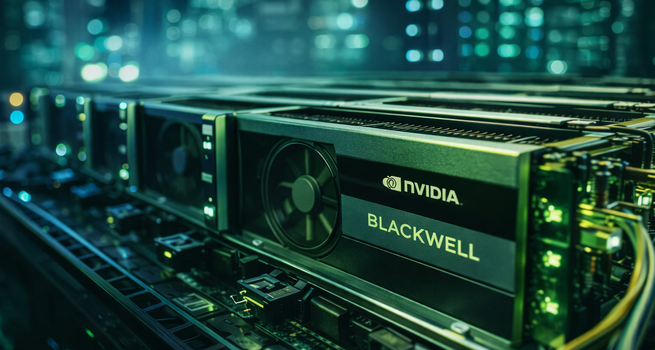
Rising GPU rental costs and constrained supply challenge assumptions of cloud scalability as AI demand accelerates. Nvidia’s Blackwell GPU rental prices surge 50% in three months as AI demand overwhelms supply, forcing companies like Anthropic to ration compute capacity.
Key Highlights
- Nvidia’s Blackwell GPU rental prices have risen roughly 50% in three months amid acute supply shortages
- Older-generation GPUs are commanding premiums, with A100 rates up 30–60% in secondary markets
- Anthropic has reduced compute intensity for its Claude model, signalling capacity constraints
- Lead times for advanced GPU clusters have extended to nine months or longer
- The surge reflects a structural shift as “reasoning models” dramatically increase compute demand
Rental prices for (NASDAQ: NVDA) Nvidia’s most advanced artificial intelligence chips have surged in recent months, underscoring a growing imbalance between supply and demand that is reshaping the economics of the semiconductor industry and cloud computing.
Prices for Blackwell-architecture GPUs have climbed by approximately 50 per cent since January, according to industry estimates, marking one of the sharpest short-term increases in the history of high-performance computing markets. The rise reflects an intensifying scramble among technology companies to secure the processing power required to run increasingly complex AI systems.
The development signals a broader shift. For more than a decade, cloud computing has operated on the assumption that capacity could expand elastically to meet demand. The current shortage suggests those assumptions are under strain, as physical constraints in chip manufacturing and data centre infrastructure begin to bind.
In January, Nvidia chief executive Jensen Huang indicated that even older chips were experiencing unexpected pricing pressure. At the time, the remark appeared anecdotal. Subsequent data suggests it was an early indicator of a more systemic dislocation.
The secondary market for older GPUs has tightened significantly. Ampere-generation A100 chips, once considered near the end of their premium lifecycle, are now seeing rental price increases of between 30 and 60 per cent. Inference workloads, which allow trained models to generate responses, can be run on less advanced hardware, turning legacy capacity into a valuable asset.
Blackwell units, however, remain the focal point of demand. GPUs that rented for roughly $3.50 per hour late last year are now priced above $5 where supply exists. In many cases, it does not. Industry participants report lead times of up to nine months for reserved capacity on large-scale clusters.
The proximate causes are relatively clear. Advanced chip production remains constrained by manufacturing capacity at Taiwan Semiconductor Manufacturing Company’s most sophisticated nodes. Geopolitical tensions and export controls have added further friction to global supply chains. At the same time, demand has accelerated sharply as companies deploy more advanced AI models.
The most important driver of this demand is the emergence of so-called reasoning models. Unlike earlier systems that generate responses in a single pass, these models perform multiple computational iterations before producing an output. The result is a significant increase in processing requirements per query.
Estimates suggest that reasoning-based systems can consume between 10 and 50 times more compute than conventional models, depending on task complexity. This has altered the cost structure of AI deployment, turning compute efficiency into a central operational constraint rather than a background consideration.
The effects are beginning to surface in user-facing products. Anthropic, the San Francisco-based AI company backed by Amazon and Google, recently confirmed that it had reduced the default compute intensity of its Claude model. The adjustment, described as temporary, reflects an attempt to manage limited resources across a growing user base.
A senior industry executive said the move amounted to “implicit rationing”, adding that “the constraint is no longer theoretical — it is operational and immediate”. Anthropic declined to comment beyond previous statements indicating that capacity expansion remains under way.
Analysts say the episode highlights a broader tension within the AI sector. More capable models tend to require significantly more compute to operate. As demand scales, companies must balance performance against cost and availability.
“This is the central trade-off in AI right now,” said one semiconductor analyst at a US investment bank. “The frontier models deliver better results, but they are exponentially more expensive to run. That creates pressure across the entire value chain.”
The market implications have been significant. Nvidia continues to benefit from strong pricing power, with demand for its latest chips exceeding supply by a substantial margin. The company’s margins, once expected to compress with the transition to new architectures, have instead remained resilient.
Other players are also capturing spillover demand. Oracle has expanded its position in cloud infrastructure, attracting customers unable to secure capacity from larger providers. Advanced Micro Devices is gaining incremental traction with its Instinct series accelerators, though it remains a distant competitor in the high-end segment.
European infrastructure providers have also seen increased activity. Nebius, a data centre operator with roots in the Netherlands, has reported rising utilisation rates as companies seek alternative sources of compute capacity outside North America.
Financial markets have begun to reflect these dynamics. Shares of semiconductor and infrastructure companies tied to AI have outperformed broader indices, while capital expenditure commitments across hyperscale data centre operators have continued to rise. Analysts estimate that global data centre investment could exceed $500bn annually by the end of the decade if current trends persist.
At the same time, constraints remain evident. Power availability has emerged as a limiting factor for new data centre construction, particularly in the US and Europe. Grid connection timelines can extend several years, adding another layer of friction to capacity expansion.
There are, however, reasons to expect some easing over time. Nvidia’s next-generation architectures, including Blackwell Ultra and subsequent designs, are expected to increase output as manufacturing scales. Advances in software efficiency — such as model compression, quantisation, and improved inference techniques — could reduce per-query compute requirements.
Even so, industry observers caution against assuming a rapid return to equilibrium. Historically, gains in computational efficiency have been matched or exceeded by increases in model complexity and demand.
“The pattern over the past several years is clear,” said an academic specialising in machine learning systems. “Every time capacity expands, developers find ways to use it. The frontier keeps moving.”
The current shortage may therefore represent less a temporary disruption than a structural feature of the AI era. As companies continue to push the boundaries of model capability, the underlying infrastructure required to support those advances is becoming an increasingly critical constraint.
For end users, the implications are subtle but tangible. The seamless experience promised by AI systems depends on vast networks of hardware operating at scale. When that infrastructure tightens, the effects can surface in the form of slower responses, reduced functionality, or, as in Anthropic’s case, deliberate adjustments to performance.
The episode serves as a reminder that the digital economy remains anchored in physical systems. Silicon, power and cooling capacity are finite resources. As demand for artificial intelligence continues to grow, the limits of those resources are becoming more visible.


 Jun 15, 2026




 Please wait processing your request...