
 AU
AU
 UK
UK
 CA
CA
 NZ
NZ
 IND
IND

 US
US

 Share
Share
 X (Formerly Twitter)
 Whatsapp
 Facebook
 LinkedIn
 Telegram
 Email This Article
 Copy Link
 Summarize with AI
 Chat GPT
 Perplexity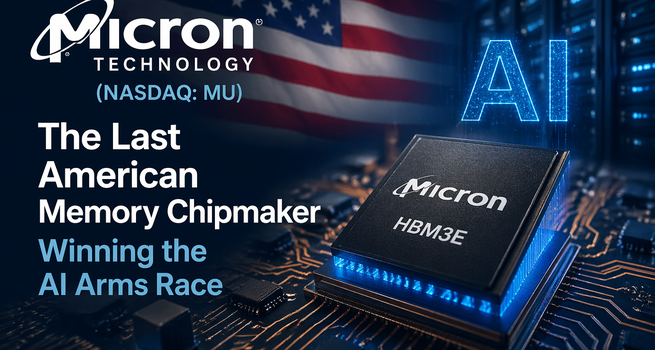
Micron Technology (NASDAQ: MU) stands at a once-in-a-generation convergence of artificial intelligence demand, US government backing, and geopolitical tailwinds. This deep-dive research explores the $155 billion global memory chip industry, the explosive rise of HBM technology powering Nvidia's AI chips, and how the US CHIPS Act's $6.1 billion grant is transforming Micron's competitive position against Samsung and SK Hynix. Understand why Washington considers Micron irreplaceable — and what that means for the future of AI infrastructure.
Why This Industry Matters Right Now
There are moments in history when a single industry quietly becomes the backbone of everything else — and most people only realise it after the fact. The steam engine did it in the 1800s. Oil did it in the 1900s. Today, in the 2020s, that industry is semiconductors, and within semiconductors, the most strategically critical and least understood segment is memory chips.
This article tells the full story: what memory chips are, how the industry was born, how it evolved, who the key players are, why artificial intelligence has changed the game completely, and — most importantly — why one American company, Micron Technology, sits at the intersection of technology, geopolitics, and government policy in a way that no other memory company on Earth can match.
We will explain everything in plain language. You do not need an engineering degree or a finance background to follow this. Think of this as a guided tour through one of the most important industries in the world.
Part 1: What Is a Memory Chip, and Why Does It Exist?
To understand why memory chips matter, start with a simple analogy. Imagine your brain has two types of memory. The first is what you are holding in your head right now as you read this sentence — the working, temporary, instantly accessible kind. The second is everything stored in your long-term memory — your childhood, your skills, your knowledge — which you can retrieve but which takes a fraction longer to access.
Computers work exactly the same way.
DRAM (Dynamic Random Access Memory) is the short-term memory. When your laptop runs a programme, streams a video, or processes a spreadsheet, it is holding all those calculations and instructions in DRAM. It is blazing fast to access but completely erased the moment you turn the machine off. Micron, Samsung, and SK Hynix are the only three companies in the world that manufacture advanced DRAM at scale.
NAND Flash is the long-term memory — the storage. Your photos, your documents, the operating system on your laptop — all of that lives in NAND. It is slower than DRAM but retains information permanently. Your phone's internal storage, your laptop's SSD, your USB drive — all NAND flash.
HBM (High Bandwidth Memory) is the newest and most strategically important type. Think of it as a turbocharged version of DRAM designed specifically for artificial intelligence chips. We will explain it in detail shortly, because HBM is the reason this industry has gone from cyclical commodity to geopolitical flashpoint.
Without memory chips, computers cannot function. Without advanced memory chips, AI cannot exist. It is that simple.
Part 2: The Birth and Evolution of the Memory Industry
The 1960s and 1970s — From Rooms to Chips
Before memory chips existed, computers stored information using magnetic cores — tiny rings threaded with wires, each ring representing one bit of data. A computer with just 4,000 bits of memory occupied an entire cabinet. In 1970, Intel — then a small startup — invented the first commercially viable DRAM chip, the Intel 1103. It could store 1,024 bits of data on a piece of silicon the size of a fingernail. Memory cost roughly one dollar per bit. A modern smartphone holds 128 billion bits. Do the maths on what that would have cost in 1970.
The 1980s — Japan Dominates, America Panics
By the 1980s, Japanese companies had mastered the art of mass-producing memory chips cheaply. Toshiba, NEC, Hitachi, and Fujitsu flooded the global market with inexpensive DRAM. American companies — Intel, Mostek, National Semiconductor — were wiped out of the memory business one by one. They simply could not compete on price. By 1986, Japanese firms controlled over 80% of the global DRAM market.
This set off alarm bells in Washington. Politicians and defence officials realised that the US military's weapons systems, satellites, and computers all depended on memory chips made in a foreign country. A 1987 US-Japan Semiconductor Trade Agreement attempted to stabilise prices and guarantee market access, but the damage was done. The US had lost memory chip manufacturing to Asia.
Only Micron Technology — a small Idaho-based startup founded in 1978 by a group of engineers in a dentist's office — survived the Japanese onslaught. It did so by focusing relentlessly on manufacturing efficiency and keeping costs lower than anyone thought possible.
The 1990s — Korea Rises and Takes Over
While Japan dominated the 1980s, South Korea was quietly building the next empire. Samsung Electronics, under the leadership of Lee Kun-hee, made a bold and almost reckless decision: invest billions of dollars into memory chip manufacturing regardless of whether it was profitable in the short term. Samsung built massive fabs, hired thousands of engineers, and used economies of scale to undercut everyone.
By the late 1990s, Samsung had become the world's largest memory chip maker — a position it has held ever since. SK Hynix (originally Hyundai Electronics) followed a similar path. Between them, the two Korean companies came to dominate global DRAM production, joined only by Micron as the lone Western survivor.
The lesson of this era is crucial: memory chip manufacturing rewards scale and patience above almost everything else. The companies that survived were the ones that could absorb years of losses while building the capacity to eventually crush competitors on cost.
The 2000s — The NAND Explosion and Survival of the Fittest
The 2000s brought two new forces: digital cameras and mobile phones. Both needed storage, and NAND flash was the answer. The market exploded. But so did competition — dozens of companies poured into NAND manufacturing, flooding the market. Prices crashed.
The result was brutal consolidation. Most competitors went bankrupt, were acquired, or retreated. By the 2010s, the NAND flash market had collapsed to a handful of survivors: Samsung, SK Hynix, Micron, Kioxia (formerly Toshiba Memory), and Western Digital. The DRAM market was even more concentrated — essentially just Samsung, SK Hynix, and Micron.
This consolidation is important because it created the oligopoly structure that exists today — a structure that, combined with AI demand, has made memory chips enormously valuable.
The 2010s — Smartphones, Boom-Bust, and the Memory Wall
The iPhone era sent memory demand into the stratosphere. Every smartphone, tablet, and laptop needed both DRAM and NAND. The industry ran at full tilt. But it also discovered its perennial curse: the boom-bust cycle.
When demand spikes, every company builds new factories. But a new memory fab takes three to four years to complete. By the time it opens, all three companies' factories open simultaneously — flooding the market with supply just as demand normalises. Prices collapse, companies lose money, production is cut, supply shrinks, and eventually prices recover. The cycle repeats roughly every three to five years.
The 2022-2023 downturn was the worst in a decade. DRAM prices fell over 50%. Micron reported a net loss of more than five billion dollars. Samsung and SK Hynix also lost billions. Then, just as the industry was bottoming out, something changed everything: ChatGPT launched in November 2022, and the AI revolution began.
Part 3: Artificial Intelligence Changes Everything — The HBM Story
Why AI Is Different from Everything Before It
Every technology wave before AI — smartphones, cloud computing, streaming video — needed memory chips, but in manageable quantities. AI is different in a fundamental way: it needs an almost incomprehensible amount of memory, and it needs to access it at speeds that regular DRAM simply cannot provide.
Here is why. An AI model like GPT-4 contains roughly 1.8 trillion parameters — numbers that define how the model thinks and responds. Every time the AI answers a question, it must rapidly read huge portions of those parameters from memory into the processor. To answer one query in real time, an AI chip processes hundreds of gigabytes of data in milliseconds. Multiply this by millions of queries per second across thousands of servers, and you begin to understand the scale of the memory demand.
The problem is what engineers call the memory wall. Modern AI processors — Nvidia's H100, for example — can perform quadrillions of mathematical operations per second. But with regular DRAM connected via a standard memory bus, the chip spends more than half its time simply waiting for data to arrive from memory. The processor is a Formula 1 car stuck in school-zone traffic. All that computational power is wasted.
What HBM Is and Why It Solves the Problem
High Bandwidth Memory solves the memory wall by rethinking the physical relationship between the memory and the processor. Instead of placing the memory on a separate circuit board connected by a thin copper wire (the conventional approach), HBM stacks multiple layers of memory chips — called dies — directly on top of or immediately beside the processor, and connects them through thousands of tiny vertical wires called Through-Silicon Vias (TSVs).
The analogy is powerful: regular DRAM is connected to the AI chip by one garden hose. HBM is connected by a thousand fire hoses running simultaneously. The water pressure (clock speed) is similar, but the total volume of water delivered per second is incomparably larger.
The numbers bear this out strikingly. A regular DDR5 DRAM module delivers roughly 50 gigabytes of data per second. A single HBM3e stack delivers over 1,200 gigabytes per second. Nvidia's H200 GPU, which uses five HBM3e stacks, has a total memory bandwidth of 3.35 terabytes per second — meaning it can move the entire contents of a 3.35 terabyte hard drive into and out of memory every single second. That is the scale of performance that makes modern AI possible.
The Oligopoly Within the Oligopoly
Making HBM is extraordinarily difficult. The stacking process requires bonding memory dies with microscopic precision, drilling thousands of vertical holes through silicon thinner than a human hair, and ensuring perfect electrical connectivity across billions of connections — all while maintaining yields high enough to be commercially viable. The engineering challenges are so severe that despite years of effort, only three companies on Earth can manufacture HBM at scale: SK Hynix, Samsung, and Micron.
This is an oligopoly within an already concentrated industry. And unlike commodity DRAM — where customers choose whoever is cheapest — HBM is qualified chip by chip for each specific AI processor. Qualification means months of testing by the chip designer (Nvidia, AMD, Google) to verify that the memory performs reliably inside their system. Failing qualification, as Samsung discovered in 2023-24, means losing business that is very difficult to recover.
Part 4: The Players — Where Each Company Stands
SK Hynix — The Current King
SK Hynix is the undisputed leader in HBM. It was the first company to qualify HBM3 for Nvidia's H100 — giving it a two-year head start that translated into 50-55% market share in 2023. Its HBM3e product was the primary memory in Nvidia's H200. Reports indicate SK Hynix's entire HBM output was committed to Nvidia through 2025 before the year began.
The company's weakness is geographic concentration: virtually all of its manufacturing happens in South Korea, creating exposure to geopolitical disruption and limiting its ability to access US government subsidies. Its China exposure is meaningful, and as US-China tensions rise, that exposure becomes an increasing liability.
Samsung — The Stumbling Giant
Samsung is the world's largest chip company by revenue and has more resources than either rival. On paper it should dominate HBM. In practice, it has stumbled badly. Samsung's HBM3e product reportedly failed Nvidia's qualification tests due to heat dissipation problems — the stacked dies generated too much heat for Nvidia's system to manage reliably. This single technical failure cost Samsung significant share at precisely the moment demand was exploding.
Samsung has the scale and engineering talent to recover. Its path back likely runs through non-Nvidia customers — AMD, Google's TPU division, and emerging AI chipmakers — while it works to fix its Nvidia relationship. But every quarter it remains unqualified for the most important AI GPUs is market share flowing to its rivals.
Micron — The American Underdog with Structural Tailwinds
Micron entered 2023 with roughly 9% HBM share — a distant third, almost an afterthought. By 2025 it was targeting 20%+. This trajectory is the result of a combination of technical execution (successfully qualifying HBM3e for Nvidia), genuine catch-up investment, and — crucially — a set of regulatory and geopolitical advantages that its Korean rivals structurally cannot replicate.
Those advantages are the subject of the next section, and they are why Micron represents one of the most compelling structural investment stories in the semiconductor industry.
Part 5: The CHIPS Act — What It Is, Where It Came From, and Why It Changes Everything for Micron
The Problem That Created the CHIPS Act
To understand the CHIPS Act, you need to go back to two events that shocked Washington into action.
The first was the COVID-19 pandemic of 2020-2021. When the pandemic hit, global supply chains collapsed. Automakers could not get chips. Electronics companies could not get chips. Hospitals could not get chips for medical equipment. The United States, the country that invented the semiconductor, could not guarantee its own supply of the technology underpinning its entire economy. The reason was simple and alarming: over decades, semiconductor manufacturing had shifted almost entirely to Asia — primarily Taiwan, South Korea, and Japan. America designed chips but no longer made many of them at home.
The second shock was the recognition — crystallised by the Taiwan Strait military tensions of 2022 — that the majority of the world's most advanced chip manufacturing was concentrated in Taiwan, a territory that China considers its own and has explicitly reserved the right to reclaim by force. A Chinese military action against Taiwan would not just be a humanitarian crisis — it would instantly cut off the world's supply of advanced chips, collapsing the global economy within months.
American policymakers concluded they had made a catastrophic strategic error over three decades of offshoring. The CHIPS and Science Act was their attempt to correct it.
Who Brought the CHIPS Act Into Existence
The CHIPS Act had a long gestation period and involved both political parties — a rare occurrence in the hyper-partisan US political environment of the 2020s.
The intellectual groundwork was laid by a bipartisan group of senators and think tanks who had been raising alarm about chip supply chain vulnerability since the mid-2010s. Senator Mark Warner of Virginia (Democrat) and Senator John Cornyn of Texas (Republican) were early co-sponsors of legislation calling for chip manufacturing subsidies. The Semiconductor Industry Association lobbied intensively, presenting economic analyses showing that the US share of global semiconductor manufacturing had fallen from 37% in 1990 to just 12% by 2020.
The legislative push accelerated in 2021 when President Biden made semiconductor supply chain resilience a top executive priority, signing an executive order in February 2021 mandating a 100-day review of critical supply chain vulnerabilities. The review confirmed the worst fears: America was dangerously dependent on foreign chips.
The bill went through multiple iterations in Congress — initially called the CHIPS for America Act, then merged with broader science funding legislation. Senate Majority Leader Chuck Schumer was instrumental in shepherding it through the Senate. Commerce Secretary Gina Raimondo became its most vocal executive branch champion, personally travelling to chip company boardrooms to urge investment.
President Biden signed the CHIPS and Science Act into law on August 9, 2022 — a date the semiconductor industry will remember for decades. The signing ceremony at the White House included executives from Intel, Micron, and other chip companies. The bill passed with bipartisan support: 64-33 in the Senate and 243-187 in the House, remarkable margins in an era of political division.
What the CHIPS Act Actually Contains
The CHIPS and Science Act authorised approximately $280 billion in total spending, though the semiconductor manufacturing subsidies represent about $52.7 billion of that total. The rest funds scientific research, workforce development, and STEM education. The manufacturing funding breaks into several buckets:
$39 billion in direct manufacturing grants for companies building or expanding semiconductor fabs on US soil. This is the most important piece — free money, not loans, for chip factory construction.
25% Advanced Manufacturing Investment Tax Credit for qualifying semiconductor manufacturing investments. On a $20 billion fab, this is a $5 billion tax saving — transformative for project economics.
$13.2 billion for R&D and workforce development, funding the National Semiconductor Technology Center, the National Advanced Packaging Manufacturing Program, and university research programmes.
The grants come with strings attached — meaningful ones. Recipients cannot expand semiconductor manufacturing capacity in China for ten years. They cannot pay excessive dividends or conduct excessive share buybacks while receiving grants. And they must share "excess profits" above certain thresholds with the government. These conditions were controversial but ultimately acceptable to recipients given the scale of the subsidies.
Micron's CHIPS Act Award — The Numbers
In April 2024, the Biden administration announced a preliminary agreement with Micron for a $6.1 billion direct grant — the largest CHIPS Act award to any memory company, and one of the largest awards of the entire programme.
The grant supports two projects. The first is a massive new fab complex in Clay, New York — near Syracuse — which will be one of the most advanced memory chip factories ever built in the United States, capable of producing both advanced DRAM and HBM. The second is an expansion of Micron's existing fab in Boise, Idaho, its headquarters city.
Alongside the $6.1 billion grant, Micron announced plans to invest over $100 billion in US semiconductor manufacturing over 20 years. The New York project alone is expected to eventually employ approximately 9,000 direct employees and tens of thousands of indirect jobs in the construction, supply chain, and support sectors.
The 25% tax credit further sweetens the economics. If Micron invests $20 billion in qualifying US fab construction, the tax credit alone is worth $5 billion. Combined with the grant, the effective US government contribution to Micron's capital programme runs into the tens of billions of dollars — effectively co-funding the capacity expansion that will allow Micron to compete aggressively with its Korean rivals.
Why This Is a Structural Advantage, Not Just a Subsidy
It is tempting to view the CHIPS Act benefit as a one-time financial boost. It is much more than that. Here is why.
First, it dramatically lowers Micron's cost of capacity expansion. Building a new leading-edge fab costs $15-25 billion and takes 4-5 years. For SK Hynix or Samsung, every dollar of that comes from their own balance sheets or capital markets. For Micron building in the US, a significant portion is covered by government grants and tax credits. This means Micron can build more capacity, faster, with less financial strain than its rivals.
Second, it creates geographic diversification that its rivals lack. SK Hynix manufactures almost exclusively in South Korea. Samsung's HBM production is also Korea-based. Micron, with fabs in Idaho, Virginia, New York, Singapore, and Japan, is far less exposed to any single geopolitical disruption. In a world where Taiwan Strait tensions, Korean peninsula risk, and supply chain resilience are permanent concerns, geographic diversification commands a premium valuation.
Third, it unlocks US government and defence procurement. Federal agencies, defence contractors like Lockheed Martin, Raytheon, and Northrop Grumman, and intelligence community suppliers operate under "Buy American" requirements and strong political pressure to source sensitive components domestically. Micron is the only advanced memory company that can fully satisfy these requirements. This is a captive, high-margin customer segment that Samsung and SK Hynix cannot access regardless of how competitive their products are.
Fourth, it strengthens Micron's Washington relationships in ways that compound over time. Having billions of dollars of government investment tied up in Micron's success means the US government has a direct financial and strategic interest in Micron's competitive position. This creates a relationship that can be leveraged in trade negotiations, export control policy, and future subsidy programmes in ways no Korean company can replicate.
Part 6: Export Controls — The Other Regulatory Tailwind
The CHIPS Act is the most visible regulatory advantage Micron holds, but export controls are arguably as important in the long run.
Beginning in October 2022, the Biden administration imposed sweeping export controls restricting the sale of advanced semiconductors and chip-making equipment to China. These controls were tightened further in 2023. The stated goal was to prevent China from acquiring the technology needed to build advanced chips for military and AI applications.
The controls affect all companies selling advanced chips to China — including Micron. In May 2023, China retaliated by banning Micron from supplying chips to "critical information infrastructure" operators, costing Micron approximately 10-11% of its revenues in the short term.
However, the controls create an asymmetric long-term dynamic that favours Micron in several ways.
Samsung and SK Hynix have far deeper China manufacturing exposure than Micron. Samsung operates major fab facilities in Xi'an, China. SK Hynix has a large NAND flash factory in Wuxi. Both companies have invested tens of billions in Chinese manufacturing capacity. As US export controls tighten and the technology decoupling between the US and China accelerates, these Korean companies face an increasingly agonising choice: comply with US rules and write off enormous Chinese investments, or risk running afoul of US regulators and losing access to American technology and markets.
Micron, having already absorbed its China revenue loss in 2023, faces no such dilemma. Its manufacturing is in the US, Singapore, and Japan — all allied nations. Its customer base has already shifted heavily toward US hyperscalers. In the decoupling scenario that many analysts consider increasingly likely, Micron's cleaner geopolitical positioning becomes a durable competitive advantage.
Furthermore, the export controls also restrict the ability of Chinese memory companies — primarily CXMT in DRAM and YMTC in NAND — to acquire the cutting-edge equipment needed to compete at the frontier. ASML's EUV lithography machines, which are essential for leading-edge chip manufacturing, cannot be exported to China. Applied Materials and Lam Research tools are similarly restricted. This keeps Chinese competitors pinned to older technology generations, protecting all three incumbents but particularly benefiting Micron, which the US government actively wants to see succeed.
Part 7: The Market Opportunity — Size, Growth, and Micron's Share
The global memory chip market was worth approximately $155 billion in 2024, recovering strongly from the 2023 downturn when it dropped to around $95 billion. Within this, the HBM segment — barely $2 billion as recently as 2021 — had grown to an estimated $12-15 billion by 2024 and is projected by Yole Group and TrendForce to reach $30-35 billion by 2029.
To put that growth in context: the HBM market could expand 15-20 times in less than a decade. The driver is simple and durable — every AI data centre built, every Nvidia GPU shipped, every AI accelerator deployed, requires HBM. The hyperscalers (Microsoft, Amazon, Google, Meta) are spending hundreds of billions of dollars expanding AI infrastructure, and every dollar of that capex requires memory. Gartner estimated in 2024 that HBM supply would remain constrained well into 2026, meaning the pricing environment favours manufacturers.
For Micron specifically, the opportunity is to grow from roughly 9% HBM share in 2023 to 20-25% by 2027 — while the overall market triples in size. Even at 20% share of a $30 billion HBM market, Micron's HBM revenues alone would approach $6 billion annually — compared to effectively zero just three years earlier.
This revenue profile is qualitatively different from Micron's historical commodity DRAM business. HBM commands significantly higher average selling prices and margins. Customers are locked in through qualification processes that take months, creating switching costs. Supply is constrained by technical barriers that prevent new entrants. All of this means HBM is a structurally superior business to commodity memory — and Micron's growing HBM exposure is gradually transforming the company's financial character from cyclical commodity producer to high-margin technology enabler.
Part 8: Risks — What Could Go Wrong
No research article is complete without an honest assessment of risks.
The boom-bust cycle has not been abolished. The memory industry's history of oversupply crashes is long and painful. If AI investment slows, if hyperscaler capex budgets are cut, or if new HBM capacity comes online faster than demand grows, prices could fall sharply. Micron's HBM revenues would suffer alongside the rest of the industry.
Technical execution risk is real. Micron must successfully transition from HBM3e to HBM4 — the next generation of HBM — while maintaining or growing its Nvidia qualification. Samsung lost significant share by failing a single qualification test. Micron must not repeat that mistake. The qualification cycle for each new GPU generation effectively resets the competitive race.
China retaliation could escalate. China's 2023 ban on Micron from critical infrastructure was painful. Further Chinese restrictions — including potential bans from the broader consumer or commercial market — could remove additional revenue. A major China-Taiwan military escalation would create disruption across the entire industry.
Samsung's recovery is a real threat. Samsung has the resources to fix its HBM3e problems and qualify for HBM4. If it does so successfully, the share that Micron is winning could be competed away more quickly than expected.
CHIPS Act policy continuity. The CHIPS Act was signed by a Democratic administration. While the Trump administration that took office in January 2025 has broadly supported domestic semiconductor manufacturing (aligning with America-first industrial policy), some tension exists around the programme's implementation. A significant policy reversal — unlikely but not impossible — could affect the timing or scale of Micron's grant disbursements.
Conclusion: The Convergence of Technology, Policy, and Geopolitics
Micron Technology sits at a unique convergence point. It is the only advanced memory company that is simultaneously a technology leader in the fastest-growing segment of the semiconductor industry (HBM for AI), the direct beneficiary of the most significant US industrial policy in a generation (the CHIPS Act), and the most geopolitically advantaged player in a world defined by US-China technology competition.
None of these factors alone would make the story compelling. Together, they create a structural advantage that compounds over time — lower capital costs than rivals, access to customer segments rivals cannot serve, a government deeply invested in its success, and a geopolitical environment that pushes the world toward exactly the supply chain diversification that only Micron can provide.
The memory chip industry was born in a dentist's office in Boise, Idaho. It was nearly killed by Japanese competition in the 1980s, was overtaken by Korean giants in the 1990s, and survived the NAND bust of the 2000s by maintaining relentless manufacturing discipline. It is now at the centre of the artificial intelligence revolution — the defining technology transition of the 21st century.
The story of memory chips is the story of how the most basic building block of computation — the humble act of storing and retrieving a number — became one of the most strategic assets on the planet. And Micron, the scrappy Idaho survivor, finds itself better positioned than at any point in its nearly 50-year history to capitalise on that reality.
This article is for informational and educational purposes only. It does not constitute investment advice. All market share figures and financial projections are based on publicly available analyst estimates as of mid-2025. Readers should conduct their own due diligence before making investment decisions.


 Jun 16, 2026




 Please wait processing your request...