
 AU
AU
 UK
UK
 CA
CA
 NZ
NZ
 IND
IND

 US
US

 Share
Share
 X (Formerly Twitter)
 Whatsapp
 Facebook
 LinkedIn
 Telegram
 Email This Article
 Copy Link
 Summarize with AI
 Chat GPT
 Perplexity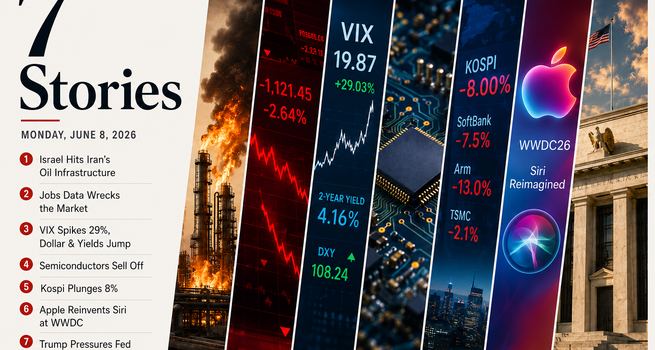
- Geopolitics and Energy: Israel Strikes Mahshahr Petrochemical Complex; First Energy Site Hit Since April Ceasefire; Oil Spikes 5%
Israel struck targets at the Mahshahr petrochemical complex in Iran's southwest on Monday, the first hit on an energy site inside Iran since the April 8 ceasefire, along with strikes on other military targets. A provincial official confirmed parts of the plant were damaged. On Sunday Iran fired a salvo of missiles at Israeli targets in retaliation for Lebanon strikes. Trump reportedly told Netanyahu to refrain from further attacks but Israel proceeded. Trump insisted an agreement "remains well within reach." Oil rose over 4% to $94.61, erasing Friday's losses. Oil has climbed nearly 60% since the war began in late February. Iran's ambassador to Moscow confirmed Hormuz will reopen "with new conditions to be determined by the Iranian and Omani authorities," including a transit fee. OPEC+ approved its fourth consecutive monthly output increase on Sunday, 188,000 barrels per day starting July, though analysts say the physical impact is near-zero while Hormuz remains closed.
- Israel's strike on Mahshahr is a qualitative escalation, the first direct attack on Iranian energy infrastructure since the ceasefire, signalling willingness to target economic Assets both sides had implicitly avoided.
- Iran's transit fee Demand directly contradicts the U.S. precondition for any deal; the gap between the two positions has widened, not narrowed.
- Risk note: if Iran formalises a transit fee mechanism with Oman, it forces the U.S. to choose between accepting tolls or maintaining the blockade indefinitely, a binary markets have not yet priced.
- Employment Report Recap: NFP 172,000 Doubles Consensus; Nasdaq Posts Largest Single-Day Point Decline on Record; Consumer Credit Collapses
May nonfarm payrolls came in at 172,000, more than double the 80,000 consensus. Unemployment held at 4.3%. Average hourly Earnings rose 0.3% month over month and 3.4% year over year, both in line. March was revised up 29,000 to 214,000 and April up 64,000 to 179,000, a combined 93,000 higher than previously reported, the strongest three-month advance in more than two years. Markets reacted in a "good news is bad news" pattern: bond yields surged, rate-hike odds climbed. The Nasdaq shed 1,121 points, its largest single-day point decline on record. The S&P 500 fell 2.64% to 7,383.74, the Dow lost 1.35%, and roughly $1.8 trillion in Market Value was erased. Consumer Credit for April came in at $9.96 billion, sharply below the $18 billion consensus and down from $24.8 billion prior, the largest single-month deceleration in consumer borrowing since the Pandemic. Q1 productivity and unit labor costs were revised sharply lower.
- Consumer Credit at $9.96 billion while payrolls surged 172,000 is the defining contradiction of 2026: the labour market is strong but consumers are pulling back sharply, suggesting Iran war Inflation is eroding spending power even among the employed.
- Risk note: prior months were revised up by a combined 93,000; if May is also revised higher next month, the Fed faces sustained above-consensus Job-growth/">Job Growth alongside PCE at 3.8%, making rate cuts impossible before year-end.
- Monday Pre-Market: VIX Spikes 29% to 19.87; Dollar at Two-Month High; 2-Year Yield at 4.16%
S&P 500 futures are up 0.35% and Nasdaq futures up 0.81%, suggesting a partial recovery. The VIX surged 29.03% to 19.87, its highest level since the peak of Iran war escalation in March. The dollar climbed to a two-month high with the 2-year Treasury Yield jumping to 4.16% and the euro slipping to $1.15. Bitcoin climbed 1.31% to $63,173 but faces stiff resistance at $63K after plunging roughly 16% last week, its largest weekly decline since the FTX collapse in 2022.
- The VIX at 19.87 is a 29% single-day spike, the largest one-day VIX move since April's Liberation Day Tariff shock, the Options market is pricing a materially different risk environment than it was a week ago.
- Risk note: Nasdaq futures up 0.81% while VIX is up 29% and oil is up nearly 5% is internally inconsistent, at least one of these moves will need to resolve by Monday's close.
- Friday Stock Movers: Qualcomm -11%, Cadence -10%, MPWR -10%, KORU -42%, Samsung -5.4%, SK Hynix -8.4%
Qualcomm (NASDAQ: QCOM) fell 10.98% to $215.94 after Nvidia's RTX Spark AI PC chip directly threatened its Snapdragon Franchise, compounded by the broader semiconductor selloff. Cadence Design Systems (NASDAQ: CDNS) fell 9.62% to $376.19 as Broadcom's guidance disappointment weighed on high-multiple semiconductor software. Monolithic Power Systems (NASDAQ: MPWR) fell 10.38% to $1,481.05. The Direxion Daily MSCI South Korea Bull 3X ETF (NYSE: KORU) crashed 41.89% to $610, its third major down session in a row, as South Korea's KOSPI fell over 5%, with losses magnified through the 3x leveraged structure. Samsung Electronics fell 5.4% and SK Hynix (KRX: 000660) dropped 8.4% in sympathy with Broadcom's AI chip guidance miss.
- Qualcomm's 11% decline is a direct market verdict: investors believe Nvidia's Arm-based RTX Spark will take meaningful share from Snapdragon in the Windows AI PC cycle.
- Risk note: KORU had surged over 458% year to date before this unwind; leveraged ETF mean-reversion in a volatile tape can accelerate in both directions Monday.
- Asian Markets Monday: Kospi Plunges 8%; SoftBank -7.5%, Arm -13%, TSMC -2.1%
Asian Equity markets tumbled sharply Monday, led by steep losses in semiconductor names. South Korea's KOSPI fell over 5% Friday and is extending losses, plunging 8% Monday. Samsung fell 5%, SoftBank Group fell 7.5%, TSMC fell 2.1%, and Arm Holdings fell 13%. Broadcom's signal that Google may diversify its chip suppliers stoked fears over Nvidia's customer concentration, cascading across the entire AI Supply chain.
- Arm's 13% decline is the most analytically significant Asian move, reflecting the market repricing the premium on Arm's architecture licensing as hyperscaler chip Diversification risk rises.
- Risk note: the nine-week U.S. win streak ended Friday; Asian markets are pricing a more prolonged correction than Monday's modest U.S. futures recovery suggests.
- Technology: Apple WWDC Begins Today; Siri Makeover to Compete with ChatGPT; Tim Cook Prepares to Hand Over to John Ternus
Apple's (NASDAQ: AAPL) Worldwide Developers Conference begins today, with the company expected to announce a makeover of Siri redesigning its interface to function more like an AI chatbot. Apple has spent far less than other big tech firms on AI model development. Rather than competing in the model wars, Apple's strategy bets that ensuring its devices are the main way users access AI is the smarter and cheaper path. Tim Cook is preparing to hand over to John Ternus on September 1. Cook's 15-year tenure saw Apple's market cap grow from $350 billion to $4.6 trillion. The conference may provide a clue as to whether Apple can produce another product on the scale of the iPhone under its incoming CEO.
- Apple's device-as-AI-gateway strategy directly competes with Microsoft's Copilot+ PC and Nvidia's RTX Spark, all three are racing to own the on-device AI inference layer that determines which AI models consumers use daily.
- Risk note: if the Siri makeover is perceived as incremental rather than transformative, the stock could react negatively against already-elevated AI expectations.
- Fed Independence: Trump Demands No Rate Hikes; Calls Powell a "Moron"; Pressure Mounts on Warsh Ahead of June 16-17 FOMC
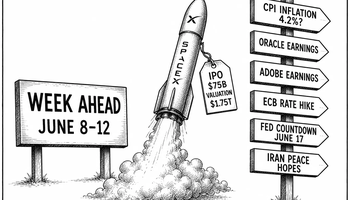
Trump insisted that raising interest rates would be the "wrong thing to do" after the stronger-than-expected jobs report prompted speculation that the Federal Reserve will tighten Monetary Policy. His remarks put direct pressure on new Fed chair Kevin Warsh, who convenes his first FOMC meeting in eight days on June 16-17. Trump repeatedly called Jerome Powell a "moron" for not cutting rates quickly enough. The 2-year Treasury yield jumped to 4.16% on Friday as markets priced approximately 60% odds of at least one rate hike by December. Warsh inherits a majority-hawkish committee, PCE at 3.8%, a labour market adding 172,000 jobs per month, and now a direct presidential instruction not to raise rates.
- The 2-year yield at 4.16% is the most precise market signal of the tension: bond markets are pricing hikes that the president is explicitly forbidding and that Warsh has not yet signalled he will deliver.
- Risk note: if Warsh signals even a neutral bias at June 16-17, no hike, no cut, markets may interpret it as Capitulation to White House pressure, potentially triggering a Bond Market reaction that forces a hike anyway.


 Jun 07, 2026



 Please wait processing your request...