
 AU
AU
 UK
UK
 CA
CA
 NZ
NZ
 IND
IND

 US
US

 Share
Share
 X (Formerly Twitter)
 Whatsapp
 Facebook
 LinkedIn
 Telegram
 Email This Article
 Copy Link
 Summarize with AI
 Chat GPT
 Perplexity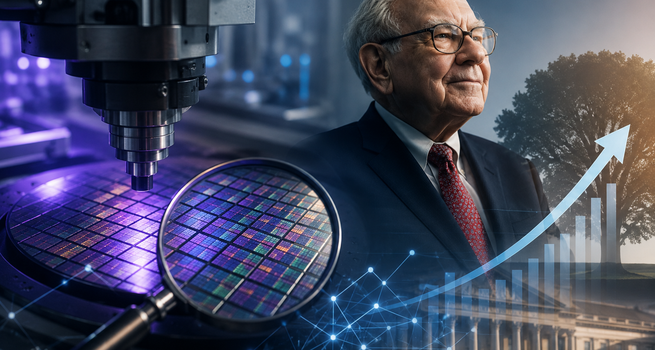
KLA Corporation (Nasdaq: KLAC) dominates semiconductor process control with 50%+ Market Share, 40%+ ROIC, and growing free Cash Flow. Discover why this chip equipment giant passes the Warren Buffett "wonderful Business" test — and what price makes it a buy.
Key Highlights
- Unbreakable moat: KLA controls ~50% of the global process control equipment market, with switching costs so deep that chipmakers cannot replace its tools mid-production without risking entire wafer runs worth hundreds of millions of dollars.
- Exceptional financial quality: Operating margins of ~38%, return on invested Capital above 40%, and free cash flow conversion consistently above 100% of Net Income — the hallmarks of a truly capital-light compounder.
- Shareholder-first capital allocation: KLA has raised its Dividend for 15 consecutive years and returned over $2.5 billion through Buybacks in FY2024 alone, steadily shrinking the share count.
- Secular tailwind, not a cyclical bet: Every new semiconductor node — from 3nm to gate-all-around and beyond — demands more process control, not less, structurally expanding KLA's addressable market.
- Key risk to watch: China represents approximately 30% of Revenue, and tightening US export controls remain the single most significant near-term overhang on the stock.
The Business Nobody Talks About — But Every Chipmaker Needs
There is a particular kind of business that Warren Buffett has spent six decades searching for. It is not the flashiest business. It is rarely the one on the cover of business magazines. It is usually the business that sits quietly in the middle of a great industry, collecting a toll from every participant, rain or shine.
KLA Corporation is that business.
You may not have heard of KLA. You have certainly benefited from what it does. Every smartphone in your pocket, every data centre running artificial intelligence workloads, every electric vehicle rolling off an assembly line — the chips inside all of them were inspected by KLA equipment before they ever reached you. KLA makes the process control and inspection tools that semiconductor manufacturers use to find defects on wafers before an entire production run is destroyed. In an industry where a single microscopic particle of contamination can ruin a chip worth thousands of dollars, KLA's equipment is not optional. It is oxygen.
The company was founded in 1975, went public in 1980, and spent the next four decades quietly building one of the most durable competitive positions in American industry. Today it commands roughly 50% of the global process control equipment market — a share that has not materially eroded in decades, despite the best efforts of well-funded competitors.
A Moat Buffett Would Recognise in an Instant
Buffett has described the ideal business as one with a wide, durable economic moat — something that protects the business from competition the way a castle moat protects against attack. He has identified several sources of such moats: cost advantages, network effects, intangible assets like patents and brands, and switching costs. KLA has most of them, and one in particular is exceptional.
Switching costs. When a semiconductor manufacturer like TSMC or Samsung installs KLA's inspection tools inside a fab, those tools do not simply sit there taking pictures. They calibrate the entire production process. Defect signatures are catalogued, alarm thresholds are tuned, Yield-improvement algorithms are trained on data that accumulates over months and years. The fab's engineers build their entire quality management workflow around KLA's software and data outputs. To rip out a KLA system mid-production and replace it with a competitor's tool is not a procurement decision — it is a multi-month validation exercise that risks production yields on nodes where a single percentage point of yield improvement is worth hundreds of millions of dollars. Chipmakers simply do not take that risk. Once KLA is inside a fab, it tends to stay.
Intangible assets. KLA holds more than 7,000 patents and has accumulated over 30 years of proprietary defect-signature data. The company's inspection algorithms have been trained on more wafer defect data than any competitor can access. This creates a self-reinforcing advantage: more installed tools generate more data, which improves the algorithms, which makes the tools more accurate, which makes customers less willing to switch. It is a flywheel that competitors cannot easily replicate, no matter how much they spend on R&D.
Pricing power. Because KLA's tools directly affect the profitability of a fab's entire output, chipmakers evaluate them on yield improvement, not unit price. A KLA system that costs $10 million but improves yield by 1% on a $5 billion annual production line pays for itself in weeks. In this environment, KLA has genuine pricing power — it can raise prices as node complexity increases, and customers will pay because the alternative is worse.
What the Financial Statements Reveal
Buffett has always said that truly great businesses reveal themselves in the numbers. He looks for consistently high returns on capital, honest Earnings (meaning free cash flow closely tracks reported net income), and management teams that deploy capital wisely. KLA's financial history reads like a Buffett case study.
In fiscal year 2024, KLA generated approximately $9.8 billion in revenue, an increase of 19% over the prior year. More impressive than the top-line growth is the profitability structure underneath it. Gross margins held at approximately 61.5%, reflecting both the premium pricing KLA commands and the growing contribution of high-Margin service revenue — the maintenance contracts, software subscriptions, and parts agreements that KLA's enormous installed base generates every year regardless of new equipment orders.
Operating margins reached approximately 38%, a level that most industrial companies would consider aspirational. KLA sustains these margins not through financial engineering but through genuine pricing power and Operating Leverage — its cost base does not grow proportionally as revenue expands. The result is a business that converts nearly a third of every revenue dollar into net income, and translates that net income into real free cash flow at a rate above 100%.
That last point deserves emphasis. One of the most common signs of a low-quality business is a wide and persistent gap between reported earnings and actual cash generation. Companies that routinely report earnings they cannot collect in cash are either managing their numbers aggressively or operating in businesses where capital must constantly be reinvested just to stand still. KLA is the opposite. Its free cash flow in FY2024 was approximately $3.4 billion on net income of $3.1 billion. The business generates more cash than it reports in earnings — a sign of honest, durable profitability.
Return on invested capital, the single metric Buffett cares most about for assessing business quality, has averaged above 40% over the past five years. To put that in context: most S&P 500 companies generate ROIC in the 10–15% range. A business generating 40%+ ROIC year after year is compounding its Intrinsic Value at a pace that, over time, the stock price has no choice but to follow.
Capital Allocation: The Test of Management Character
A wonderful business with poor capital allocation is a tragedy. Buffett has spent decades watching management teams destroy shareholder value through overpriced acquisitions, vanity projects, and empire-building. He prizes managers who think like owners — who understand that every dollar they retain must be put to work at returns exceeding what shareholders could earn themselves.
By this standard, KLA's management team earns high marks.
The company has raised its dividend every year for 15 consecutive years. The dividend has grown at a compound annual rate of approximately 15% over the past decade — not a token raise to maintain a streak, but a genuine, substantial, annual increase that reflects management's confidence in the business's earning power. In FY2024, KLA returned approximately $2.5 billion to shareholders through share repurchases, reducing the share count by roughly 3% — a meaningful reduction that increases each remaining shareholder's claim on future earnings without any additional Investment required.
The Balance Sheet is disciplined but not pristine. KLA carries net Debt of approximately $1.5 billion — a modest sum covered more than twice by a single year's free cash flow. The debt is not reckless; it reflects management's rational recognition that cheap, long-dated debt is a sensible way to enhance returns when the business can reliably generate FCF that dwarfs its interest costs.
The one area warranting scrutiny is acquisitions. KLA acquired Orbotech, an Israeli maker of inspection equipment for printed circuit boards and flat-panel displays, in 2019 for approximately $3.4 billion. The deal was reasonably priced and has been well-integrated. But every large Acquisition deserves scrutiny, and investors should watch for any signs that management begins to prioritise deal size over deal quality.
The Secular Tailwind That Never Stops
Buffett is famously patient. He does not need a catalyst to buy a great business. But he appreciates it when the wind is at a company's back, and for KLA, the wind has been blowing in one direction for 50 years and shows no signs of shifting.
The semiconductor industry operates on a relentless cadence of miniaturisation. Every two to three years, chipmakers shrink transistors to fit more of them on a chip of the same size, improving performance and reducing power consumption. Each generation of miniaturisation is more difficult than the last. Transistors that were once simple flat structures are now three-dimensional, folded, stacked, wrapped. The tolerances involved are measured in atoms. The defect budgets — the number and size of imperfections a finished chip can tolerate — shrink alongside the transistors.
This means that process control does not become less important as chips become more advanced. It becomes more important. KLA's tools must detect defects that are smaller, rarer, and more damaging than anything they needed to find a decade ago. The company spends approximately 13% of revenue on Research and Development every year — not to protect a business that is eroding, but to stay at the frontier of a technology that is continuously advancing. The customers who need KLA most urgently are the very customers spending the most on the most advanced nodes: TSMC at 2nm, Samsung's GAA, Intel's 18A. These are the fabs of the future, and KLA's equipment is inside all of them.
The artificial intelligence buildout accelerating today is a direct tailwind. AI chips — graphics processors, custom accelerators, high-bandwidth memory — are among the most complex semiconductors ever manufactured. They require intensive process control. The hyperscalers investing hundreds of billions of dollars in AI infrastructure are creating Demand not just for chips, but for the equipment that makes sure those chips work.
The Risks: What Buffett Would Flag
Intellectual honesty requires acknowledging what could go wrong. Buffett has always said that risk comes from not knowing what you are doing, and a clear-eyed investor in KLA must understand its vulnerabilities.
The most significant is geopolitical. China represents approximately 30% of KLA's annual revenue, one of the highest China-revenue exposures among major US semiconductor equipment companies. Washington has progressively tightened restrictions on the export of advanced chip-making tools to China, and the trajectory suggests further restrictions rather than relaxation. A comprehensive ban on KLA tool exports to China would remove a substantial portion of the revenue base in a single regulatory stroke. This risk is not hypothetical — it is active, evolving, and partially reflected in the stock price, though perhaps not fully.
The second risk is cyclicality. Semiconductor Capital Expenditure is notoriously cyclical. Chipmakers build fabs in booms and freeze capex in busts. KLA's revenue fell approximately 5% in FY2023 as the industry worked through inventory excesses. In a deeper or more prolonged downcycle — a global Recession, a sustained AI investment pause, a geopolitical disruption to the fab buildout — revenue could fall 20% or more. Buffett has historically avoided deeply cyclical businesses, preferring the predictable earnings streams of consumer staples and insurance. KLA is as close to a "wonderful" cyclical as exists, but investors must be prepared for periodic turbulence.
Valuation: A Wonderful Business at a Fair Price?
At current prices in May 2026, KLA trades at approximately 23 times forward earnings and roughly 27 times free cash flow. The owner earnings yield — free cash flow divided by Market Capitalisation — sits near 3.7%. Against a 10-year average P/E of approximately 20 times, the stock is modestly above its historical norm, reflecting both the quality of the business and the market's current enthusiasm for anything connected to AI and semiconductors.
Buffett's famous dictum — "It is far better to buy a wonderful company at a fair price than a fair company at a wonderful price" — applies here with precision. KLA is unambiguously wonderful. At 27 times FCF, it is not egregiously expensive, but neither is it the kind of obvious bargain that makes the decision easy. A business compounding FCF per share at 10–12% annually, purchased at 27 times FCF, delivers a satisfactory but not spectacular long-term return if the multiple holds. The historical pattern has been clear: investors who accumulate during semiconductor fear events — export control escalations, inventory correction fears, macro slowdowns — at multiples closer to 18–20 times FCF have generated significantly better long-term outcomes.
The business deserves a place on every long-term investor's watch list. The price deserves patience.
The Final Word
KLA Corporation is the kind of business that makes a fundamental investor pause and appreciate what the market has built over 50 years. It sits at the intersection of necessity and expertise — customers cannot live without it, and competitors cannot easily replicate it. It generates extraordinary returns on capital, converts earnings faithfully into cash, and returns that cash to shareholders with discipline and consistency.
It is not a perfect business. The cyclicality is real. The China exposure is a genuine risk. The valuation leaves little room for disappointment. But stripped of those caveats, the core asset — a dominant, irreplaceable position at the heart of the most important Manufacturing industry in the world — is exactly what Buffett has spent a lifetime looking for.
In Buffett's own words, the best investment you can make is in a business with a durable moat, honest management, and a long runway for growth. KLA has all three. The only question is the price you pay to own a piece of it.
Disclaimer: This article is for informational and educational purposes only and does not constitute investment advice. All figures are approximate, based on publicly available information as of May 2026. Investors should conduct their own Due Diligence before making any investment decision.

_06_12_2026_23_00_13_327450.jpg)
 Jun 12, 2026




 Please wait processing your request...