
 AU
AU
 UK
UK
 CA
CA
 NZ
NZ
 IND
IND

 US
US

 Share
Share
 X (Formerly Twitter)
 Whatsapp
 Facebook
 LinkedIn
 Telegram
 Email This Article
 Copy Link
 Summarize with AI
 Chat GPT
 Perplexity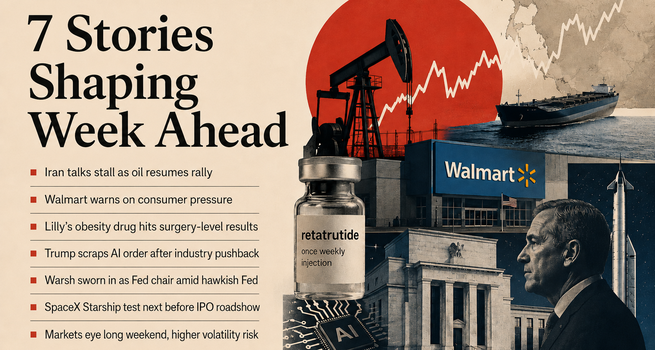
Oil resumes its rally as Iran peace talks stall, Trump scraps a landmark AI executive order, and a historic week of Earnings closes before a long weekend. S&P 500 futures up 0.37%, Nasdaq futures up 0.51%, Dow futures up 0.35%, VIX down 3.90% to 16.76.
- Geopolitics and Energy: Iran Holds Firm on Uranium and Hormuz as Oil Resumes Rally; House Cancels War Powers Vote
Iran's Supreme Leader Ayatollah Mojtaba Khamenei issued a directive that near-weapons-grade uranium must not be sent abroad. Iran's deputy foreign minister restated Tehran's claims to sovereignty over the Strait of Hormuz, and a senior Iranian source confirmed no deal has been reached, with uranium enrichment and Hormuz control remaining the central sticking points. Tehran's latest offer largely repeats terms Trump previously rejected, including sovereignty over the strait, compensation for war damage, sanctions relief, and U.S. troop Withdrawal.
Trump responded Thursday: "We will get it. We don't need it, we don't want it. We'll probably destroy it after we get it, but we're not going to let them have it." Secretary of State Marco Rubio said there had been "some good signs" but added: "I don't want to be overly optimistic... let's see what happens over the next few days." Pakistan's Army Chief Asim Munir visited Tehran on Thursday carrying a U.S. message.
Only 31 ships passed Hormuz in the last 24 hours versus 125 to 140 daily before the war. Brent gained 1.9% to $104.52 and WTI advanced 1.5% to $97.81 on Friday. The IEA warned the market could enter a "red zone" in July and August at peak summer Demand.
- House Republican leaders cancelled a scheduled Thursday war powers vote that looked likely to pass, with Democrat Gregory Meeks telling reporters: "We had the votes without question, and they knew it." The vote has been delayed until June after the Memorial Day recess.
- Iran's Revolutionary Guards warned renewed attacks would trigger retaliation beyond its region; Trump has said he is ready to resume strikes if he does not get the right answer from Tehran.
- Risk note: oil heading into a three-day weekend with no deal signed, no Congressional constraint on Trump's military authority, and IEA projecting steepest inventory draws in July and August creates asymmetric upside risk for Brent through the holiday gap.
- Earnings Movers: Walmart Tumbles 7%, Intuit Collapses 20%, While Ralph Lauren, IBM and Workday Surge
Thursday delivered the most bifurcated earnings session of the year. Walmart (NYSE:WMT) fell 7.27% to $121.34, its worst single-day drop in more than a year. Q1 Revenue rose 7.3% to $177.8 billion and E-commerce surged 26%, but Q2 EPS guidance of $0.72 to $0.74 missed the $0.75 consensus and full-year EPS guidance of $2.75 to $2.85 fell well below the $2.92 expectation. Management warned that a $175 million fuel cost headwind in Q1 and consumer financial strain could push retail price Inflation higher in H2 2026.
Intuit (NASDAQ:INTU) plunged 20.02% to $307.07 after fiscal Q3 results beat estimates but were overshadowed by a 17% workforce cut and TurboTax revenue growth decelerating to 7% from 11%, fuelling fears that AI is disrupting its core tax Business.
On the other side, Ralph Lauren (NYSE:RL) surged 13.84% to $374.80 after Blowout fiscal Q4 results: adjusted EPS of $2.80 beat by $0.26, revenue of $1.98 billion topped forecasts by $130 million, Asia surged 31%, Europe rose 18%, and full-year revenues crossed $8 billion for the first time.
IBM (NYSE:IBM) surged 12.43% to $252.97 on announcement of Anderon, America's first pure-play quantum chip foundry, backed by $1 billion in CHIPS Act incentives and $1 billion from IBM.
Workday (NASDAQ:WDAY) surged 10.8% after hours: Q1 revenue of $2.542 billion, up 13.5%, with non-GAAP EPS of $2.66 beating the $2.56 estimate.
- Walmart's guidance cut is the most structurally significant signal of the week for the U.S. consumer: the world's largest retailer is explicitly warning that Iran war-driven energy costs will drive retail price inflation higher in H2 2026.
- Workday's strong print directly counters the Intuit narrative; subscription revenue grew 14.3% year over year and non-GAAP Operating Margin expanded to 13.3% from 1.8% a year earlier.
- Risk note: Walmart and Intuit declining on the same day represents the most concentrated negative consumer and software signal since the Iran war began in February.
- Healthcare: Eli Lilly's Retatrutide Clears Obesity Trial; 28.3% Weight Loss Reaches Bariatric Surgery Territory
Eli Lilly (NYSE:LLY) said retatrutide cleared a crucial Phase 3 trial in obesity patients, with the highest dose delivering average weight loss of 28.3%, or 70.3 pounds, over 80 weeks versus 2.2% with placebo. Roughly 45% of the 2,500 patients achieved 30% or more weight loss. Chief scientific officer Dan Skovronsky called the 30% threshold "an incredible number to see," noting it had previously only been associated with bariatric surgery. A lower 4-milligram dose delivered 19% weight loss with a discontinuation rate of 4%, lower than the placebo group's 5%, which Skovronsky called "remarkable." Retatrutide targets three gut hormones (GLP-1, GIP and glucagon) versus two for Zepbound and one for Novo Nordisk's (NYSE:NVO) Wegovy. TD Cowen projects $3.8 billion in retatrutide sales by 2030. Lilly held a 60.1% share of the U.S. obesity and diabetes market in Q1 versus Novo's 39.4%.
- The results bring Lilly one step closer to filing for regulatory approval; retatrutide has now succeeded in a diabetes trial, a knee arthritis study, and this obesity Phase 3.
- Novo Nordisk paid up to $2 billion in March 2025 for rights to a competing three-pronged drug from United Laboratories International, but it remains years behind in development.
- Risk note: the highest dose showed nausea at 42%, diarrhea at 32%, and a discontinuation rate of 11.3%; dysesthesia was observed in more than 12% of patients at the highest dose.
- Capital Markets: SpaceX Starship V3 Retries Launch Today; Last Showcase Before June 12 IPO
SpaceX (NASDAQ: SPCX, pending) scrubbed the 12th test flight of Starship V3 Thursday after loading onto its new launch pad at Starbase, Texas, and will retry Friday. V3 stands 408 feet tall with 18 million pounds of thrust and is designed to deliver 100 metric tons to orbit in a fully reusable configuration. SpaceX has spent more than $15 billion on the Starship programme. The test flight is likely the company's last chance to demonstrate Starship's capabilities before the June 4 roadshow and June 12 Nasdaq listing under ticker SPCX. SpaceX's growth strategy depends entirely on increasing launch cadence and payload capacity through Starship at scale. NASA is counting on Starship as the Artemis IV lunar lander, scheduled for early 2028.
- SpaceX is carrying mock Starlink satellites during the test; no astronauts or cargo are aboard. The primary objective is to validate V3's new engines and new launch pad before commercial operations begin.
- SpaceX insiders will be permitted to sell shares earlier than usual after the IPO under a unique lock-up structure disclosed in the prospectus.
- Risk note: a second consecutive scrub heading into the roadshow beginning June 4 would raise questions about the space segment's revenue timeline and the growth strategy disclosed in the prospectus.
- Monetary Policy: Trump Swears in Warsh as Fed Chair Today; Takes Office as Majority of Governors Favour Rate Hikes
President Trump will formally swear in Kevin Warsh as Federal Reserve chair at a White House ceremony today. Trump selected Warsh as what Reuters described as "a bulwark against further rate hikes," and Warsh has long expressed a desire to lower rates while slashing the Fed's Balance Sheet. Warsh takes office as the precise opposite condition holds: the April FOMC minutes confirmed a majority of policymakers see rate hikes as the likely next move if inflation stays above 2%, four dissents were registered at the April meeting, the most since 1992, and Fed funds futures price approximately 50% odds of a rate hike by December. Warsh, 56, will serve a four-year term as chair. Fed Governor Stephen Miran is leaving his position on or shortly before the swearing-in.
In a contrasting global signal, Japan's core CPI softened to 1.4% in April, its lowest since March 2022 and below the 1.7% consensus, reducing near-term pressure on the BOJ to hike and lowering the risk of Japanese institutional selling of U.S. Treasuries.
- Warsh was passed over for the role in 2017 during Trump's first term; North Carolina Senator Thom Tillis stalled his nomination until prosecutors dropped a Powell renovation inquiry in April.
- Warsh's first FOMC meeting as chair is June 16 to 17; bond markets close early at 2:00 PM ET today ahead of the Memorial Day weekend, with NYSE and Nasdaq closed Monday May 25 and trading resuming Tuesday May 26.
- Risk note: Warsh was sworn in by a president who publicly demands deep rate cuts, while the committee he inherits leans majority-hawkish, the tension between executive pressure and institutional independence is the defining theme of the Warsh era from day one.
- AI Policy: Trump Scraps AI Executive Order After Calls from Musk, Zuckerberg and Sacks
Trump abruptly cancelled the signing ceremony for a highly anticipated AI executive order Thursday, hours after the White House had sent invitations to leading technology executives, some of whom were already travelling to Washington. Trump told reporters he had delayed the signing "because I didn't like certain aspects of it," adding he did not want to do anything that would "get in the way" of America's AI lead over China.
The order would have created a voluntary system requiring companies to give the government a 90-day advance look at frontier AI models to test for security vulnerabilities. Musk, Zuckerberg, and former AI czar David Sacks called Trump in the hours before the ceremony and argued the voluntary review would function as a mandatory regime in practice, slowing AI development and handing China an advantage. Sacks also warned a future administration could weaponise the review process. Officials who backed the order argued without it China could manipulate newly released AI models to attack U.S. infrastructure. Internal disagreements continued late into Wednesday night, with officials divided over how burdensome the proposal would genuinely be for industry.
- The cancellation illustrates how much influence Silicon Valley retains within the Trump administration even after figures such as Sacks and Musk have stepped back from formal White House roles.
- The federal Center for AI Standards and Innovation this month announced voluntary model evaluation agreements with Google DeepMind (NASDAQ:GOOGL), Microsoft (NASDAQ:MSFT) and xAI, suggesting the administration is pursuing oversight through informal channels rather than executive mandate.
- Risk note: the absence of a structured federal AI review framework leaves the U.S. without a formal mechanism to identify security vulnerabilities in frontier models before public release, a gap that national security officials inside the administration had argued the order was designed to close.
- Markets and Memorial Day: Futures Higher as Week Closes; Position Squaring Ahead of Four-Day Gap
S&P 500 futures are up 0.37% at $7,493.75, Nasdaq futures up 0.51% at $29,597.75, and Dow futures up 0.35% at $50,554.00 Friday morning. The VIX fell 3.90% to 16.76. The week closing today is the most event-dense trading week of 2026: Nvidia (NASDAQ:NVDA) reported, SpaceX filed its IPO, FOMC minutes confirmed the hawkish shift, Samsung averted its strike, Walmart warned on the consumer, Eli Lilly cleared a landmark obesity trial, Trump scrapped an AI executive order, and Iran peace talks stalled despite being described as in "final stages."
Memorial Day weekend creates a four-day gap: NYSE and Nasdaq are closed Monday May 25, regular trading resumes Tuesday May 26, and T+1 settlement means Friday trades settle Tuesday. Futures, oil, and yields can move over the weekend before stocks reprice on Tuesday. The U.S. labour market showed resilience Thursday with initial jobless claims coming in below expectations, though housing data confirmed the market remains subdued with 30-year Mortgage rates above 7%.
- The S&P 500 enters the long weekend up approximately 12% year to date, but with rate hike probability at 50%, oil above $104, and the Iran war unresolved, three of the four macro risks that have defined 2026 remain structurally open.
- Position squaring ahead of the long weekend combined with lower Friday Liquidity and potential oil Volatility from the Starship launch and Iran developments creates an asymmetric setup for the Tuesday open.
- Risk note: any geopolitical development over the three-day weekend, a breakdown in Iran talks, a military escalation, or a Hormuz incident, would arrive into a market that cannot reprice until Tuesday morning.

_06_12_2026_23_00_13_327450.jpg)
 Jun 12, 2026




 Please wait processing your request...