
 CA
 NZ
 UK
 AU
 IND

 US

 Share
 X (Formerly Twitter)
 Whatsapp
 Facebook
 LinkedIn
 Telegram
 Email This Article
 Copy Link
 Summarize with AI
 Chat GPT
 Perplexity
Key Highlights
- The dollar's reserve share has fallen for two decades, yet it still dominates payments, trade finance and global borrowing.
- Private money, not central banks, is now doing the heavy lifting to keep the world buying dollars.
- Dollar-backed stablecoins were expected to level the currency playing field. New research shows they are doing the opposite.
- The euro and the renminbi have both had their shot at replacing the dollar and missed it.
- Researchers see three possible endings for this story, and the dollar wins two of them.
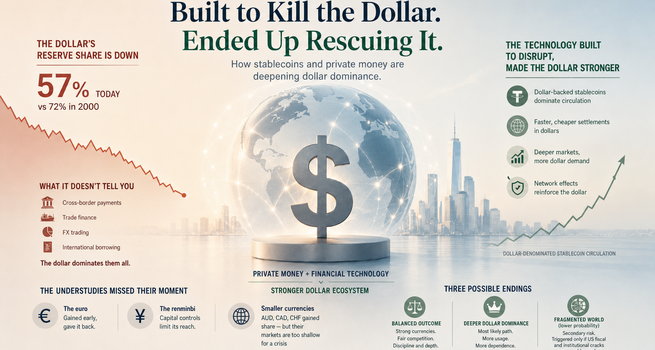
Something strange is happening to the world's most-predicted collapse. For twenty years, economists, central bankers and financial commentators have been writing the dollar's obituary. Rising US debt. Sanctions used as a weapon. Talk of "de-dollarisation" at every G20 summit. And the evidence, on the surface, backs them up: the dollar's share of global reserves has fallen from about 72 percent in 2000 to 57 percent today. That is not a small move. It is the kind of number that ends up in headlines and policy speeches as proof that the dollar's reign is finally cracking.
Except it isn't. New research digs past that one statistic and finds something almost nobody predicted: the technology built to dismantle the dollar's advantage is instead being used to entrench it deeper than before.
One Statistic, and It's Not the One That Matters
Here is the trick. Reserves are what central banks hold. They are not what the world actually uses. And when you look at what the world uses, the dollar hasn't budged an inch.
Cross-border payments still run through the dollar. Trade finance, the system that lets a shipment leave a port in one country and get paid for in another, is even more dollar-heavy than payments in general. Foreign exchange trading, the biggest financial market on Earth, has become more dollar-dependent over the past fifteen years, not less. And when governments and companies anywhere in the world want to borrow money internationally, they still overwhelmingly borrow it in dollars.
So the reserve number tells a true story about one narrow corner of finance. It just happens to be the wrong corner to read the whole picture from.
The Buyers Changed. The Currency Didn't.
The honest explanation for the falling reserve share isn't decline. It's satisfaction. Most emerging economies spent the 2000s stockpiling dollars as insurance against financial shocks, and by now most of them have enough. They stopped adding, not because they stopped trusting the dollar, but because they already have what they need.
Meanwhile, the people who were never trying to hit a safety target kept buying anyway. Private investors, companies, pension funds and banks around the world have quietly become the dollar's biggest customers. Something like 36 percent of all the Wealth held outside the United States is now parked in US assets, and the money keeps arriving, month after month. Nobody forced that. It is simply where the world's private money has decided it wants to sit.
The Understudies Never Showed Up
If the dollar were really on its way out, someone would be stepping into the spotlight. The two obvious candidates, the euro and China's renminbi, both got their chance. Neither delivered.
The euro had a genuine moment right after it launched in 1999, gaining ground fast. Then it spent the next two decades slowly giving almost all of it back. The renminbi tried a different path, building international momentum after 2010, only to stall out as China kept a tight grip on how freely its currency could move across borders. A currency that cannot flow easily in and out of a country will struggle to become the currency the rest of the world reaches for.
What actually picked up the dollar's lost reserve share wasn't a rival heavyweight. It was a handful of smaller currencies, the Australian dollar, the Canadian dollar, the Swiss franc, quietly growing their combined slice of the pie. But these are small economies with shallow bond markets. They cannot absorb serious money when a crisis hits, and a crisis is exactly the moment a reserve currency has to prove it can.
The Technology That Was Supposed to Free the World From the Dollar
This is where the story gets genuinely interesting, because it involves the one piece of financial technology everyone assumed would finally break the dollar's grip.
Stablecoins and other fast digital settlement tools were built to erase the friction of moving money across borders. Cheaper, faster, no middlemen. The logic seemed airtight: if it becomes just as easy to settle a transaction in any currency, size stops mattering as much, and smaller currencies finally get a fair fight.
Researchers built a model of exactly how this plays out for companies in emerging markets deciding which currency to borrow in, and the fair fight never arrives. The overwhelming majority of stablecoins in circulation are backed by dollars. That means the easiest, cheapest, most frictionless way for a company anywhere in the world to settle a Debt is still, and now more than ever, in dollars. Every company that takes that easier route pulls more borrowing into dollar markets. Deeper dollar markets make the next dollar transaction even smoother. It is a flywheel, and the dollar happens to be sitting inside it.
The technology that was supposed to set currencies free from the dollar has instead built it a faster on-ramp.
Three Ways This Could End
Where does this leave the rest of the world? Researchers lay out three possible futures. One is genuine balance, several strong currencies competing fairly, each backed by disciplined policy and deep capital markets. Another is the dollar tightening its grip even further, with the rest of the world growing more exposed to whatever Washington decides to do next. The third is the darkest option: total fragmentation, where no currency is trusted enough to anchor the system, and a shock anywhere can spiral into panic everywhere.
Based on where things stand today, deeper dollar dominance is judged the most likely outcome. Fragmentation is the uncomfortable understudy waiting in the wings if US fiscal problems and institutional cracks are left unaddressed.
Conclusion
The dollar's obituary keeps getting written on the strength of one shrinking number, while the rest of the evidence tells a different story entirely. Payments, trade, borrowing, even the new technology designed to dismantle dollar dominance, are all still bending in the dollar's favor. For any country hoping to change that, the fix isn't rejecting the new financial plumbing. It's building the deep, credible markets needed to compete inside it. Until that happens, betting against the dollar has been, and looks set to remain, a bet against the evidence.


 Nov 05, 2026




 Please wait processing your request...