
 AU
AU
 UK
UK
 CA
CA
 NZ
NZ
 IND
IND

 US
US

 Share
Share
 X (Formerly Twitter)
 Whatsapp
 Facebook
 LinkedIn
 Telegram
 Email This Article
 Copy Link
 Summarize with AI
 Chat GPT
 Perplexity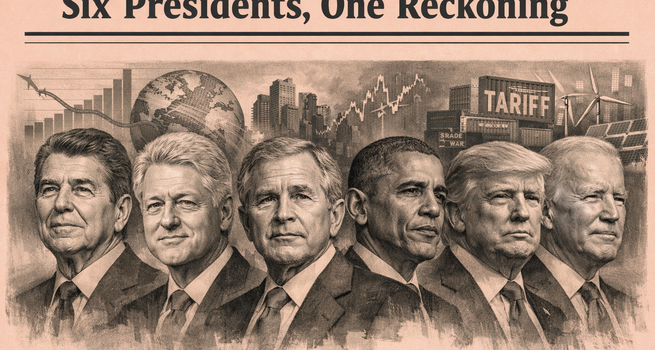
From Reagan's deficit gambit to Trump's tariff regime, presidential policy cycles have ceased to be political events. They are now the dominant structural driver of global capital allocation — and institutional investors are only beginning to price that reality
Key Highlights
- Trump's 2025 tariff regime has pushed average US import duties to their highest level since 1935, embedding structural inflation risk across global supply chains
- The federal deficit reached $1.8 trillion in fiscal year 2025; the Congressional Budget Office projects it will approach $1.9 trillion in 2026 and $3.1 trillion by 2036
- The US dollar declined approximately 10 percent in 2025, prompting record central bank gold purchases and a structural reassessment of dollar reserve dominance
- A Supreme Court ruling that IEEPA-based tariffs are unconstitutional has introduced a new dimension of legal and policy uncertainty into trade strategy
- Institutional investors are increasingly treating presidential policy cycles as a persistent, quantifiable macro risk factor rather than an episodic political variable
The New Architecture of Market Risk
There is a question that institutional investors have spent most of the past century trying to avoid asking too seriously: what if the most important variable in a portfolio is not earnings, not inflation, not the yield curve — but the occupant of the White House?
The second Trump administration has made that question unavoidable. Within twelve months of taking office, a single executive branch deployed trade policy, fiscal legislation, regulatory posture, and legal authority in ways that moved equity indices by trillions of dollars, weakened the world's reserve currency by a tenth of its value, and forced a Supreme Court ruling on the constitutional limits of presidential economic power. The Economic Policy Uncertainty Index hit its highest reading since the onset of the Covid-19 pandemic. Central banks around the world accelerated the diversification of reserves away from the dollar. The Treasury market's status as a global safe haven came under its most serious institutional scrutiny in a generation.
This is not a passing episode. It is the operating environment. And understanding it requires tracing the full arc of how American presidential power became the dominant structural driver of global capital.
The Transmission Mechanism
Presidents do not control economic outcomes directly. What they control is the institutional architecture through which capital flows, costs are set, and expectations are formed.
The transmission from policy to market operates through five channels, all of which are simultaneously active in the current cycle. Fiscal policy is the most direct: decisions on taxation, deficit tolerance, and public investment alter aggregate demand, reshape corporate earnings profiles, and influence the structural supply of government debt. Regulatory posture determines the risk-return calculation in specific sectors, affecting competition and profitability at the industry level. Trade policy, through tariffs and sanctions regimes, restructures global supply chains and embeds cost pressures that can persist well beyond any single administration. Presidential influence over monetary conditions operates indirectly through central bank appointments and the signalling that shapes rate expectations. And geopolitical strategy — through alliance management, military posture, and commodity access — influences the pricing of energy, currencies, and risk assets globally.
In the current cycle, the compounding interaction of all five channels simultaneously is producing a level of structural market uncertainty that existing institutional frameworks were not built to handle. The calibration is still incomplete.
Six Administrations: The Arc That Led Here
Reagan: The Supply-Side Template
Ronald Reagan's presidency established the foundational logic of debt-supported expansion that has defined American fiscal policy ever since. Tax reductions and aggressive deregulation stimulated private investment and produced strong nominal growth through the mid-1980s. The structural consequence, however, was a permanent widening of the fiscal deficit — an implicit policy choice to subordinate long-term debt sustainability to short-term growth optimisation.
The era entrenched a political tolerance for deficit finance that subsequent administrations would repeatedly exploit. The line from Reagan's first budget to the $1.8 trillion deficit of 2025 is not straight, but it is unbroken.
Clinton: The Globalisation Dividend
The Clinton years represent the peak of the efficiency-led growth model. Fiscal consolidation produced genuine budget surpluses while simultaneous trade liberalisation accelerated the integration of global supply chains. Corporate profitability expanded structurally as labour and manufacturing costs were arbitraged internationally, and the equity bull market of the 1990s reflected both the earnings reality and a profound repricing of globalisation as a durable source of productivity.
That repricing is now being systematically reversed. The 1990s consensus — that open trade was a permanent feature of the US growth model — was the intellectual foundation on which four decades of equity valuation assumptions rested. The current administration is dismantling it.
George W. Bush: Leverage and Systemic Fragility
The combination of tax cuts, defence spending, and permissive financial regulation during the Bush years created a deficit-financed expansion that masked the accumulation of systemic leverage. Financial deregulation allowed risk to propagate through the banking system with inadequate capital buffers. The resulting financial crisis required a decade of policy repair and permanently altered the global regulatory environment, establishing state intervention as a mainstream macroeconomic tool.
Obama: Stabilisation Without Full Recovery
The Obama administration inherited a financial system in acute distress and responded with fiscal stimulus alongside comprehensive re-regulation of the banking sector. The result was gradual stabilisation that restored systemic resilience without fully restoring pre-crisis growth trajectories — a classic post-crisis transition: improved institutional stability at the cost of growth momentum. The era's lasting legacy is the normalisation of large-scale government market intervention as a first-response tool.
The Policy Break: Trump First Term and Biden
The first Trump administration delivered the most significant structural break in US trade policy since Bretton Woods, combining corporate tax reductions with tariffs that disrupted established supply chains and signalled a decisive turn toward economic nationalism.
The Biden administration then deepened state-directed capital allocation through the Infrastructure Investment and Jobs Act, the CHIPS and Science Act, and the Inflation Reduction Act — collectively redirecting hundreds of billions of dollars toward semiconductors, clean energy, and physical infrastructure. Together, these two presidencies completed a decisive transition away from market-led capital allocation. Fiscal intervention and industrial policy are now permanent features of the US growth model. The inflationary and fiscal consequences of that transition are fully visible in current asset prices.
The Current Regime: April 2025 and Its Aftermath
The second Trump administration has pursued the logic of economic nationalism with considerably more institutional preparation and legal reach than the first.
On April 2, 2025 — now referred to in some trading floors simply as "Liberation Day" — President Trump invoked the International Emergency Economic Powers Act to declare a national emergency over the US trade deficit, imposing a 10 percent base tariff on imports from nearly every country in the world. The average effective tariff rate in the US rose from 2.4 percent at the start of the year to 17 percent — the highest level since 1935. Global equity markets responded immediately: the S&P 500 fell below 5,000 points for the first time in nearly a year, wiping out trillions of dollars in equity value within days.
The administration subsequently announced a 90-day pause on the highest reciprocal tariffs and reached bilateral arrangements with several trading partners, including a trade agreement with Japan that set tariffs on Japanese goods at 15 percent, well below the 25 percent figure previously signalled. However, the legal architecture of the entire regime was challenged in the courts.
The Supreme Court ultimately ruled that tariffs imposed under IEEPA were unconstitutional without congressional authorisation — a landmark determination that forced the administration to end the IEEPA-based programme and impose a temporary 10 percent global tariff under Section 121 of the Trade Act of 1974. The ruling did not resolve the underlying policy ambition. It simply forced a change of statutory vehicle, producing ongoing legal complexity and episodic market volatility that shows no sign of abating.
On the fiscal side, the One Big Beautiful Bill Act extended and expanded the 2017 tax cuts, making several provisions permanent. The direct deficit-increasing effects of the legislation exceeded the projected deficit-reducing impact of newly imposed tariffs — even before the Supreme Court ruling rendered some of those tariffs unconstitutional.
Four Structural Shifts Now in Active Repricing
The cumulative effect of six decades of policy evolution has reconfigured the global economic framework. Four structural shifts are now directly visible in asset pricing.
Trade architecture. The global economy has moved decisively from open globalisation toward strategic decoupling. Organisations face pressure to renegotiate supply contracts to account for cost volatility and to integrate trade policy forecasting with capital allocation models in ways that would have seemed exotic a decade ago. This is no longer a contingency. It is standard operating procedure.
The fiscal dominance of growth cycles. The dominant macroeconomic stabilisation tool has shifted from monetary policy to fiscal intervention, which now drives growth cycles with sovereign balance sheet consequences that are growing acute. The federal deficit is projected at $1.9 trillion in fiscal year 2026, rising to $3.1 trillion by 2036. Debt held by the public is forecast to rise from 101 percent of GDP to 120 percent within a decade — well above the previous post-war record.
The renationalisation of capital allocation. Government spending is reshaping sectoral earnings trajectories in semiconductors, defence, and energy in ways that override traditional market-led capital flows. The distinction between a portfolio allocation decision and a reading of government industrial policy has effectively collapsed in several key sectors.
The inflation regime. Inflation has persisted near 3 percent, significantly above the Federal Reserve's 2 percent target. Rising bond supply from large and growing fiscal deficits is keeping long-term yields elevated despite policy easing. Net interest payments on federal debt now stand at 3.2 percent of GDP — tied with 1991 as the all-time high — and are projected to rise to 4.6 percent of GDP by 2036 as the average nominal interest rate on government debt begins to exceed the nominal growth rate of the economy.
The Dollar and the Safe-Haven Question
The dollar's 10 percent decline in 2025 is not merely a currency story. It is an institutional story. One direct consequence of more uncertain US trade policy has been structurally lower demand for dollars as a reserve asset, evidenced most clearly by record annual purchases of gold by global central banks — a development that reflects not a crisis of confidence but a deliberate and systematic diversification away from dollar dependence.
A 2025 survey of 75 central banks by the Official Monetary and Financial Institutions Forum found that respondents plan a gradual reallocation away from the dollar in coming years, including further toward gold. Foreign net purchases of US Treasuries remained resilient at $472 billion through September 2025, tracking slightly above the prior year — suggesting that the erosion of dollar reserve status is at present gradual rather than acute. But gradual is not the same as reversible.
The Treasury market's safe-haven premium — the discount at which investors have traditionally been willing to hold US government debt precisely because of its perceived security — is now subject to the kind of questioning that would have been considered fringe analysis five years ago. It is now mainstream institutional concern.
Market Implications: Where Capital Is Moving
The policy backdrop is now a primary driver of asset class divergence. Sectors with lower foreign revenue exposure — software, cybersecurity, defence technology, and large-cap domestic financials — are less exposed to the direct impact of tariffs and may benefit from structural tailwinds around AI adoption and government spending. Utilities carry low tariff exposure and have emerged as a defensive leader in an environment of elevated macro uncertainty.
In fixed income, the term premium is expanding as markets price the structural implications of an open-ended fiscal expansion. Duration management now requires explicit scenario analysis for tariff-on and tariff-off outcomes, given the ongoing legal and political contestation of trade policy.
In equities, dollar weakness has reshuffled relative performance decisively in favour of international indices — a dynamic that may prove more durable than temporary if the structural reassessment of dollar reserve dominance continues.
The Risk Register
The Penn Wharton Budget Model projects that Trump's tariff programme will reduce long-run US GDP by approximately 6 percent and wages by 5 percent. A middle-income household faces an estimated $22,000 lifetime loss — losses calculated to be roughly twice as large as a revenue-equivalent corporate tax increase. Moody's issued a credit warning in March 2025 about the potential negative impact of sustained high tariffs set against a national debt-to-GDP ratio of 123 percent.
Policy uncertainty itself has become a market variable. The rise in economic uncertainty through the first quarter of 2025 is estimated to have reduced investment by approximately 4.4 percent for the year. The long-term fiscal outlook has deteriorated materially: under current-law projections, the 2055 debt-to-GDP ratio is forecast at approximately 172 percent — a trajectory that raises the spectre of explosive debt dynamics within the next two to three decades.
The Supreme Court's IEEPA ruling has introduced a contested framework for executive trade authority that is likely to produce continued litigation and policy reversals. Legal uncertainty is now embedded in trade planning as a permanent operating condition rather than an exceptional risk.
Conclusion: Policy Risk as a Core Allocation Variable
The second Trump administration has done more than any in recent memory to make the policy-market nexus explicit and immediate. Tariffs, tax legislation, executive legal authority, and dollar dynamics have converged into a single policy event that is still working through asset prices. For institutional investors, this is not a passing phase to be waited out. It is the operating environment.
The structural implication is unambiguous. Policy risk must now be treated as a core input in asset allocation alongside growth, inflation, and liquidity. Across the full arc of the presidential policy cycles examined here, one pattern remains consistent: short-term policy gains tend to generate long-term structural trade-offs. In the current cycle, both the gains and the trade-offs are arriving simultaneously — and the institutions best placed to navigate that environment are those that have already stopped treating political risk as a residual.
The president, it turns out, is the market.
This analysis draws on data from the Congressional Budget Office, the Penn Wharton Budget Model, the Official Monetary and Financial Institutions Forum, and public market data through April 2026.


 Jun 15, 2026




 Please wait processing your request...