
 AU
AU
 UK
UK
 CA
CA
 NZ
NZ
 IND
IND

 US
US

 Share
Share
 X (Formerly Twitter)
 Whatsapp
 Facebook
 LinkedIn
 Telegram
 Email This Article
 Copy Link
 Summarize with AI
 Chat GPT
 Perplexity
Highlights
- Frontline reported Q3 FY25 revenues of USD 438.6 million, down 10.5% YoY, reflecting softer tanker rates.
- Operating profit fell 33.3% to USD 40.3 million, impacted by higher vessel expenses and dry-docking costs.
- The company announced long-term time charter contracts for seven VLCCs, boosting contracted revenue visibility.
- Frontline is pursuing a fleet renewal initiative, selling eight older VLCCs for USD 831.5 million to modernize its assets.
FRONTLINE PLC (NYSE:FRO) is a Cyprus-based company and it primarily operates in the transportation sector. The company's main focus is on seaborne transportation of crude oil and refined products.
The company follows a flexible, earnings-based dividend policy, linking payouts to prevailing tanker market conditions and supporting its role as a high-beta yield option in the crude tanker sector. For Q3 2025, the Board announced a dividend of USD 0.19 per share, payable around 19 December 2025, which corresponds to an estimated quarterly cash distribution of roughly USD 42.3 million, based on 222.6 million shares outstanding.
Q3 FY25 Operating Metrics
For the third quarter of financial year 2025 (Q3 FY25), FRO reported total revenues and other operating income of USD 438.6 million, down 10.5% from USD 490.4 million in the same quarter last year. The decline was primarily due to lower average TCE rates, partially offset by fleet utilization.
Operating profit fell 33.3% to USD 40.3 million from USD 60.5 million in Q3 FY24, reflecting softer time charter earnings and higher vessel operating expenses, including ship management transition costs and dry-docking impacts.
Net cash provided by operating activities for the year-to-date was USD 399.1 million, a decrease of 29.8% compared with USD 568.6 million a year earlier, largely reflecting weaker freight rate realization. Cash at bank and on hand fell 54.2% to USD 189.4 million from USD 413.5 million, primarily due to debt prepayments, balance sheet optimization, and dividend distributions.
Recent Business Update
The company announced on January 23, 2026, that it has secured multiple long-term time charter-out contracts for seven of its very large crude carriers (VLCCs). The agreements are expected to strengthen contracted revenue visibility and reinforce the company’s fleet employment profile.
Earlier, on January 8, 2026, the company confirmed a strategic fleet renewal initiative involving the sale of eight older VLCCs built between 2015 and 2016 for USD 831.5 million. The move is part of ongoing efforts to optimize and modernize its asset base.
Top 10 Shareholders
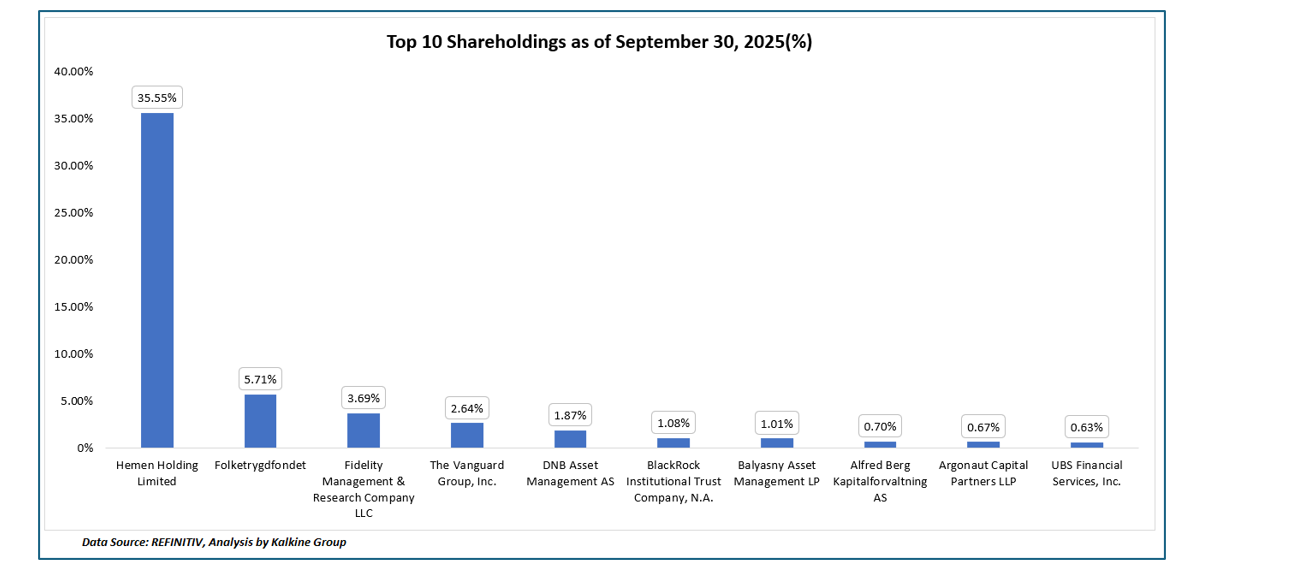
The top 10 shareholders of FRO account for ~53.56% of the total shareholding, signifying concentrated shareholding. Hemen Holding Limited and Folketrygdfondet are the biggest shareholders, holding the maximum stake in the company at ~35.55% and ~5.71%, respectively.
Share Performance
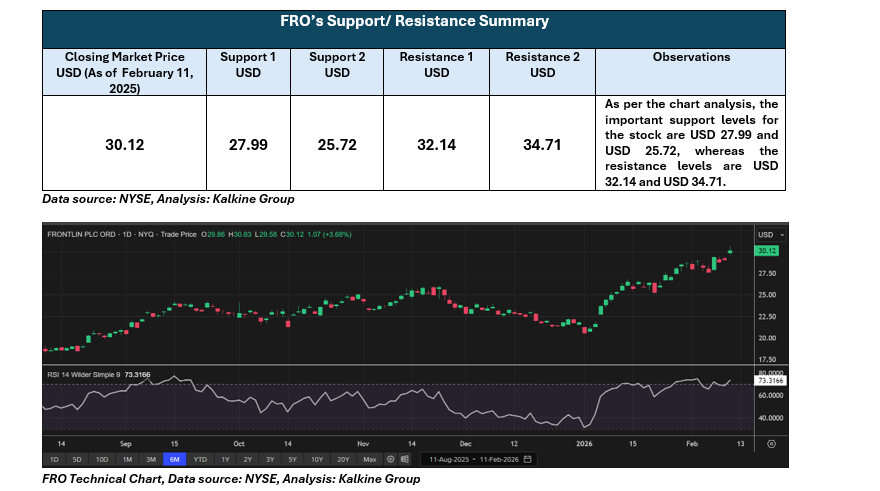
FRO closed at USD 30.12 on February 11, 2026, rising 3.68% intraday. The stock has surged 73.10% over the past year, hitting a 52-week high of USD 29.40 on 06-Feb-2026. Year-to-date gains stand at 38.04%, with a 52-week low of USD 12.40.
Support and Resistance Summary
Note 1: Past performance is not a reliable indicator of future performance.
Note 2: The reference date for all price data, currency, technical indicators, support, and resistance levels is February 11, 2026. The reference data in this report has been partly sourced from EODHD/Others.
Technical Indicators Defined: -
Support: A level at which the stock prices tend to find support if they are falling, and a downtrend may take a pause backed by demand or buying interest. Support 1 refers to the nearby support level for the stock and if the price breaches the level, then Support 2 may act as the crucial support level for the stock.
Resistance: A level at which the stock prices tend to find resistance when they are rising, and an uptrend may take a pause due to profit booking or selling interest. Resistance 1 refers to the nearby resistance level for the stock and if the price surpasses the level, then Resistance 2 may act as the crucial resistance level for the stock.

_06_12_2026_23_00_13_327450.jpg)
 Jun 12, 2026




 Please wait processing your request...