
 AU
AU
 UK
UK
 CA
CA
 NZ
NZ
 IND
IND

 US
US

 Share
Share
 X (Formerly Twitter)
 Whatsapp
 Facebook
 LinkedIn
 Telegram
 Email This Article
 Copy Link
 Summarize with AI
 Chat GPT
 Perplexity
Gold Starts 2026 Strong as Geopolitics Support Prices, but Fading Rate-Cut Hopes Raise Volatility Risks
Gold has begun 2026 on a firm footing, extending last year’s powerful rally and trading above $4,460 per ounce. The metal has now posted three consecutive sessions of gains, underpinned by a fresh wave of safe-haven demand and a still-supportive long-term technical structure. However, with key US economic data due later this week and expectations for aggressive rate cuts continuing to fade, investors should brace for higher volatility in the near term.
The immediate catalyst for gold’s latest surge has been geopolitics. Bullion jumped 2.7% on Monday after a US military operation in Venezuela over the weekend led to the capture of President Nicolas Maduro. President Donald Trump said Washington would temporarily “run” Venezuela and warned of further action if the interim government fails to comply with US demands. These developments rattled risk sentiment and drove investors toward traditional havens, lifting gold to its highest levels in weeks.
At the same time, markets are becoming more cautious ahead of the December US jobs report, due on Friday. With gold increasingly sensitive to shifts in interest-rate expectations, labour-market data could prove decisive. Minneapolis Fed President Neel Kashkari said inflation remains too high and warned that unemployment could rise, while noting that interest rates may be nearing a neutral level. His comments highlight the growing uncertainty around how much further central banks can ease policy.
After one of its strongest annual performances on record, gold’s backdrop is evolving. In recent years, the rally was powered by a combination of aggressive monetary easing and heavy central-bank buying. While both forces are still present, neither looks as powerful as before. Expectations for additional rate cuts have cooled, with several central banks signalling a pause or even discussing policy normalisation. In such an environment, gold risks losing one of its most important tailwinds: falling interest rates.
Central-bank demand remains supportive but is showing early signs of slowing. Physical gold purchases stayed robust through 2025, yet the pace eased as prices climbed to record highs. China, which played a pivotal role in driving official-sector buying in recent years, has scaled back its purchases, raising concerns that elevated prices may deter further accumulation. Adding to this, a handful of countries have begun trimming their gold reserves, suggesting that profit-taking at current levels is no longer unthinkable.
Geopolitics continues to matter, though its influence is becoming more nuanced. While conflicts and strategic tensions supported safe-haven flows last year, early signs of de-escalation in parts of Eastern Europe and the Middle East have slightly dulled gold’s defensive appeal. That said, global stability remains fragile. Political risks have not disappeared, and sudden flare-ups—particularly involving energy markets or emerging economies—could quickly revive demand for protection.
The US dollar is another key variable. A softer dollar helped underpin gold throughout 2025, but it is far from certain that this trend will persist. Any renewed inflation pressures or supply-side shocks could strengthen the greenback and complicate the outlook for precious metals.
Gold Technical Analysis
From a technical standpoint, gold’s long-term bullish structure remains intact. The daily chart continues to print higher highs and higher lows, and prices remain well supported above key moving averages. As long as this structure holds, aggressively selling gold makes little sense. While momentum indicators suggest the metal is approaching overbought territory, that alone is not a reason to turn bearish.
The $4,350–$4,380 zone is the most important support area to watch. This region previously acted as resistance in October before being decisively broken in December. After a brief dip below it late last year, gold quickly reclaimed this zone at the start of 2026, reinforcing its importance. A successful retest would keep the bulls in control.
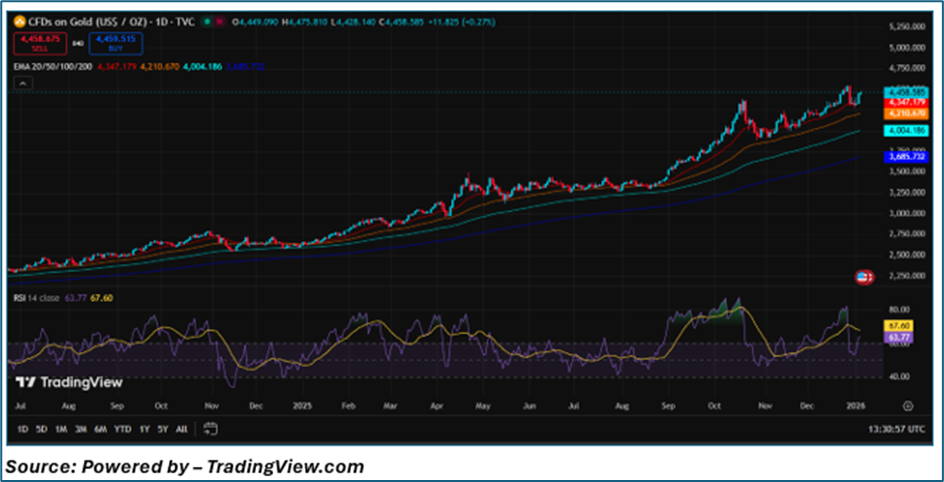
However, a sustained break below $4,350 would be a warning sign. In that scenario, gold could slide toward the next major support near $4,250. Below that, technical support is thin until the low $4,000s, increasing the risk of a deeper pullback.
On the upside, $4,500 remains a key psychological resistance level. Gold sold off sharply from this area in late December, suggesting sellers are still active there. Ahead of that, the $4,469 level—the late-December swing low—could also act as near-term resistance. A decisive break above $4,500 would shift focus toward liquidity above the December all-time high near $4,550, with round-number targets such as $4,600 and $4,700 coming into view.
Overall, gold looks less like a one-way trade and more like a test of conviction. The metal remains strategically attractive, but with fading rate-cut expectations and slowing central-bank buying, 2026 is shaping up to be a more volatile and selective year for gold investors.

_06_12_2026_23_00_13_327450.jpg)
 Jun 12, 2026




 Please wait processing your request...