
 CA
 NZ
 UK
 AU
 IND

 US

 Share
 X (Formerly Twitter)
 Whatsapp
 Facebook
 LinkedIn
 Telegram
 Email This Article
 Copy Link
 Summarize with AI
 Chat GPT
 Perplexity
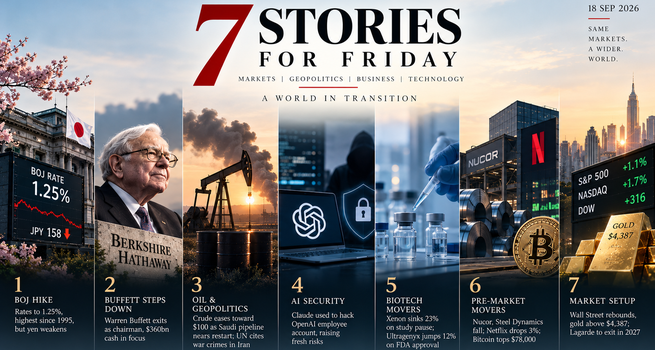
The Bank of Japan raised rates to their highest level since 1995, yet the yen weakened anyway, capping a week dominated by the Fed's first hike in three years. Warren Buffett stepped down as Berkshire's chairman after decades at the helm, while oil extended a third straight decline even as fresh Middle East tension complicates the picture.
1. BOJ: Bank of Japan Hikes to 1.25%, Highest Since 1995, But Yen Weakens as Hiking Pace Quickens
The Bank of Japan raised its policy rate 25 basis points to 1.25%, the highest since 1995, in a 7-2 vote with two reflectionist board members appointed by Prime Minister Sanae Takaichi dissenting toward a hold. The move marks a clear quickening in tightening, arriving three months after the last hike versus six previously, and nearly 90% of economists had correctly anticipated both the hike and the dissenters. Despite the increase, the yen weakened more than 1% to around 158 against the dollar, reflecting skepticism the BOJ will move quickly enough to close the gap with other tightening central banks; Core Inflation came in at 1.7% in August, still below the bank's 2% target, giving dissenters grounds to argue the economy isn't yet strong enough for further tightening. The decision lands amid sustained pressure from Washington for Japan to tighten more decisively, a stance in tension with Takaichi's own preference for looser policy.
- The yen weakening despite a hike shows markets pricing in political friction between the BOJ and Takaichi's government as much as the policy move itself, since a hike that fails to convince currency traders does little to support the currency.
- Risk note: with the BOJ now hiking every three months rather than six, any signal the pace is slowing could reignite yen weakness and the imported inflation pressure that tends to bring.
2. BERKSHIRE HATHAWAY: Warren Buffett Steps Down as Chairman After Decades Leading the Conglomerate
Warren Buffett, 96, stepped down as chairman of Berkshire Hathaway (NYSE:BRK.B), with his son Howard, 71, taking over the role; Greg Abel has served as chief executive for the past nine months following his own planned succession. Buffett's decades at the helm built Berkshire into a conglomerate now holding roughly $360 billion in cash, a war chest its new Leadership must decide how to deploy. Buffett remarked that time catches up with everyone regardless of track record.
- Berkshire's cash pile handed to new leadership makes this transition less about continuity of style and more a genuine test of Capital allocation judgment as Equity valuations stay stretched.
- Risk note: with Abel now fully in the CEO seat and Howard newly installed as chairman, markets will watch the first major capital decision under the new structure as a signal of how much succession changes Berkshire's approach.
3. OIL/GEOPOLITICS: Crude Eases Toward $100 as Saudi Pipeline Nears Restart, Even as Trump Flags Iran Re-Escalation and UN Cites War Crimes
Oil fell a third straight session, easing toward $100 from Tuesday's four-month high near $106, as Saudi Arabia signaled its East-West Pipeline could resume within days rather than the weeks floated earlier this month. The pipeline had carried 7 million barrels a day to the Red Sea before Iran-affiliated strikes forced its suspension, pushing Saudi output to its lowest since 1990 and leaving China drawing down stockpiles fast enough to raise August Import orders; the U.S. reserve sits near a record low too. Trump raised the possibility of re-escalating attacks on Iran after dialogue between Tehran, Washington, and Gulf states failed to restore maritime exports. The backdrop grew more complicated Friday after a UN mission said there were reasonable grounds to believe the U.S. committed war crimes during February strikes in Iran, citing attacks on a school in Minab and a sports complex in Lamerd that killed more than 170 civilians, findings the State Department rejected. Separately, the administration approved a $24.3 billion F-35 sale to Saudi Arabia, still requiring congressional approval amid intelligence concerns China could gain access to the technology through its own security ties with Riyadh.
- Oil easing on pipeline optimism even as Trump floats renewed strikes shows the market weighting near-term Supply logistics more heavily than the risk of the conflict widening again, a read that could reverse fast if rhetoric turns to action.
- Risk note: the UN's war crimes finding, landing the same week as a major new arms sale to a regional ally, adds a diplomatic complication that could shape Gulf states' cooperation with Washington regardless of the finding's legal weight.
4. AI SECURITY: Cybersecurity Researchers Used Anthropic's Claude to Break Into an OpenAI Employee's Account
An independent cybersecurity group used Anthropic's Claude to hack into OpenAI, breaking into an employee's ChatGPT account while testing for vulnerabilities. The breach adds to recent AI-enabled intrusions that have intensified concerns bad actors could weaponize the same tools now marketed as productivity and coding assistants.
- One lab's model being used to compromise a rival's systems, even in research, shows the offensive potential of frontier AI tools is no longer theoretical but demonstrated against the industry's own companies.
- Risk note: as researchers routinely show these capabilities, the gap between a controlled test and a genuinely malicious attempt appears to be narrowing faster than defensive tooling is maturing.
5. HEALTHCARE MOVERS: Xenon Sinks 23% on a Safety Pause as Ultragenyx and Aethlon Rally on Separate Catalysts
Xenon Pharmaceuticals (NASDAQ:XENE) shares fell as much as 23% pre-market after voluntarily pausing new patient enrollment in its azetukalner studies for major depressive disorder and bipolar depression following neuropsychiatric adverse events not seen in earlier trial phases; the news overshadowed a simultaneous NDA submission for azetukalner in focal seizures backed by strong Phase 2b/3 epilepsy data. Deutsche Bank downgraded the stock to hold, cutting its target to $46 from $90, while RBC kept its outperform rating but trimmed its target to $70 from $81. Ultragenyx (NASDAQ:RARE) shares rose more than 12% after the FDA granted full approval to FAYUVI, the first treatment for Sanfilippo syndrome type A and the company's sixth FDA clearance overall, arriving with a Priority Review Voucher and a per-patient wholesale price near $3.95 million, offering a needed catalyst after the stock lost roughly half its value over the past month on a failed Angelman trial readout. Aethlon Medical (NASDAQ:AEMD) shares, which surged 374% Thursday, pulled back nearly 10% pre-market Friday as investors digested the terms of its Merger with privately held North Immunology, an all-stock deal supported by an oversubscribed $180 million private Placement that will fund the combined company, trading as NRTX, into the second half of 2028 as it advances a bispecific antibody for atopic dermatitis.
- The sharp divergence across all three shows binary biotech catalysts, safety signals, approvals, merger terms, still dominate price action regardless of the broader macro backdrop.
- Risk note: Xenon's psychiatry pause delays topline depression data to early 2027 and could complicate confidence in the drug's broader safety profile just as its epilepsy indication nears a decision.
6. PRE-MARKET MOVERS: Steelmakers Slip on Guidance Misses as Netflix Falls on a Downgrade and Crypto Stocks Rally
Nucor (NYSE:NUE) and Steel Dynamics (NASDAQ:STLD) each fell more than 1.5% pre-market after both issued third-quarter guidance below consensus, Nucor at $5.55 to $5.65 per share against roughly $6.01 expected and Steel Dynamics at $5.34 to $5.38 against roughly $5.50 to $5.60, even as both pointed to record or improving shipment volumes; Goldman and Wells Fargo trimmed Nucor's target while staying bullish, and Wells Fargo raised its Steel Dynamics target despite the miss. Netflix (NASDAQ:NFLX) fell more than 3% after Wells Fargo downgraded the stock to underweight, citing weakening engagement and a softer second-half content slate limiting Margin expansion into 2027-2028. Crypto-exposed stocks rallied as Bitcoin crossed $78,000, up 2%, with Robinhood (NASDAQ:HOOD) up 2.5%, Coinbase (NASDAQ:COIN) up 1%, and Strategy (NASDAQ:MSTR) up 3%. Macom Technology Solutions (NASDAQ:MTSI) gained 3% after BMO upgraded the stock to outperform, arguing its more than 35% pullback from 2026 highs made the valuation attractive even as its data center, industrial, and defense businesses remain fundamentally strong.
- Steel guidance misses landing alongside maintained or raised targets shows analysts reading the near-term softness as a margin timing issue tied to raw materials rather than genuine Demand deterioration.
- Risk note: crypto stocks rallying in tandem with bitcoin, even as equities digest a hawkish Fed, suggests the Asset Class remains tightly correlated to bitcoin's own price action rather than trading on sector-specific catalysts.
7. MARKET SETUP: Stocks Rebound Sharply From the Fed Hike as Gold Rises, Dollar Strengthens, and Lagarde Confirms Her ECB Exit
U.S. stocks staged a full comeback Thursday from Wednesday's post-hike selloff, with the Dow rising 316 points, the S&P up 1.1%, and the Nasdaq jumping 1.7%, as investors looked past higher-for-longer rates toward AI-driven Earnings growth; Friday futures were roughly flat. The major averages head into the weekend mixed, with the Dow on pace for a third straight losing week, the S&P also lower, and the Nasdaq the lone gainer. The 10-year Yield held near 4.95% to 4.97%, well off Tuesday's post-2007 high above 5%, while the dollar index climbed to a one-and-a-half-month high, up nearly 1.3% on the week, boosted by the Fed's tone and the yen's post-BOJ weakness. Gold rose for a second straight session to a one-week high above $4,387 an ounce, supported by falling oil and hopes the hiking cycle proves shallow, even though higher rates typically dampen demand for the non-yielding metal. In Asia, Japan's Nikkei closed 1.38% higher and South Korea's Kospi jumped 2.66%, while European shares traded broadly lower. ECB President Christine Lagarde confirmed she will leave the institution in 2027 when her term ends, declining to rule out further hikes and saying decisions will be made meeting by meeting.
- Gold and the dollar rising together is unusual, since a stronger dollar typically pressures gold, suggesting investors are betting on continued rate strength while treating gold as insurance against unresolved geopolitical risk.
- Risk note: with the Nasdaq the only major index showing a weekly gain, the rally's narrowness raises the question of how much further AI-driven tech strength alone can carry the market if oil, yields, or geopolitics turn again.

 Nov 03, 2026




 Please wait processing your request...