
 AU
AU
 UK
UK
 CA
CA
 NZ
NZ
 IND
IND

 US
US

 Share
Share
 X (Formerly Twitter)
 Whatsapp
 Facebook
 LinkedIn
 Telegram
 Email This Article
 Copy Link
 Summarize with AI
 Chat GPT
 Perplexity
In global markets, some companies dominate headlines while others quietly shape the future. ASML Holding NV belongs firmly to the second group. It does not design chips like NVIDIA, nor does it manufacture them like TSMC. Yet without ASML, neither could operate at the cutting edge of technology. In practice, nearly every advanced chip—whether used for artificial intelligence, data centres, or smartphones—must pass through ASML’s lithography tools.
This unique position helps explain why investors have again turned their attention to the company. On January 6, Bernstein upgraded ASML to Outperform, raised its price target, and named it its top European semiconductor pick for 2026. The firm cited expectations of a DRAM upcycle, expanding fabrication capacity, and faster migration to advanced chip nodes as factors that could support demand for ASML’s most advanced systems into 2027.
More Than Just Machines
ASML is best known for its extreme ultraviolet (EUV) lithography machines. These are among the most complex industrial systems ever built, often costing more than $150 million each and taking years to assemble. ASML is currently the only company capable of producing them at scale.
However, focusing solely on machine sales overlooks an increasingly important part of ASML’s business model.
Around 25% of ASML’s revenue comes from “services and field options.” This segment includes maintenance, performance upgrades, software enhancements, and component replacements for machines already installed at customer sites. According to company disclosures, this segment has grown at a compound annual rate of roughly 20% since 2012, outpacing overall revenue growth.
This matters because service revenue tends to be recurring, higher-margin, and less cyclical than new equipment sales. Once an EUV machine is installed, it requires continuous servicing and upgrades to remain productive. ASML’s systems are designed to last for decades, but only with regular improvement. Their modular architecture makes ongoing upgrades not optional, but essential.
As the global installed base of ASML systems expands, so too does this recurring revenue stream. Each new system sold today has the potential to generate service-related revenue for many years.
Why the Next Cycle May Look Different
The semiconductor industry is famously cyclical. Periods of heavy capital spending are often followed by sharp slowdowns. What appears different about the current phase is the structural nature of demand.
Artificial intelligence is no longer a niche application. It is increasingly becoming part of the core infrastructure of the global economy. Training and running AI models requires chips with smaller transistors, higher performance, and lower power consumption. That trend pushes chipmakers toward advanced manufacturing nodes—and advanced nodes rely heavily on EUV lithography.
Bernstein highlights three forces that could align over the next few years:
- A potential DRAM upcycle linked to AI-related memory demand
- New fabrication capacity scheduled to come online around 2026
- Accelerating node migration as chip designers seek competitive advantages
Together, these factors could support sustained EUV demand beyond the near term. Rather than simply riding a traditional cycle, ASML appears positioned to benefit from a longer-term shift in how computing capacity is built.
Margins, Scale, and the Long View
ASML’s long-term outlook reflects this confidence. The company has indicated ambitions of reaching around $55 billion in annual revenue by 2030, with gross margins approaching 60%, assuming continued expansion of advanced manufacturing. Such margins are unusually high for an industrial business and reflect ASML’s strong competitive position and the growing contribution from services.
These projections are not guarantees. They depend on continued customer investment, technology adoption, and stable operating conditions. Still, the logic is straightforward: every additional system installed today increases not just near-term revenue, but the potential for long-duration service income. This is why ASML increasingly resembles a platform business rather than a conventional capital-goods supplier.
Technical Commentary: What the Chart Suggests
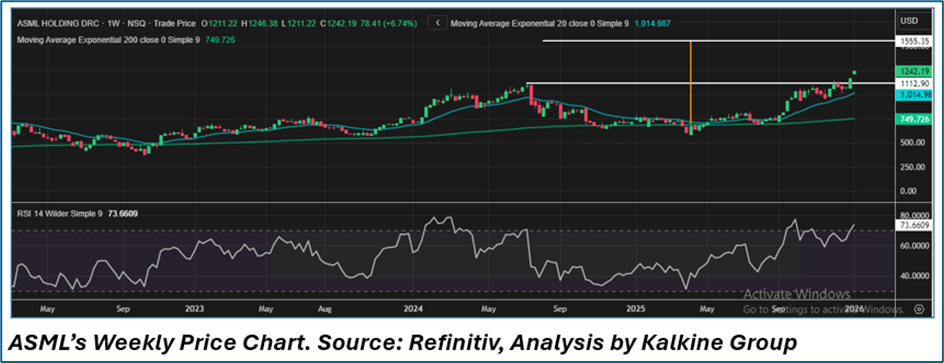
From a technical perspective, ASML recently moved to a new all-time high, breaking above the prior resistance zone around $1,110–$1,150. This area had capped prices for much of the past year and may now act as support, though this remains subject to market conditions.
The broader weekly price structure resembles a rounded base, followed by a breakout. Such formations are often interpreted as signs of longer-term accumulation rather than short-term speculation. After a sharp correction in 2024, the stock spent several months consolidating before resuming its upward trend.
Momentum indicators support this interpretation. The RSI has moved into the low-70s range, indicating strong momentum but not yet levels typically associated with major market peaks. In previous uptrends, ASML has sustained elevated RSI readings for extended periods.
From a technical standpoint:
- Support appears near the $1,110–$1,150 region
- Chart patterns suggest potential upside toward the $1,600 area, broadly consistent with some analyst targets
- Short-term pullbacks would be normal following a strong advance
Overall, the chart points to leadership characteristics, though it does not eliminate the possibility of volatility.
Why ASML Is Often Called an “AI Kingmaker”
ASML does not decide which AI model succeeds or which chip design dominates. But it provides the tools that make advanced chip manufacturing possible. In that sense, it controls a critical gate in the semiconductor value chain.
Even if competition intensifies among chip designers or foundries, ASML’s role remains central. Chips used in data centres, autonomous systems, or future technologies yet to be defined are likely to rely on its equipment. This is why many observers view ASML less as a cyclical semiconductor stock and more as critical infrastructure for the digital economy.
Risks to Watch
No investment is without risk. ASML remains exposed to:
- Geopolitical tensions affecting global semiconductor supply chains
- Export controls that could restrict sales to certain regions
- The inherent volatility of semiconductor capital spending cycles
That said, the growing share of recurring service revenue may help moderate some of these risks compared with past cycles.
Conclusion: Quiet Power, Lasting Influence
ASML’s recent share price strength reflects more than a single analyst upgrade. It suggests growing recognition of the company’s structural importance to the global technology ecosystem. With an expanding installed base, increasing high-margin service revenue, and long-term demand linked to AI and advanced computing, ASML appears well positioned for continued relevance.
It may not command the same attention as its customers. But in the semiconductor world, ASML remains an indispensable enabler—a quiet power behind the AI era.
Disclaimer: This article is for informational and educational purposes only and does not constitute investment advice or a recommendation to buy or sell any security.

_06_12_2026_23_00_13_327450.jpg)
 Jun 12, 2026




 Please wait processing your request...