
 AU
AU
 UK
UK
 CA
CA
 NZ
NZ
 IND
IND

 US
US

 Share
Share
 X (Formerly Twitter)
 Whatsapp
 Facebook
 LinkedIn
 Telegram
 Email This Article
 Copy Link
 Summarize with AI
 Chat GPT
 Perplexity
Structural Compounding at the Center of AI-Led Capex
The defining characteristic of enduring wealth creation is ownership of businesses that sit at the irreversible chokepoints of global value chains. ASML Holding NV represents precisely such an enterprise. As the sole provider of extreme ultraviolet (EUV) lithography systems—and the uncontested leader in next-generation High-NA EUV—ASML occupies a position that is not merely competitively advantaged, but structurally non-substitutable.
The company’s record 2025 performance reinforces a central investment insight: the next leg of semiconductor expansion is not cyclical in nature. It is structural, driven by the compute intensity of artificial intelligence, which is forcing the industry toward ever-smaller nodes, higher lithography complexity, and significantly greater tool intensity per wafer. In this environment, ASML is not simply a beneficiary of industry growth; it is the enabler of that growth.
2025: Record Execution Confirms Operating Leverage
ASML exited 2025 with its strongest operational and financial performance to date. Full-year revenue reached €32.7 billion, growing 16% year-on-year, while net income climbed to €9.6 billion. Gross margins remained exceptional at 52.8%, highlighting the company’s ability to scale profitably despite rising manufacturing complexity and heavy reinvestment into capacity and R&D.
The quality of this growth is particularly important. Incremental revenue is increasingly concentrated in advanced lithography layers—precisely where ASML’s competitive moats are deepest and pricing power strongest. This creates a virtuous loop: higher technological dependence drives higher margins, which in turn funds faster innovation.
A Defining Quarter: Q4 Demonstrates Both Demand and Delivery
Q4 2025 marked the strongest quarter in ASML’s history, with net revenue of €9.7 billion and net income of €2.8 billion. Notably, the quarter included revenue recognition of two High-NA EUV systems, providing tangible evidence that ASML’s most strategically important long-term platform is transitioning from development into early commercial deployment.
Gross margin of 52.2% in the quarter underscores that the company’s earnings power is not being diluted by scale; instead, scale is enhancing profitability through favorable mix and disciplined execution.
EUV as the Epicenter of AI-Driven Capital Allocation
Order intake provides the clearest real-time signal of where customers are placing long-term bets. ASML reported Q4 net bookings of €13.2 billion, of which €7.4 billion came from EUV systems. This is not opportunistic ordering. It reflects semiconductor manufacturers locking in advanced lithography capacity to support multi-year AI-related buildouts.
The backlog reinforces this narrative. At year-end 2025, total backlog stood at €38.8 billion, with €25.5 billion attributable to EUV. Such visibility is rare in capital equipment and confers a level of earnings durability typically associated with infrastructure-like assets rather than cyclical machinery suppliers.
Installed Base Monetisation: The Quiet Compounding Engine
ASML’s installed base business has evolved into a second growth pillar. Installed Base Management revenue reached €8.2 billion in 2025, with €2.1 billion in Q4 alone. Two forces drive this expansion:
- The growing global population of EUV tools, each requiring intensive service and support
- Rising customer preference for upgrades, which expand effective capacity faster than new tool installations
This recurring revenue stream enhances resilience across semiconductor cycles and structurally raises return on capital.
Technology Roadmap: Staying Several Years Ahead
ASML’s leadership is not static; it is being actively extended.
- Low-NA EUV NXE 3800 systems demonstrated throughput of 220 wafers per hour, with testing indicating potential up to 230 wafers per hour
- High-NA EUV continues to progress through customer qualification, anchoring ASML’s relevance in the sub-2nm era
- Metrology and inspection solutions are gaining strategic importance as chip architectures grow more complex
The implication is straightforward: competitors are not merely behind—they are falling further behind.
2026 Outlook: Growth with Constrained Supply, Not Constrained Demand
For Q1 2026, ASML guides revenue of €8.2–€8.9 billion and gross margin of 51%–53%. Full-year 2026 revenue is expected between €34–€39 billion.
Management acknowledges supply tightness, particularly around EUV, but this represents a delivery constraint rather than a demand issue. In practical terms, this means revenue growth is capped by how fast ASML can build tools, not by how many customers want them.
Capital Allocation: Shareholder Alignment with Long-Term Vision
ASML plans to declare a 2025 dividend of €7.50 per share (17% growth YoY) and has announced a share buyback program of up to €12 billion through 2028. This reflects confidence in sustained free cash flow generation while maintaining aggressive reinvestment in future technology platforms.
Long-Term Trajectory: 2030 as a Logical Extension, Not a Stretch
ASML targets 2030 revenue of €44–€60 billion with gross margins of 56%–60%. Given the structural nature of AI-driven semiconductor demand and increasing lithography intensity, these targets appear less aspirational and more evolutionary.
Technical Analysis (Weekly Price Chart Analysis)
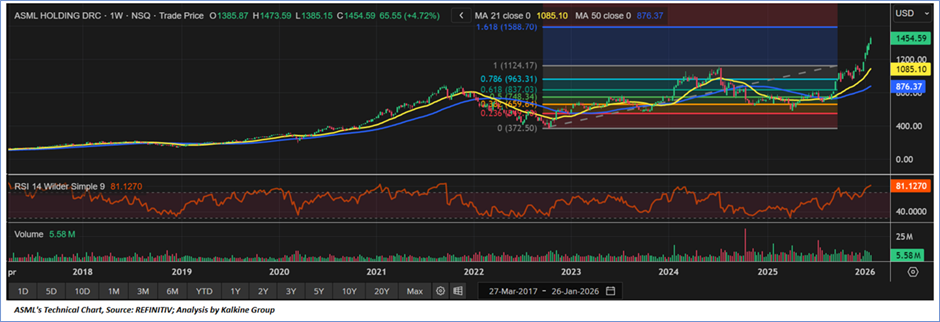
ASML has confirmed a decisive upside breakout from a multi-year consolidation range that persisted between 2023 and 2025. The resolution of this base signals a transition from accumulation to mark-up, a pattern commonly observed when long-term institutional positioning shifts decisively bullish.
Price is trading at new highs, well above historical resistance zones, implying that prior overhead supply has been absorbed and a higher valuation regime is being established.
Moving Average Configuration
- Price significantly above 21-week MA (~1,085)
- Price significantly above 50-week MA (~876)
- Both moving averages rising and widening
This configuration defines a strong bull regime. The slope and separation indicate accelerating medium- and long-term momentum.
Momentum & Risk Management
Weekly RSI near ~81 places ASML in overbought territory. In institutional practice, this is interpreted not as a sell signal but as evidence of strong trend velocity. However, it does increase the probability of near-term consolidation or shallow pullbacks before the next impulse leg higher.
Technical Summary
- Trend: Strongly bullish
- Structure: Breakout and continuation
- Risk: Short-term overextension, long-term trend intact
Final Perspective
ASML represents a rare combination: monopoly-like positioning, expanding technological relevance, recurring revenue growth, and disciplined capital allocation. The AI era is not creating a new competitor to ASML—it is deepening the world’s dependence on it.
For long-term investors seeking exposure to structural compounding rather than cyclical trading, ASML stands out as a cornerstone holding in the global technology value chain.

_06_12_2026_23_00_13_327450.jpg)
 Jun 12, 2026




 Please wait processing your request...