
 AU
AU
 UK
UK
 CA
CA
 NZ
NZ
 IND
IND

 US
US

 Share
Share
 X (Formerly Twitter)
 Whatsapp
 Facebook
 LinkedIn
 Telegram
 Email This Article
 Copy Link
 Summarize with AI
 Chat GPT
 Perplexity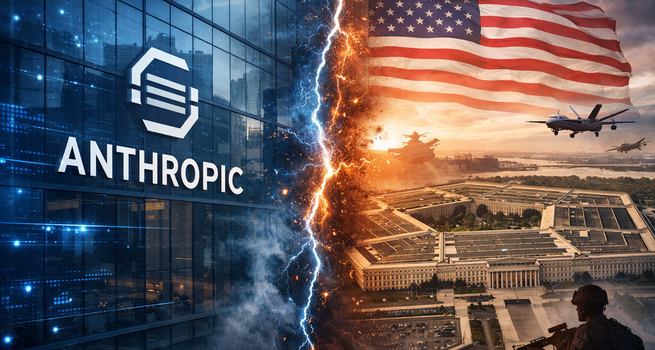
Key Highlights
- Dario Amodei said Anthropic will challenge the Pentagon’s supply chain risk designation in court.
- Amodei said the restriction applies only to limited Department of War contract uses of Claude.
- He reiterated that Anthropic does not support fully autonomous weapons or mass domestic surveillance.
- Amodei apologized for an internal company message that was leaked during the dispute.
- He confirmed Anthropic will continue supporting U.S. warfighters during the transition period.
Introduction: AI Governance Meets National Security Strategy
The rapid integration of artificial intelligence into national defense systems is forcing governments and technology companies into increasingly complex partnerships. A recent confrontation between AI developer Anthropic and the United States Department of War illustrates how fragile that relationship can be.
On March 4, the Department of War informed Anthropic that the company had been designated a supply chain risk to American national security. The decision triggered immediate legal and strategic questions across the technology sector and defense establishment.
Anthropic CEO Dario Amodei responded publicly on March 5, stating that the company believes the designation lacks legal foundation and will be challenged in court. At the same time, Amodei emphasized that Anthropic intends to continue supporting U.S. national security operations while the situation is resolved.
The dispute highlights a deeper structural tension shaping the AI industry. Technology companies are developing increasingly powerful models that governments want to deploy rapidly across defense operations. Yet many AI developers are also establishing ethical boundaries that restrict certain military applications.
AI and Defense Technology: The Strategic Context
Artificial intelligence has become a central pillar of modern military modernization strategies. Governments across the world are investing heavily in AI systems capable of processing intelligence data, optimizing logistics networks, strengthening cyber defense, and supporting operational planning.
In the United States, the Department of War has accelerated adoption of machine learning across multiple mission areas. These systems are increasingly used to analyze satellite imagery, process battlefield intelligence, and simulate complex operational scenarios.
Unlike previous generations of defense technologies, the most advanced AI systems are developed primarily in the private sector. Leading research labs now drive the frontier of machine learning innovation.
This shift has created a new strategic dependency. Governments rely on private technology companies for critical AI infrastructure. At the same time, those companies maintain internal policies governing how their technologies can be deployed.
Anthropic has positioned itself as one of the most prominent advocates of AI safety and governance frameworks within the industry.
The Supply Chain Risk Designation: Legal and Policy Questions
The Department of War’s designation of Anthropic as a supply chain risk was issued under a federal statute designed to protect defense procurement systems.
According to Amodei’s statement, the relevant law is narrow in scope. It allows the Secretary of War to limit the use of specific suppliers when necessary to safeguard the defense supply chain.
Anthropic argues that the statute requires the government to apply the least restrictive measures possible. The company believes the designation goes beyond that standard.
Amodei emphasized that the restriction applies only to situations where Anthropic’s AI model Claude would be used directly within Department of War contracts.
This distinction is significant for the broader technology ecosystem. Many private companies that hold government contracts also use commercial AI systems across unrelated business operations.
Anthropic clarified that those activities remain unaffected by the designation. In practical terms, the majority of the company’s customers can continue using Claude without interruption.
The company nevertheless intends to challenge the decision in court, arguing that the designation lacks sufficient legal grounding.
Anthropic’s Role in U.S. National Security AI Programs
Despite the dispute, Anthropic has previously collaborated with national security agencies on several analytical applications.
According to Amodei, the company’s AI systems have supported intelligence analysis, modeling and simulation, cyber operations, and operational planning.
These tools function primarily as analytical assistants rather than autonomous decision makers. They help analysts process large volumes of information and generate insights from complex datasets.
Anthropic has consistently emphasized that private technology companies should not play a role in operational military decision making. The company believes that authority must remain entirely within military command structures.
Instead, its models are designed to augment human analysts and improve situational awareness across defense operations.
Amodei reiterated that Anthropic’s primary restrictions relate to two specific areas: fully autonomous weapons systems and mass domestic surveillance.
These limitations form part of the company’s broader AI safety framework, which aims to ensure that powerful models are deployed responsibly.
Competitive Dynamics in the AI Defense Market
The dispute emerged amid rapidly intensifying competition within the defense AI ecosystem.
Large technology firms and AI laboratories are increasingly pursuing government contracts as defense agencies expand their investment in machine learning capabilities.
The Pentagon recently announced a new partnership with OpenAI, a development that briefly created confusion within the industry regarding the future role of Anthropic’s systems in defense programs.
Amodei referenced the announcement in his statement, noting that the situation had been difficult for the company during the initial wave of public communications.
He also apologized for an internal company post that was leaked to the media during the early stages of the dispute. Amodei said the message did not reflect his considered views and was written during a period of intense uncertainty.
The CEO emphasized that Anthropic did not leak the message and has no interest in escalating tensions with the government.
Market and Policy Implications for the AI Industry
The confrontation between Anthropic and the Department of War may have broader implications for the AI sector.
First, the episode highlights the growing role of national security policy in shaping the competitive landscape of artificial intelligence companies. Government decisions about supply chain risk can quickly influence which firms gain access to large defense contracts.
Second, the dispute underscores the importance of governance frameworks for AI developers. As models become more capable, companies face increasing pressure to define ethical boundaries for their technologies.
Third, the case may influence future regulatory approaches to AI procurement. Governments may seek clearer guidelines on how commercial AI systems can be integrated into military infrastructure while maintaining operational flexibility.
From an investment perspective, the outcome could affect the positioning of major AI firms competing for defense contracts.
Strategic Outlook: The Future of AI and Military Collaboration
Despite the legal dispute, Amodei stressed that Anthropic shares many strategic objectives with the Department of War.
Both the company and the defense establishment support the rapid integration of artificial intelligence across government systems.
Amodei stated that Anthropic’s immediate priority is ensuring that U.S. warfighters and national security professionals do not lose access to critical tools during ongoing operations.
To support this objective, the company has committed to continuing to provide its AI models to national security agencies at nominal cost during the transition period.
Anthropic engineers will also continue supporting those deployments for as long as the company is legally permitted to do so.
This approach reflects a broader effort by the company to maintain constructive cooperation with defense institutions while defending its legal position.
The longer term outcome will likely shape how AI companies structure relationships with national security agencies.
Conclusion
The dispute between Anthropic and the Department of War represents an early test of how advanced AI companies and national governments will navigate the intersection of technology, ethics, and security.
Anthropic argues that its safety policies are compatible with national security objectives. The Department of War appears to view those constraints as potential risks within the defense supply chain.
The legal challenge now being prepared by Anthropic could clarify how far governments can go in regulating AI suppliers involved in sensitive defense programs.
As artificial intelligence becomes an essential component of military capability, the balance between ethical governance and strategic necessity will become one of the defining policy debates of the decade.
FAQ
Why did the Department of War designate Anthropic as a supply chain risk?
The designation was issued under a U.S. defense procurement statute that allows the government to restrict suppliers considered risky to the defense supply chain. The restriction focuses specifically on how Anthropic’s AI models may be used within certain military contracts.
Does the decision affect all Anthropic customers?
No. According to Anthropic’s CEO, the designation applies only to limited situations where the Claude AI model would be used directly within Department of War contracts. Most commercial customers and unrelated government uses remain unaffected.
Why is Anthropic challenging the decision legally?
Anthropic believes the law requires the government to apply the least restrictive measures necessary to protect the supply chain. The company argues that the designation exceeds that requirement and therefore plans to challenge the decision in court.
What role does Anthropic play in national security AI applications?
Anthropic’s AI systems have supported intelligence analysis, operational simulations, cyber defense analysis, and planning tools. These systems are designed to assist human analysts rather than make autonomous military decisions.
What could this dispute mean for the broader AI industry?
The case may shape how governments regulate AI suppliers involved in defense programs. It could also influence how AI companies establish ethical guidelines for military use of advanced artificial intelligence systems.

_06_12_2026_23_00_13_327450.jpg)
 Jun 12, 2026




 Please wait processing your request...