
 AU
AU
 UK
UK
 CA
CA
 NZ
NZ
 IND
IND

 US
US

 Share
Share
 X (Formerly Twitter)
 Whatsapp
 Facebook
 LinkedIn
 Telegram
 Email This Article
 Copy Link
 Summarize with AI
 Chat GPT
 Perplexity
Key Highlights
- MRNA is attempting to stabilise after one of the most severe post-Pandemic drawdowns in the biotechnology sector, with technical conditions beginning to hint at a possible long-term bottoming process
- The stock has started forming progressively shallower lows, suggesting that aggressive distribution pressure may finally be fading after a prolonged multi-year decline
- RSI has remained within the 30–45 range, historically associated with deeply oversold conditions where significant biotech recoveries have often emerged
- A developing double-bottom structure is beginning to appear on the chart, with the neckline representing a critical breakout confirmation zone
- Moving averages remain in a broader bearish alignment but are starting to flatten — often an early technical precursor to a trend Reversal
- Volume analysis shows declining selling pressure, while recent bullish sessions have generated stronger participation from buyers
- Moderna’s diversified mRNA pipeline, including RSV vaccines, cancer therapies, influenza products, and rare disease programs, continues supporting the long-term platform thesis
- The company’s individualized neoantigen therapy (INT) cancer Vaccine Partnership with Merck remains one of the most important long-term catalysts in biotechnology
- Moderna maintains a strong Balance Sheet and substantial cash reserves accumulated during the pandemic, reducing near-term financing risk
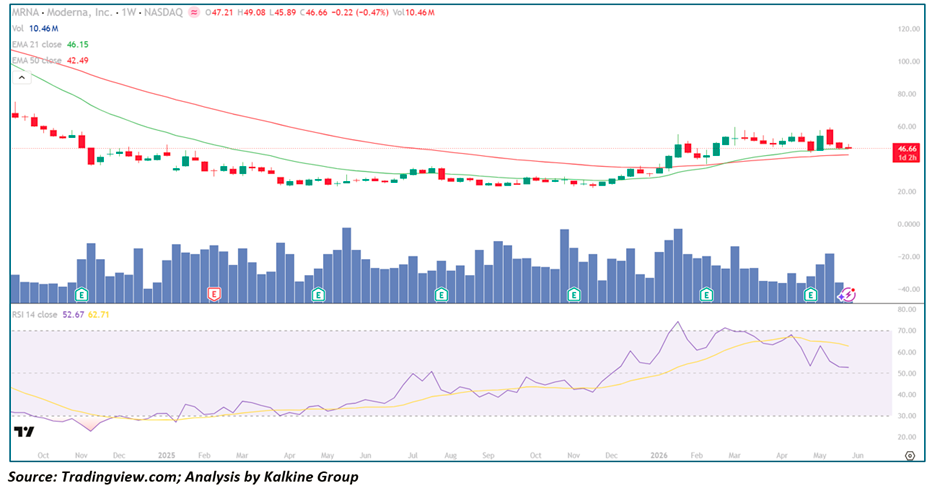
Trend Structure: From Pandemic Euphoria to Deep Capitulation and Recovery Attempt
Phase 1 — Pandemic Expansion and Historic Institutional Re-Rating (2020 – 2021)
Moderna experienced one of the most extraordinary rallies in biotechnology history during the COVID-19 pandemic:
- The company emerged as a global biotechnology leader following the rapid development and commercial success of its COVID-19 vaccine
- Institutional Capital flooded into the stock as investors aggressively repriced the long-term potential of mRNA platform technology
- Price advanced parabolically during this phase, reaching historically elevated valuations and momentum conditions
- RSI frequently traded in deeply overbought territory while volume surged aggressively alongside the broader uptrend
- Moderna became one of the defining biotechnology success stories of the pandemic era
This explosive rally established the valuation peak that would later lead to an equally dramatic correction.
Phase 2 — Post-Pandemic Revenue Collapse and Multi-Year Downtrend (2022 – 2025)
Following the normalization of COVID-related revenues, Moderna entered a severe Revaluation cycle:
- Investors aggressively repriced the stock lower as pandemic vaccine Demand declined sharply
- Concerns over the company’s ability to replace COVID-era revenues triggered sustained institutional selling pressure
- Price entered a prolonged downtrend characterised by lower highs, lower lows, and persistent bearish momentum
- RSI spent extended periods near oversold territory as investor sentiment deteriorated materially
- Moving averages remained decisively bearish throughout most of the decline
This phase represented the market’s transition from pandemic-driven optimism toward skepticism surrounding Moderna’s post-COVID growth outlook.
Phase 3 — Bottoming Process and Early Recovery Signals (2025 – Present)
The current phase reflects the early stages of what may become a longer-term technical stabilisation process:
- Price action has begun forming progressively shallower lows, suggesting downside momentum is weakening
- A potential double-bottom pattern is emerging, historically viewed as one of the most important bullish reversal formations
- EMA structures remain bearish but are beginning to flatten materially as Volatility compresses
- Volume patterns show reduced distribution intensity compared to earlier phases of the decline
- Buyers are increasingly stepping into weakness, laying the groundwork for a possible medium-term trend reversal
While confirmation remains necessary, the broader technical structure is becoming materially healthier than during prior breakdown phases.
Moving Averages: Bearish Structure Begins Stabilising
EMA-21
- Price action continues fluctuating near the EMA-21 as short-term momentum attempts to stabilise
- The Moving Average is beginning to flatten after an extended period of aggressive decline
- Sustained trading above the EMA-21 would represent an important early bullish development
EMA-50
- The EMA-50 remains overhead resistance within the broader downtrend structure
- However, the declining slope of the moving average has started moderating significantly
- A future bullish crossover between shorter-term moving averages could attract institutional momentum positioning
The stabilisation of moving averages often represents one of the earliest stages of broader trend reversals in biotechnology stocks.
Momentum Analysis: RSI Reflects Deep Oversold Recovery Conditions
Momentum indicators continue supporting the developing bottoming thesis:
- RSI has remained primarily within the 30–45 range, historically associated with oversold biotechnology conditions
- The current RSI profile suggests that selling pressure has weakened materially compared to earlier decline phases
- Unlike previous breakdowns, recent price weakness has not triggered severe RSI collapses
- Momentum conditions increasingly support the possibility of a technical recovery if positive catalysts emerge
The improving RSI structure reflects exhaustion of aggressive downside momentum rather than renewed capitulation.
Volume Analysis: Distribution Pressure Continues to Fade
Volume behaviour has improved meaningfully during recent consolidation phases:
- Selling volume has declined significantly relative to the heavy distribution seen during the major downtrend
- Recent bullish sessions have generated comparatively stronger volume participation
- Institutional selling pressure appears to be moderating substantially
- Accumulation behaviour is beginning to emerge near historically depressed valuation levels
This evolving volume profile materially strengthens the argument that MRNA may be transitioning into a longer-term stabilisation phase.
Fundamental Catalysts: Diversified mRNA Pipeline Supports Long-Term Recovery Thesis
RSV and Respiratory Franchise Expansion
Moderna continues building a broader respiratory vaccine franchise beyond COVID:
- The company’s RSV vaccine has received regulatory approval and is now entering commercial deployment
- Combined COVID, RSV, and influenza products provide Moderna with a diversified respiratory revenue base
- Multi-product respiratory expansion could support more stable long-term recurring revenues
Personalized Cancer Vaccine Program
The individualized neoantigen therapy (INT) partnership with Merck remains Moderna’s most transformational long-term opportunity:
- Early melanoma trial data has shown promising reductions in cancer recurrence risk
- The program has received Breakthrough Therapy Designation from the FDA
- Successful Phase 3 outcomes could validate mRNA technology as a major oncology treatment platform
- The oncology opportunity alone could dramatically reshape Moderna’s long-term revenue profile
Broad Pipeline Diversification
Moderna continues expanding across multiple therapeutic areas:
- Programs targeting latent HIV, cardiovascular disease, autoimmune conditions, and rare diseases continue progressing
- The breadth of the pipeline reinforces the versatility and scalability of the mRNA platform
- Multiple late-stage programs provide diversified Long-term Growth opportunities rather than reliance on a single product
Balance Sheet Strength
The company retains substantial financial flexibility:
- Moderna continues holding a large cash reserve accumulated during the pandemic years
- Strong Liquidity reduces near-term dilution and financing risks
- The balance sheet provides sufficient runway to continue advancing major pipeline programs aggressively
Key Technical Levels
Resistance: Double-bottom neckline resistance → EMA-50 → major prior breakdown zones
Support: Recent stabilisation lows → long-term capitulation support → historical oversold base region
Conclusion
Moderna is attempting to transition from one of biotechnology’s most dramatic post-pandemic collapses into what may become a credible long-term recovery and re-rating story. While the stock remains technically damaged relative to its former highs, several important early stabilisation signals are beginning to emerge, including shallower lows, improving RSI structure, declining selling pressure, and the development of a potential double-bottom reversal formation.
Fundamentally, Moderna continues possessing one of the most versatile and ambitious mRNA pipelines in the biotechnology industry. The combination of respiratory vaccine expansion, oncology breakthroughs through the Merck partnership, and diversified therapeutic programs across multiple disease categories reinforces the long-term platform potential that originally attracted institutional interest during the pandemic years.
Although significant clinical and execution risks remain inherent within biotechnology investing, the combination of depressed valuation levels, improving technical structure, strong balance sheet positioning, and potentially transformative pipeline catalysts creates one of the more intriguing high-risk, high-reward turnaround opportunities currently visible within the biotech sector. A confirmed technical breakout supported by strong clinical data could mark the beginning of a significant long-term recovery cycle for one of the industry’s most innovative platform companies.


 Jun 05, 2026




 Please wait processing your request...