
 AU
AU
 UK
UK
 CA
CA
 NZ
NZ
 IND
IND

 US
US

 Share
Share
 X (Formerly Twitter)
 Whatsapp
 Facebook
 LinkedIn
 Telegram
 Email This Article
 Copy Link
 Summarize with AI
 Chat GPT
 Perplexity
_05_05_2026_22_27_31_717338.jpg)
Key Highlights
- All five names trade below USD 5 per share and operate in high-conviction therapeutic areas including cell therapy, epigenetics, gene therapy, oncology, and CRISPR-based immunology representing the highest-risk, highest-optionality segment of the biotechnology investment universe
- Lineage Cell Therapeutics (NYSE Arca: LCTX) is the only name of the five with a product approaching commercial relevance, with its OpRegen program in geographic atrophy representing one of the most clinically advanced cell therapy programs in ophthalmology globally
- Foghorn Therapeutics (Nasdaq: FHTX) is backed by Eli Lilly following a significant strategic investment, providing the most visible institutional validation of any company in this group and meaningfully de-risking its near-term financing outlook
- Voyager Therapeutics (Nasdaq: VYGR) has pivoted successfully to a capital-efficient royalty generator model, securing multiple partnerships with major pharmaceutical companies that provide non-dilutive milestone and royalty income streams
- The group collectively represents a high-volatility, binary-event-driven investment category where individual catalysts clinical trial readouts, partnership announcements, and regulatory decisions can generate 50% to 200% single-day price moves in either direction
Industry and Macro Context: The Penny Biotech Opportunity in 2026
Small and micro-cap biotechnology enters May 2026 in a state of historic bifurcation. Large-cap pharmaceutical companies AbbVie facing the Humira cliff, Bristol-Myers Squibb managing Revlimid and Eliquis losses, Pfizer navigating post-COVID revenue normalisation are sitting on record cash balances and facing imminent patent cliffs that make acquisition of validated small biotech pipelines the most capital-efficient path to revenue replacement. Simultaneously, three years of elevated interest rates, a punishing post-2021 correction that wiped 60% to 80% off most small-cap names, and a difficult equity financing environment have forced small biotechs to become genuinely more disciplined and capital-efficient. The result is a cohort of companies that are more strategically focused and more attractively valued relative to their clinical assets than at virtually any point in the past decade creating what many biotech investors describe as a generational entry point precisely when institutional M&A motivation is at its highest. The FDA's science-driven approval posture across cell therapy, gene therapy, and novel small molecules, combined with open breakthrough therapy and accelerated approval pathways, further supports meaningful re-rating potential for the five names discussed here as they approach key 2026 milestones.
Technical Analysis
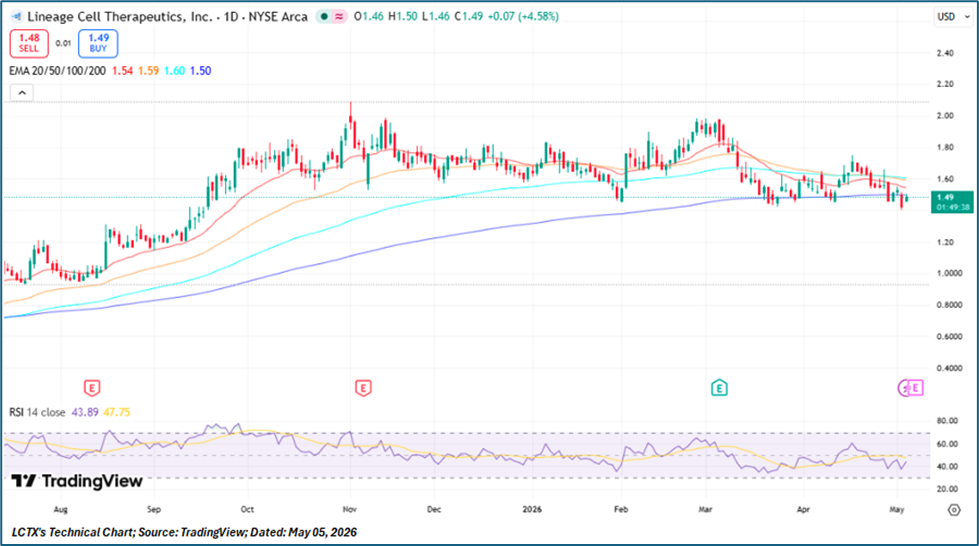
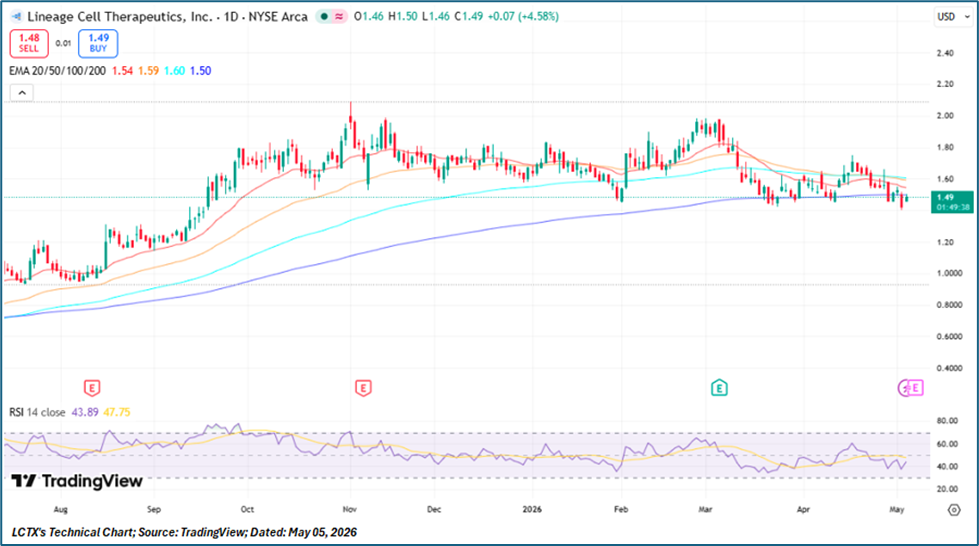
Lineage Cell Therapeutics (NYSE Arca: LCTX): Price at USD 1.49 sits below all four EMAs 20-day at USD 1.54, 50-day at USD 1.59, 100-day at USD 1.60, and 200-day at USD 1.50 in a bearish cascade structure reflecting the stock's gradual downtrend since peaking near USD 2.00 in November 2025. The 200-day EMA at USD 1.50 is the closest average to current price, meaning a closer USD 1.50 would be the first meaningful technical positive in months. The RSI at 43.89 is mildly oversold without positive divergence, and a fundamental catalyst clinical update or partnership news is likely required to break the stock out of its current bearish technical structure.
Foghorn Therapeutics (Nasdaq: FHTX): After peaking near USD 6.75 in early January 2026, FHTX has declined in an orderly fashion to USD 4.68, trading below all four EMAs 20-day at USD 4.95, 50-day at USD 5.07, 100-day at USD 5.11, and 200-day at USD 5.11 with the 50-day, 100-day, and 200-day clustered tightly between USD 5.07 and USD 5.11, forming a dense resistance zone. The RSI at 40.80 is approaching oversold territory with bounce potential, but USD 4.50 is the critical support level a break below their opens the USD 3.75 to USD 4.00 range. Eli Lilly's institutional backing provides a fundamental floor that pure technical analysis would not capture.
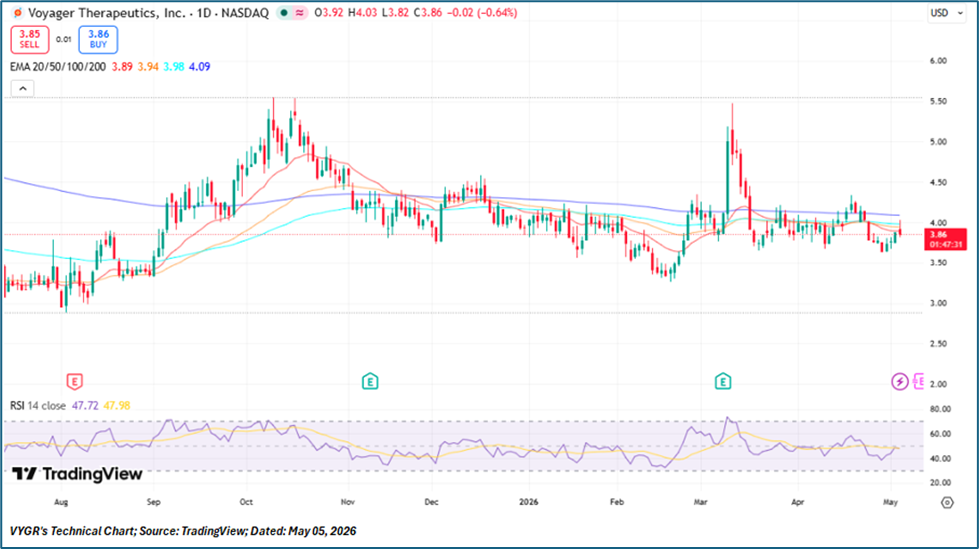
Voyager Therapeutics (Nasdaq: VYGR): After a catalyst-driven spike to USD 5.25 in February 2026 from USD 3.50 lows, VYGR has retraced to USD 3.86, now trading below all four EMAs 20-day at USD 3.89, 50-day at USD 3.94, 100-day at USD 3.98, and 200-day at USD 4.09 which are compressed tightly between USD 3.89 and USD 4.09, a pattern that typically precedes a significant directional move. The RSI at 47.72 is neutral. A decisive break above USD 4.10 clearing all four averages would be a meaningful bullish signal, while a break below the USD 3.60 prior support would signal further weakness.
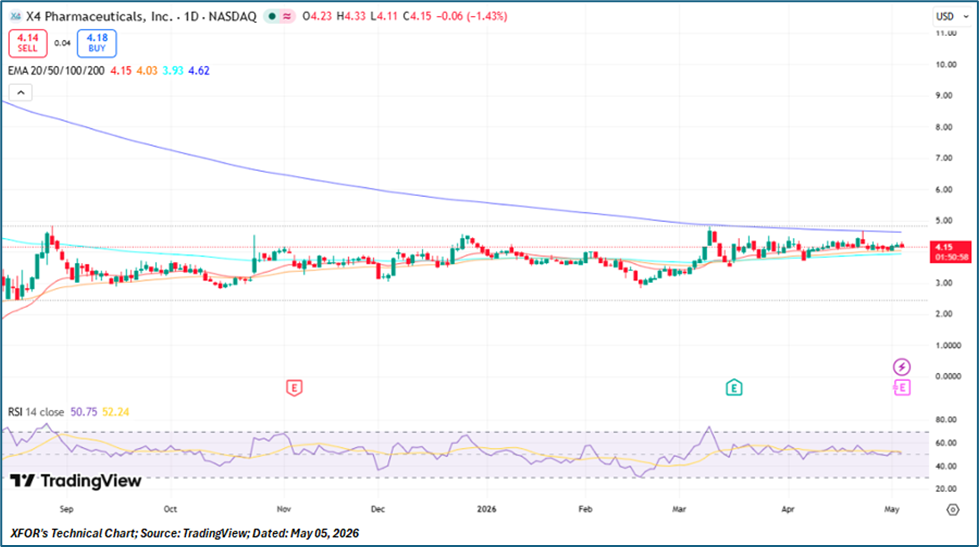
X4 Pharmaceuticals (Nasdaq: XFOR): XFOR trades at USD 4.15 with the 20-day at USD 4.15, 50-day at USD 4.03, and 100-day at USD 3.93 in a mild bullish sequential alignment, suggesting the shorter-term trend is turning constructive even while the 200-day EMA at USD 4.62 remains a significant overhead resistance. The RSI at 50.75 is perfectly neutral. Price holding above the 20-day EMA is a modest positive, but USD 4.62 is the critical level clearing it would signal a genuine technical trend change and shift the stock from range-bound to a nascent uptrend.
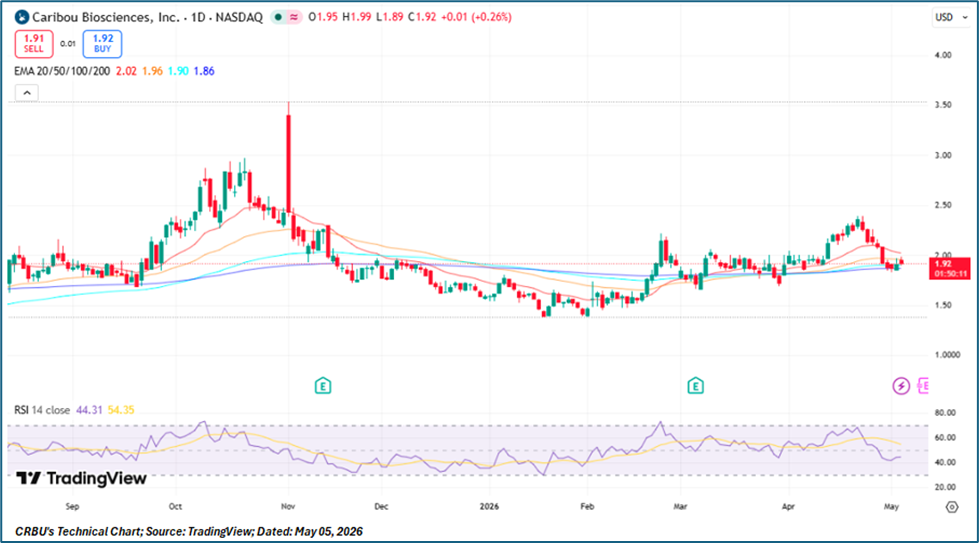
Caribou Biosciences (Nasdaq: CRBU): Price at USD 1.92 sits in a compressed EMA cluster 20-day at USD 2.02, 50-day at USD 1.96, 100-day at USD 1.90, 200-day at USD 1.86 reflecting months of indecisive price action following the November 2025 spike to USD 3.50. The RSI at 44.31 is mildly negative. The USD 1.86 200-day EMA is the key support below, while USD 2.02 is the resistance to clear for any meaningful technical recovery. Given CRBU's binary clinical event profile, upcoming Phase 1 data catalysts will be far more determinative of near-term price direction than technical structure alone.
Fundamental Analysis
Lineage Cell Therapeutics (NYSE Arca: LCTX) develops allogeneic cell therapies with its flagship OpRegen program a retinal pigment epithelium cell therapy licensed to Roche and Genentech for geographic atrophy, the advanced form of dry AMD affecting approximately 5 million Americans with no currently approved cell-based treatment. Roche's global commercial infrastructure and ophthalmology expertise de-risk the commercial pathway, while Phase 1/2a data showing visual acuity improvement and lesion stabilisation in a subset of patients provides early clinical validation. LCTX is essentially a long-dated call option on OpRegen's success if Phase 2/3 data confirm the early signal, the milestone and royalty economics flowing back to LCTX could be transformative relative to its current market capitalisation.
Foghorn Therapeutics (Nasdaq: FHTX) targets the chromatin regulatory system specifically the BAF complex, mutated in approximately 20% of all human cancers with its lead program FHD-909, a BRD9 inhibitor in Phase 1 development in synovial sarcoma and SMARCB1-mutant solid tumours. Eli Lilly's strategic investment provides not only capital but also medicinal chemistry expertise and target validation from one of pharma's most credible R&D organisations, materially reducing the dilution risk that typically dogs pre-revenue penny biotechs. Phase 1 dose escalation data from FHD-909 expected in 2026 is the primary near-term catalyst, with Lilly's backing providing a meaningful institutional floor beneath the stock while that data matures.
Voyager Therapeutics (Nasdaq: VYGR) has executed a successful pivot from traditional gene therapy developer to a capital-efficient royalty generator, licensing its proprietary TRACER AAV capsid platform to partners including Pfizer and Neurocrine Biosciences while retaining royalty interests on any eventual commercial products. This model generates non-dilutive milestone revenue without bearing the full cost of late-stage clinical development, while Voyager's own retained pipeline programs in Huntington's disease and Alzheimer's disease provide additional optionality not yet reflected in the share price. The February 2026 price spike likely reflected a partnership milestone, with the subsequent retracement suggesting the market is awaiting the next catalyst before meaningfully re-rating the stock.
X4 Pharmaceuticals (Nasdaq: XFOR) holds a unique position in this penny biotech group it is the only company with an FDA-approved commercial product, mavorixafor for WHIM syndrome, an ultra-rare primary immunodeficiency affecting an estimated few hundred U.S. patients. While WHIM syndrome revenue is modest given the tiny patient population, the approval establishes commercial infrastructure, manufacturing precedent, and regulatory track record that directly de-risks mavorixafor's advancement into Waldenström's macroglobulinemia a meaningfully larger opportunity where CXCR4 mutations occur in approximately 30% to 40% of patients. For investors, XFOR represents the rarest combination in penny biotech: an approved product with rare disease pricing power and pipeline optionality in larger adjacent indications.
Caribou Biosciences (Nasdaq: CRBU) develops allogeneic CRISPR-edited cell therapies using its proprietary chRDNA technology, which the company claims deliver superior on-target editing efficiency with reduced off-target effects compared to standard CRISPR-Cas9 a clinically meaningful distinction given that off-target editing is a primary regulatory concern for the entire CRISPR field. Lead program CB-010 is in Phase 1 for relapsed or refractory B-cell non-Hodgkin lymphoma, while CB-011 targets BCMA in multiple myeloma with AbbVie holding certain commercial rights a partnership that provides both validation and non-dilutive capital. The November 2025 price spike almost certainly reflected positive CB-010 clinical data, and dual Phase 1 readouts for CB-010 and CB-011 expected in 2026 provide two distinct re-rating catalysts.
Strategic Outlook
The five names span five genuinely uncorrelated biological approaches cell therapy, chromatin regulation, gene therapy capsids, CXCR4 pathway modulation, and CRISPR genome editing meaning portfolio returns are driven by largely independent binary events rather than a single sector bet. XFOR carries the lowest binary risk given its approved product, FHTX carries the strongest institutional backing from Lilly, VYGR has the most capital-efficient platform model, and LCTX and CRBU carry the highest event-driven volatility profiles given imminent clinical data catalysts. Prudent position sizing limiting each name to 1% to 3% of total portfolio with the group collectively capped at 5% to 10% of equity exposure allows investors to maintain conviction through the volatility that binary biotech events inevitably generate while capturing the asymmetric upside that has historically made penny biotech one of the most rewarding, if unforgiving, segments of the investment universe.


 Jun 08, 2026




 Please wait processing your request...